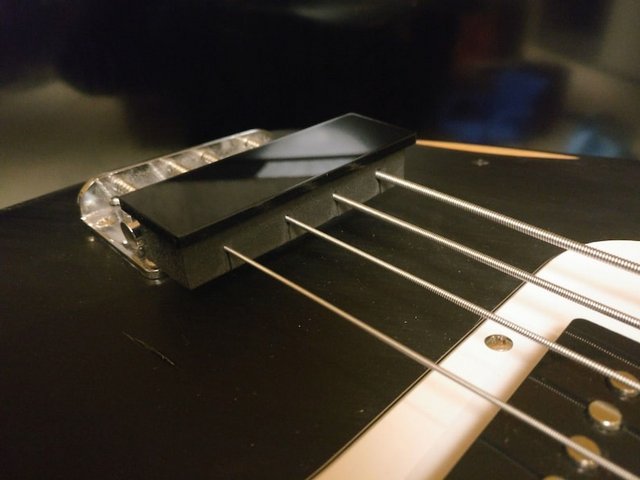
This is something I might try. I tried a foam mute under the strings at the bridge, it just doesn't sound that great. But the idea of a foam mute in the bridge cover could be just what I'm looking for. Unfortunately this one didn't come with the foam mute. Now I'm wondering how I can put one in.
While I don't like
telling people to "use the 'Search' function", I will say that foam mutes, and mutes in the bridge cover, are subjects that have come up more than once. And, there are pictures of P-Bass bridge covers that still had the (
probably) original piece of now-petrified foam still in them. So...
Based on the pictures, the mute was a piece of self-adhesive weatherstripping foam, about halfway between the saddles and the front edge of the bridge cover. It appeared to be about 3/4" wide over the E string, and tapered to about 1/2" over the G string. Personally, I just use a piece of 3M weatherstripping, as is, and leave it at that. Tapered foam
might work slightly better, but... I've never had the urge to experiment and find out. But, now that I'm finally, really, retired - and am always looking for things to keep me occupied? It might be interesting to find out...
And, as for the covers affecting the tone because of playing constraints? Yes, of course they do; that's why people took them off - until Fender quit putting them on. But, having to play between the covers - or between the neck and the p/u cover - is why that old music sounds the way it does. Especially if you play with a pick - which I almost always do. I also use the built-in mutes on my Ricks; have the bridge p/u cover still on them, and play the Optima RB Flats (analogs of the original factory Maxima Flats) with a pick. With these basses, I'm after the original, "vintage" tone. When I want something more modern? That's why I have an Alembic; a G&L ASAT; and a 4HH Stingray Special...







 I do understand perfectly, why so many people took the covers off, that Fender finally stopped wasting their time (and money) with them. But, for some of us? We like the way the bass sounds with the mute & the covers. Besides, if you don't use rounds - and aren't one of those people who are constantly fiddling with things? The bridge cover is no problem at all. Remember; the Fender basses came with flats until 1979/80 for Jazz Basses, and until '82 or '83 for Precisions. I put Roto RS77LDs on my P-Bass when I bought it in 1988 - and the bridge cover didn't come off -except for having it refinished/re-fretted (long story) in 1991 - until I put Fender 9050L's on it in... about 2008. The current GHS Precision Flats went on it in... 2019, IIRC...








 Seriously though, the only reason I would think it could cause a change in tone is that they don't allow you to play over the pickup or near the bridge. I play near the bridge quite a bit but like to be able to vary my hand position and take them right off on all basses.


