

Enjoy the benefits of a premium membership!
Upgrade Account
-
TalkBass has been independent since 1998. Add your voice.
Create a free account to reply to discussions, view embedded media, and browse with fewer display ads.
Join free Log in
Want zero display ads or expanded classifieds tools? Compare plans.
You are using an out of date browser. It may not display this or other websites correctly.
You should upgrade or use an alternative browser.
You should upgrade or use an alternative browser.
Biamping your rig - Crossover - Yes or No
- Thread starter Ampig
- Start date
More options
Who Replied?

14 years later.
You are being pedantic.
The accepted definition of biamplified is as described by Passingwind.
Different amplifier channel for different frequency range. If that is acheived via crossovers, filters or voodoo- the definition remains relatively ubiquitous, nevertheless.
If you've decided to be in denial about the concept, cool. Some of us didn't just learn about the concept after it was packaged by others. If you dont want to know, don't. That seems pedantic.
You seem to need to ignore biamp setups that overlap on frequencies. Like running a 410 full range and a 210 high pass. I mentioned them because they exist and can work... unless you'd like to show that they don't.
Sometimes people want the popular definition vs. digging in and actually understanding the concept. I lean towards the side of understanding. You apparently don't or you wouldn't be taking issues with the facts I laid out so long ago.
See ya in 14 years.

No you don't.
I understand why people want to think this but in fact you don't.
No you don't. The signal could be separated at the cab. Two cabs could be controlled separately. Etc.
"Bi" means "two". "Two" "Amps". That can "just" be running two cabs full range.
Here's an example since this seems to not be sinking in with some folks here. For this example let's say you have two cabs... a Bag End S15D amd a older Carvin 210 w/horn. If you ran them on ONE channel of amplification you'd have no way to address any difference in efficiencies.
OTOH with two channels of amplification you could run the Bag End as hot as you wanted, knowing a low pass might not be necessary since the Bag End has no horn. You could bring the gain up on the Carvin to flesh out the frequency range the BE didn't reproduce. And that setup would be what?
No crossover involved, independently controlled mono signal driven by two amps.
This is basic.

Again.
Biamping allows more control for two outputs than a single channel. You can address variances in efficiencies between two cabs, or frequency response, tone... it's not limited to simply crossing over highs and lows when we're talking electric bass. The pushback seems to ignore this. I don't know why.
Last edited:

Only one person understands biamping - after all these years.... hallelujah!!!!!
(isn't that lucky …. maybe, special even ... [c: )
(isn't that lucky …. maybe, special even ... [c: )


Again.
Biamping allows more control for two outputs than a single channel. You can address variances in efficiencies between two cabs, or frequency response, tone... it's not limited to simply crossing over highs and lows when we're talking electric bass. The pushback seems to ignore this. I don't know why.
Seems like an attempt to change the terminology if you ask me. It is widely, but obviously not universally accepted that biamping requires the use of a crossover.
If you are running full range signals through two amps I would use a term like multi-amping or dual mono. Even if you apply a HPF to one channel I would not say you are a truly biamping, but you are heading in that direction.
But I accept that there are communities that assume the word biamping has a less specific meaning. FYI, You are going to create confusion and probably get an argument anytime you use the term in this non-standard manor outside one of the small communities that accepts the broader meaning you promote. It may be a good idea to keep in mind your in the minority.
For fun maybe you could make an effort to regularly update Wikipedia to broaden the definition to suit your beliefs.
Bi-amping and tri-amping - Wikipedia


Would this setup be considered bi-amping in theory but not in accordance with audio parlance as there is no crossover involved? Maybe dual-amping? To be clear each pup signal goes to a different head/cab with the signals being eq'd differently.
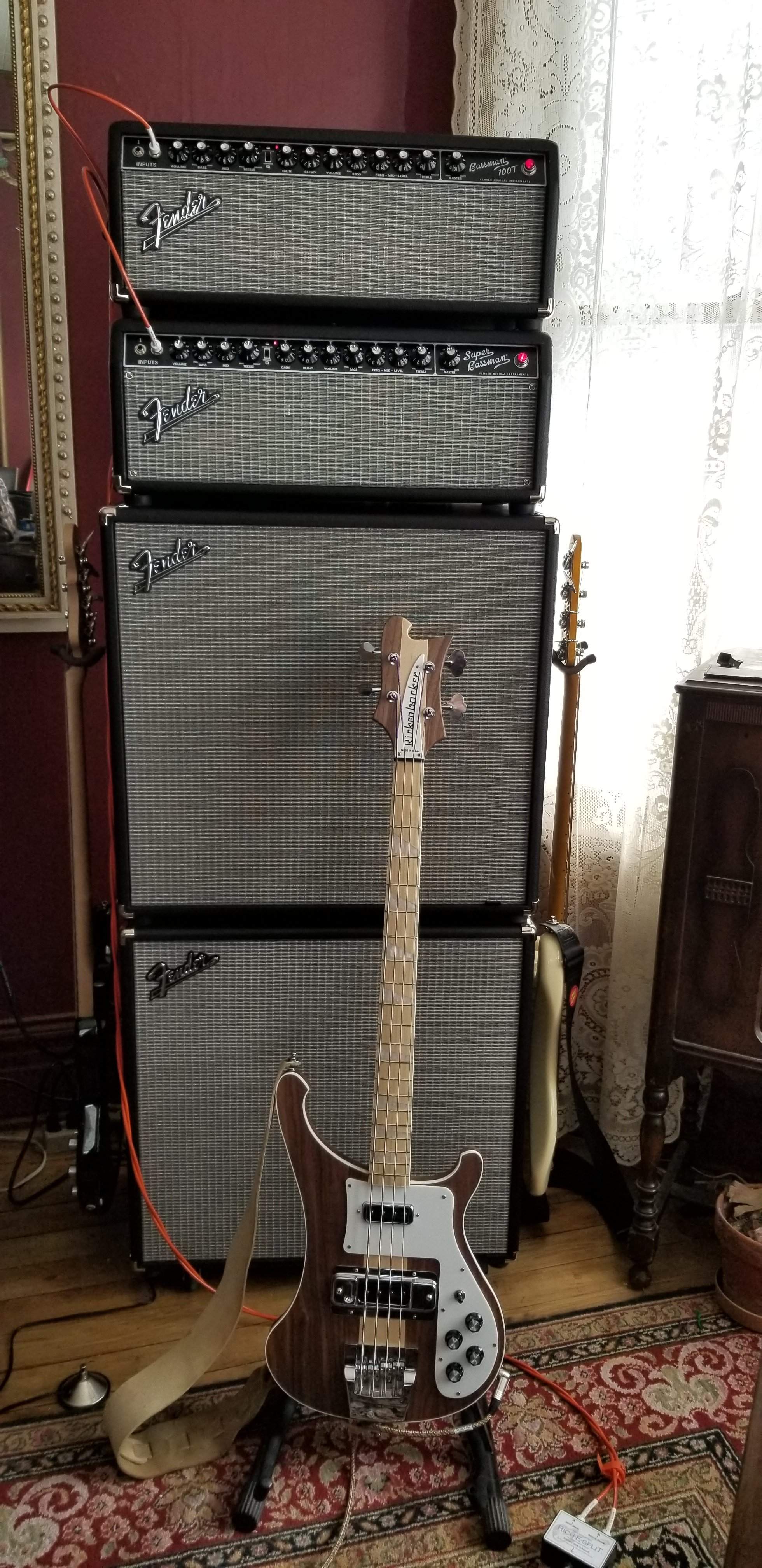
Would this setup be considered bi-amping in theory but not in accordance with audio parlance as there is no crossover involved? Maybe dual-amping? To be clear each pup signal goes to a different head/cab with the signals being eq'd differently.
View attachment 3434790
Ric-o-sound is what I would call that. It's stereo.
Deffinetly Ric-o-sound but that is another debate I've run into if it's stereo or not as there isn't exactly left or right channels but just 2 different signals. When I use the same rig with a standard bass and an ABY pedal it wouldn't be a Ric-o-sound or stereo setup but back to dual-amp or biamp? Symantics aside, creative amping is a blastRic-o-sound is what I would call that. It's stereo.
Deffinetly Ric-o-sound but that is another debate I've run into if it's stereo or not as there isn't exactly left or right channels but just 2 different signals. When I use the same rig with a standard bass and an ABY pedal it wouldn't be a Ric-o-sound or stereo setup but back to dual-amp or biamp? Symantics aside, creative amping is a blast
To me stereo is two sound sources combined into one device (the cable in this instance) and then being routed into two different amp channels/speakers. But I agree some will argue because the speakers are top bottom instead of LR. I would stick with Ric-O-Sound as this makes it obvious to the informed exactly what you are doing.
If you use the same setup with a mono sound source I think dual-amping is an acceptable term.
Feel free to use the term biamp if you want. I just think you are going to experience more unnecessary arguments if you do, because most audio enthusiasts will assume you mean something different and then attempt to correct you if/when it becomes clear what you really mean.

I am find the term Bi Amping
Offensive
Think I'll make a Facebook MeMe for it.
The proper term is Pan Amp or Omni Amping.
Technically the proper definition is =
1)The act of buying 3 more uneassary cords. Making a possible extra stupid thing you can do, with a already pointless 4x10 and 1x15 ....in the 80s.
2) Using a 2way active crossover to send
Signal to a HF and LF speaker system.
Offensive
Think I'll make a Facebook MeMe for it.
The proper term is Pan Amp or Omni Amping.
Technically the proper definition is =
1)The act of buying 3 more uneassary cords. Making a possible extra stupid thing you can do, with a already pointless 4x10 and 1x15 ....in the 80s.
2) Using a 2way active crossover to send
Signal to a HF and LF speaker system.
Last edited:

- Feb 12, 2006
- 61,037
- 5
- 220,965
- Disclosures
- Development Engineer-Mesa Boogie, Development Engineer-Genzler (pedals), Product Support-Genz Benz
It's not limited to, but in MOST of the knowledgeable world's definition of biamping and triamping, an active crossover is involved be the very definition of the process. This goes back over 40 years, and is where the term "biamp" and "triamp" crossover comes from.Again.
Biamping allows more control for two outputs than a single channel. You can address variances in efficiencies between two cabs, or frequency response, tone... it's not limited to simply crossing over highs and lows when we're talking electric bass. The pushback seems to ignore this. I don't know why.
It's not limited to, but in MOST of the knowledgeable world's definition of biamping and triamping, an active crossover is involved be the very definition of the process. This goes back over 40 years, and is where the term "biamp" and "triamp" crossover comes from.
Here's a Wiki on "Multi-Amp" guitar rigs. [Invalid or Expired Link Removed]
The term biamp does not appear once in the entire article.
Multi-amping. Now that is nomenclature that should be nondebatableHere's a Wiki on "Multi-Amp" guitar rigs. [Invalid or Expired Link Removed]
The term biamp does not appear once in the entire article.

There is a scientific threshold that once you get pass 3 cabinets and 3 heads.
Adding a Fourth amp and cabinet. You can't even freaking hear it lol.
You just see lights wayyyyy over there. You know it's on. It might be doing something.
And prey to God when you go for backups that the microphone doesn't zap your teeth.
Adding a Fourth amp and cabinet. You can't even freaking hear it lol.
You just see lights wayyyyy over there. You know it's on. It might be doing something.
And prey to God when you go for backups that the microphone doesn't zap your teeth.
Would this setup be considered bi-amping in theory but not in accordance with audio parlance as there is no crossover involved? Maybe dual-amping? To be clear each pup signal goes to a different head/cab with the signals being eq'd differently.
View attachment 3434790
I'd consider dual amping doing two of the same things. If you're running each with a different purpose...
Last edited:
It's not limited to, but in MOST of the knowledgeable world's definition of biamping and triamping, an active crossover is involved be the very definition of the process. This goes back over 40 years, and is where the term "biamp" and "triamp" crossover comes from.
I agree that is the case MOST often. Which I suppose would not be ALL. What about the rest of the time... should that be completely ignored?
I go back more than 40 years experimenting with this with electric bass... probably why my definition tends to be more inclusive.
I agree that dual would denote two of the same. I'm going with multi-amp, not that many of my non-TB musical acquaintances would even acknowledge the difference.I'd consider dual camping doing two of the same things. If you're running each with a different purpose...


