Enjoy the benefits of a premium membership!
Upgrade Account
-
TalkBass has been independent since 1998. Add your voice.
Create a free account to reply to discussions, view embedded media, and browse with fewer display ads.
Join free Log in
Want zero display ads or expanded classifieds tools? Compare plans.
You are using an out of date browser. It may not display this or other websites correctly.
You should upgrade or use an alternative browser.
You should upgrade or use an alternative browser.
Bigger neck = deep bass ?
- Thread starter killer
- Start date
More options
Who Replied?
So wouldn't that be, smaller neck = deep bass? To your experience?
I don't think it has anything to do with neck size. Generally speaking, a jazz is going to have more lows than a Ric.
I don't think it has anything to do with neck size. Generally speaking, a jazz is going to have more lows than a Ric.


I've tested my bass with a ua 610.
I listen thru Adam a7 monitors and I see the graphics on the eq of logic pro.
The jazz "go down" better .
Totally different basses. The neck may have everything to do with it along with the pickups, body, how you address the strings, finish, binding, tuners, bridge, pickguard.....

SirMjac28
Patiently Waiting For The Next British Invasion
Either you are on to something... or on something.
+1 Heyyyyy Ohhhhhhh!!!!!


To some degree yes.
I put a bigger P-Bass neck on a Jazz body.
And it did fatten tone up a little.
But neck and body still have to be compatible.

I have not had the chance to compare similar basses with larger & smaller necks, but I have played many similar Les Paul guitars with various size necks, and the larger neck models almost always have better resonance, sustain and tone.

Damian Coccio
Supporting Member
Actually there is science to a longer neck giving a "deeper" bass, and a thicker and hence more massive neck would also help as well. Whether or not thats what your hearing between the jazz and the rick is hard to tell.
To me the deep bass sound is a matter of many things like strings, tuning, amp etc.
For example, my Defil Luna to me has deeper sounding than my Fernandes Gravity (JB hardware, but with longer scale), even tough the neck is shorter. BUT its fatter, the pickups are different (humbuckers vs JB singles), and the strings (Luna has original strings from 1988, and Fernandes got a set of Olympia strings, that has more metallic sounding).
I also remember a guy, who sold modified Hondo SG bass (with Tesla pickup), the scale was only 620 mm, so the neck was more similiar to an electric guitar. It doesnt sounded bad, but as I say - that may be a pickup matter. Here you can hear some sound
examples:
Link Removed
Link Removed
Link Removed
Link Removed
(Finger tone down/up, pick tone down/up)
JB has a different coil construction than Rick does, so I think that matters most in your case.
For example, my Defil Luna to me has deeper sounding than my Fernandes Gravity (JB hardware, but with longer scale), even tough the neck is shorter. BUT its fatter, the pickups are different (humbuckers vs JB singles), and the strings (Luna has original strings from 1988, and Fernandes got a set of Olympia strings, that has more metallic sounding).
I also remember a guy, who sold modified Hondo SG bass (with Tesla pickup), the scale was only 620 mm, so the neck was more similiar to an electric guitar. It doesnt sounded bad, but as I say - that may be a pickup matter. Here you can hear some sound
examples:
Link Removed
Link Removed
Link Removed
Link Removed
(Finger tone down/up, pick tone down/up)
JB has a different coil construction than Rick does, so I think that matters most in your case.

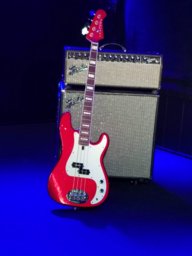
A thicker neck on the same model bass, yeah, a little. On a different model bass ? Who knows considering all the variables.

I have found this to be generally true. I've switched out relatively thin Jazz necks with chunky Precision necks before and noticed a difference in the low end punch. I have a VERY chunky, baseball bat like Warmoth maple/rosewood Precision neck that I've had on several basses and each bass sounded "bigger" with it than whatever other neck(s) I had on them.

I played Ibby SR series and had to compensate with a .125>.130 B string to get some depth. I bought a Gecko5 wide and found those gauges to muddy lacking articulation (at least for me). Went to Circle K's .118 B on a balanced set and the thicker neck allows the lighter gauges to "speak" better.

Jim Carr
Dr. Jim
- Jan 21, 2006
- 16,223
- 7,614
- 76
- Disclosures
- fEARful Kool-Aid dispensing liberal academic card-carrying union member Musicians Local 72-147
wood with higher density will resonate more
No. Otherwise, why would violins, violas, celli, basses, pianos, harps, mandolins, etc. have light thin spruce soundboards?

No. Otherwise, why would violins, violas, celli, basses, pianos, harps, mandolins, etc. have light thin spruce soundboards?
there is more to it than that. There is a little cylinder of pine held in place by the pressure the top and back of the instrument make. The cylinder is place on the bass side of the bridge.
the cylinder take the vibration of the bridge and transfer it to the back ( which is a harder wood ) and thus the vibration move the air out of the instrument. Without that little cylinder a violin would be dead silent.
My claim is it takes more than high density wood or a soft wood to make an instrument resonate.
In the case of a violin without that little cylinder the instrument would be dead silent.
In the case of a EB I think the brige, nut, frets or fingerboard surface for fretless and the pickup are the important part. Your strings are in direct contact with the bridge and nut, then when you press to get a note the strings is stopped by a fret or by the fingerboard ... of all of these don't resonate well your instrument doesn't have a chance.
In the case of a violin without that little cylinder the instrument would be dead silent.
In the case of a EB I think the brige, nut, frets or fingerboard surface for fretless and the pickup are the important part. Your strings are in direct contact with the bridge and nut, then when you press to get a note the strings is stopped by a fret or by the fingerboard ... of all of these don't resonate well your instrument doesn't have a chance.

The best sounding basses I have ever owned in terms of clarity were
Mmy Cirrus 5, with a thin but wide neck - Sounded much better than my Cirrus 4 with the same strings, etc.
My 2 Warwicks with the thick baseball bat neck.
It is only logical that more wood = higher stiffness. However, there are so many parts to the equation of a bass's sound, that I suppose this could work either way, depending on the rest of the parts - body, etc.
Mmy Cirrus 5, with a thin but wide neck - Sounded much better than my Cirrus 4 with the same strings, etc.
My 2 Warwicks with the thick baseball bat neck.
It is only logical that more wood = higher stiffness. However, there are so many parts to the equation of a bass's sound, that I suppose this could work either way, depending on the rest of the parts - body, etc.