I dont understand how Billy Sheehan can come up with tons and tons of fast introcate lines, tapping patterns and harmonics that actually fit into the music eventhough the man did not learn a single theory lesson and cant even read music. Any facts?

Enjoy the benefits of a premium membership!
Upgrade Account
-
TalkBass has been independent since 1998. Add your voice.
Create a free account to reply to discussions, view embedded media, and browse with fewer display ads.
Join free Log in
Want zero display ads or expanded classifieds tools? Compare plans.
You are using an out of date browser. It may not display this or other websites correctly.
You should upgrade or use an alternative browser.
You should upgrade or use an alternative browser.
Billy Sheehan
- Thread starter Venturella
- Start date
-
- Tags
- billy billy sheehan sheehan
More options
Who Replied?
He has an instructional video out there where he explains his approach to intricate runs up and down the fret board. His approach is very pattern based. (Where my approach is more scale basses.) His patterns are based upon scales though. One thing that stuck with me from that video is; on a real fast run, playing notes which are technically out of the scale, will not be perceived as out of tune.

he may not have learned theory in the by the book sense, but he has learned it by way of listening and playing.


You don't have to know theory or learn music, but it does help. Billy shows that you don't need either, but he got to where he is by practicing hour upon hour for years. All those years with Talas, UFO, David Lee Roth et al resulted in him learning by osmosis. Plus, perhaps if he'd stuck to The Big Book Of Sticking To Root Notes (tm) then maybe he wouldn't have been as interested in all the shredding techniques he ported over from guitarists. Like other things in the world of bass you end up staring down the barrel of dogma, ultimately. One party considers the other to be soulless robots following sheet music, with very limited scope for creativity. The other party views the former as underqualified slackers.
There isn't a right answer here. If you want to be a session bassist who can come up with four different, yet entirely plausible and tasteful, basslines in the time it takes the songwriter to tell you the chord progressions once then go heavy on the theory and learning how to read. I think it is fair to say that when you invite Billy Sheehan to record on your tracks then you will get that playing and that tone.
There isn't a right answer here. If you want to be a session bassist who can come up with four different, yet entirely plausible and tasteful, basslines in the time it takes the songwriter to tell you the chord progressions once then go heavy on the theory and learning how to read. I think it is fair to say that when you invite Billy Sheehan to record on your tracks then you will get that playing and that tone.

Lessons and theory don't make you a great player or writer. Lots of time combined with lots of effort do.
All good points here. I think he also had a lot of experience cutting his teeth with other high caliber musicians. I have learned the most playing with people who I consider very very good at their instruments. It helps when everyone brings 110 percent all the time and you're expected the same.
Some don't need to learn theory because they've been around a lot who know their stuff. Some don't like theory. I try to practice it to be able to communicate better but a lot of what i write with people is solely based off how it sounds not if its within a particular scale or key how does it fit within the context of the song.
Some don't need to learn theory because they've been around a lot who know their stuff. Some don't like theory. I try to practice it to be able to communicate better but a lot of what i write with people is solely based off how it sounds not if its within a particular scale or key how does it fit within the context of the song.
He has stated in interviews that his playing developed because of playing in 3 piece bands, and having to fill in holes behind guitar solos, filling in for keyboard parts, etc.
He also grew up listening to (and copying) some of the most adventurous bassists in history, before players were told that bassists should only play root notes.
That, combined with a great ear, made his style possible.
He also grew up listening to (and copying) some of the most adventurous bassists in history, before players were told that bassists should only play root notes.
That, combined with a great ear, made his style possible.
He's not a one trick pony. His playing on Tony Mac Alpine's Edge Of Insanity album is very laid back and his tone, while obviously his, isn't quite as "hairy" as it would be in one of his own projects. He does the sideman thing well.You don't have to know theory or learn music, but it does help. Billy shows that you don't need either, but he got to where he is by practicing hour upon hour for years. All those years with Talas, UFO, David Lee Roth et al resulted in him learning by osmosis. Plus, perhaps if he'd stuck to The Big Book Of Sticking To Root Notes (tm) then maybe he wouldn't have been as interested in all the shredding techniques he ported over from guitarists. Like other things in the world of bass you end up staring down the barrel of dogma, ultimately. One party considers the other to be soulless robots following sheet music, with very limited scope for creativity. The other party views the former as underqualified slackers.
There isn't a right answer here. If you want to be a session bassist who can come up with four different, yet entirely plausible and tasteful, basslines in the time it takes the songwriter to tell you the chord progressions once then go heavy on the theory and learning how to read. I think it is fair to say that when you invite Billy Sheehan to record on your tracks then you will get that playing and that tone.
Watch the Live at Astoria DVD with Steve Vai.He's not a one trick pony. His playing on Tony Mac Alpine's Edge Of Insanity album is very laid back and his tone, while obviously his, isn't quite as "hairy" as it would be in one of his own projects. He does the sideman thing well.
He pretty much plays Vai’s stuff note for note.

Watch the Live at Astoria DVD with Steve Vai.
He pretty much plays Vai’s stuff note for note.
yea, but look at how much help he needed

yea, but look at how much help he needed
That’s awesome!!

I think hes played 4000-5000 gigs. Learning on the job. Ive talked to him about this and he said he played along w records and played tons of cover gigs
yea, but look at how much help he needed
Best 3 1/2 minute video of all time.

Billy Sheehan is a prime example of a lifetime learning music and making his own rules and playing with others who did the same. Creativity without the fetters of "classical" music education.
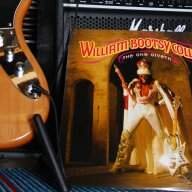
Billy's a monster. He can fill any bar in any time.
Here he's boldly supporting a talented guitarist on one of my favourites.
Here he's boldly supporting a talented guitarist on one of my favourites.

Not all those who can do something extremely well are also qualified teachers. Teaching is a separate skill.
Music theory is useful for explaining, after the fact, why something works. Or for fixing something when it doesn't due to a technical error or misunderstanding. But you don't play music theory.
Knowing scales and theory and all the other theoretical underpinnings of music can speed up your learning or deepen your understanding. But it won't teach you to hear or feel music. Bill Sheehan sidestepped all of that and learned a more organic way by listening to and playing a lot of music. To be successful with that approach requires a lot more work and a certain gift. And Bill Sheehan is both musically gifted and a very hard worker.
Bottom line: Use whatever approach works best for you. We each learn in our own unique way. And all that really matters is the result that comes out of it.
Music theory is useful for explaining, after the fact, why something works. Or for fixing something when it doesn't due to a technical error or misunderstanding. But you don't play music theory.
Knowing scales and theory and all the other theoretical underpinnings of music can speed up your learning or deepen your understanding. But it won't teach you to hear or feel music. Bill Sheehan sidestepped all of that and learned a more organic way by listening to and playing a lot of music. To be successful with that approach requires a lot more work and a certain gift. And Bill Sheehan is both musically gifted and a very hard worker.
Bottom line: Use whatever approach works best for you. We each learn in our own unique way. And all that really matters is the result that comes out of it.

Billy is a good example of mutual respect. Billy wasn't educated formally. But he has utmost respect for those who were. He doesn't have a chip on his shoulder about it. He can work with anybody. I have met him on two occasions and he seemed like just a "good guy". Steve Vai seemed the same. They work well together because, although they are both super talented, they have great respect for one another. You can tell in ALL of Billy's projects that it's not the "Look at Billy" show. It's him having fun bouncing off of what others are doing. He's having a blast playing with other great musicians. He doesn't take himself too seriously at all.
As for knowledge, it can come from many different angles. The trick is knowing when you don't have it, when you can gain it, and having an open mind enough to accept it from any source. Billy seems to be willing to learn whatever from wherever.
He doesn't stick out his chest and say "I don't need no Berkeley education, Steve!" Instead, he says "Dude, what did you just play there? Show it to me!" and "Here, check this out."
He'll be the first to tell you that anyone can do what he does.
(As an aside, I have met dozens of powerhouse bass players. Other than Stu Hamm and Dave LaRue, they have all been super nice, willing to talk, willing to help, and generally seemed like kind individuals.)
To bring this all back to the OP, practice, study (formally or otherwise), and learn from others.
As for knowledge, it can come from many different angles. The trick is knowing when you don't have it, when you can gain it, and having an open mind enough to accept it from any source. Billy seems to be willing to learn whatever from wherever.
He doesn't stick out his chest and say "I don't need no Berkeley education, Steve!" Instead, he says "Dude, what did you just play there? Show it to me!" and "Here, check this out."
He'll be the first to tell you that anyone can do what he does.
(As an aside, I have met dozens of powerhouse bass players. Other than Stu Hamm and Dave LaRue, they have all been super nice, willing to talk, willing to help, and generally seemed like kind individuals.)
To bring this all back to the OP, practice, study (formally or otherwise), and learn from others.
Last edited:

Billy's a monster. He can fill any bar in any time.
Here he's boldly supporting a talented guitarist on one of my favourites.
I am going to start this off by saying I totally respect Billy as a great player and innovator And hes got a real rocking thing going on the song although not far from the roots. But when it comes to his solo, IMO, it doesnt work. Sorry. The pentatonic/dorian licks can only do so much. If you dont hear that , sorry.
The guitarist is cool.
Edit. I really did like the way Billy anticipated where the guitarist was headed when he was soloing. Notice the solo is one chord, not the head.
Last edited:


