
Enjoy the benefits of a premium membership!
Upgrade Account
-
TalkBass has been independent since 1998. Add your voice.
Create a free account to reply to discussions, view embedded media, and browse with fewer display ads.
Join free Log in
Want zero display ads or expanded classifieds tools? Compare plans.
You are using an out of date browser. It may not display this or other websites correctly.
You should upgrade or use an alternative browser.
You should upgrade or use an alternative browser.
Blew up my 2 Edens! New head ideas??
- Thread starter cgents
- Start date
More options
Who Replied?
You don't just smoke 2 or 3 amps in a short period of time for no reason. You need to check the rest of your gear, 'lessin' you wanna smoke another one.
Those XLT cabs are all about big highbass/lowmids. They're prone to creased cones and blown drivers if try to make them do real bass for any length of time.
Those XLT cabs are all about big highbass/lowmids. They're prone to creased cones and blown drivers if try to make them do real bass for any length of time.

Hopkins
Commercial User
You don't just smoke 2 or 3 amps in a short period of time for no reason. You need to check the rest of your gear, 'lessin' you wanna smoke another one.
Those XLT cabs are all about big highbass/lowmids. They're prone to creased cones and blown drivers if try to make them do real bass for any length of time.
The first one went up in smoke, the second one took a tumble.


I'd say the closest of the ones I've played would be the Markbass LM series, but it doesn't have that really flexible eq. The Markbass F500 (I'm actually selling one right now) has the flexible eq, but its not as pillowy as the eden.
I'll concur on the MarkBass gear. I had a couple of WT400s which also had technical issues, as well as never being able to really put out the stage volume I wanted. I've owned a LMIII as well as, currently, a LM Tube800 and they are similar enough to the Eden tone that I haven't had the urge to pick up a few vintage Edens that have crossed my path since.

So only the WT800 failed. I would have it looked at by a technician. The cost to fix might be less than what it will cost to switch horses - and you might not like the next horse as much.
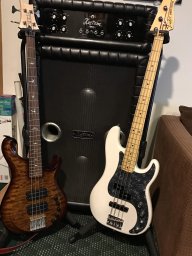
My future son-in-law had a WT800 and toasted it. I sent him the following excerpts from the Eden manual
"Operating in Bridge Mono (WT800 Only):
Running your amplifier in bridge mono will increase the output of the amplifier by bridging both power amplifiers
inside the unit to run a single output signal. To enter Bridge Mono correctly and safely you should follow the
following instructions. INCORRECT USE OF BRIDGE MONO WILL CAUSE YOUR AMPLIFIER TO FAIL."
"never turn the Bi-Amp mode on during Bridge Mono Operation as it will overload the amplifier."
"NEVER ATTEMPT TO USE Bi-Amp and Bridge Mono at the same time this will cause damage to your amplifier."
I am not saying you did this; just letting you know it isn't pretty when you do. I know, we don't need no stinking instructions.
Other excerpts (from Quick Start Guide):
20. Bi-Amp Mode Switch: Turns Bi-Amp mode off/on.
BEFORE USING THIS FEATURE PLEASE READ AND UNDERSTAND THE “BEFORE YOU PLUG IN” SECTION OF THIS GUIDE
23. Bridged mono: Turns Bridged Mono feature on / off.
BEFORE USING THIS FEATURE PLEASE READ AND UNDERSTAND THE “BEFORE YOU PLUG IN” SECTION OF THIS GUIDE!
Q: What does Bridge Mono mean?
A: Bridging is the act of using the two amplifiers to act as one larger amplifier in order to drive a single speaker or combination of speakers. When in bridge mode, each amplifier will see half the load impedance. For example, if driving a single 8-ohm D410XLT with our World Tour 800 (our most popular set-up by the way), each amplifier will see a 4-ohm load.
Considering how often they mention this, I would guess it is an easy and expensive mistake that can occur. With both switches on the front and easily accessible, I believe that was a design flaw.
"Operating in Bridge Mono (WT800 Only):
Running your amplifier in bridge mono will increase the output of the amplifier by bridging both power amplifiers
inside the unit to run a single output signal. To enter Bridge Mono correctly and safely you should follow the
following instructions. INCORRECT USE OF BRIDGE MONO WILL CAUSE YOUR AMPLIFIER TO FAIL."
"never turn the Bi-Amp mode on during Bridge Mono Operation as it will overload the amplifier."
"NEVER ATTEMPT TO USE Bi-Amp and Bridge Mono at the same time this will cause damage to your amplifier."
I am not saying you did this; just letting you know it isn't pretty when you do. I know, we don't need no stinking instructions.
Other excerpts (from Quick Start Guide):
20. Bi-Amp Mode Switch: Turns Bi-Amp mode off/on.
BEFORE USING THIS FEATURE PLEASE READ AND UNDERSTAND THE “BEFORE YOU PLUG IN” SECTION OF THIS GUIDE
23. Bridged mono: Turns Bridged Mono feature on / off.
BEFORE USING THIS FEATURE PLEASE READ AND UNDERSTAND THE “BEFORE YOU PLUG IN” SECTION OF THIS GUIDE!
Q: What does Bridge Mono mean?
A: Bridging is the act of using the two amplifiers to act as one larger amplifier in order to drive a single speaker or combination of speakers. When in bridge mode, each amplifier will see half the load impedance. For example, if driving a single 8-ohm D410XLT with our World Tour 800 (our most popular set-up by the way), each amplifier will see a 4-ohm load.
Considering how often they mention this, I would guess it is an easy and expensive mistake that can occur. With both switches on the front and easily accessible, I believe that was a design flaw.


How can you tell if your Eden was USA made?
I have this one: Invalid Link Removed
It's kind of entry level, I guess, but I don't play gigs, so it works for me.
I'm worried about it though. It won't make any sound till you hit the fourth click on the volume knob.
From there on up, it seems fine. But it didn't do that when I first got it.
im pretty sure that all 264 are Chinese made
My WTX264 says "Manufactured in China...". I bought it new from Best Buy as they closed down the musical department experiment. It sounds great and my future son-in-law used to borrow it before he bought the WT800 and then again when he blew up the WT800 until he got a replacement.
Last edited:
newvintageamps.com
I second that suggestion. Their Undertow line is truly stellar.

New to this Talkbass thing, and am flattered by all the replies from my fellow low-enders. I am actually borrowing my friends Eden Navigator preamp with the 1000 watt power amp. Thing weighs roughly 42,879 pounds, but OH the TESTICLES this rig has!
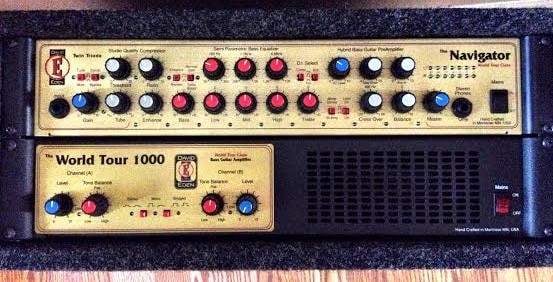
I've gigged roughly 800 gigs with my previous Eden 800 set up the same way every time, (didn't bridge it...), so I doubt it is my cab. I'm going to our local music store later in the week to slap a few heads around....thanks so much for the suggestions!
I've gigged roughly 800 gigs with my previous Eden 800 set up the same way every time, (didn't bridge it...), so I doubt it is my cab. I'm going to our local music store later in the week to slap a few heads around....thanks so much for the suggestions!

I second that suggestion. Their Undertow line is truly stellar.
YES! I use the Undertow 160. It's a shagin' beast
My future son-in-law had a WT800 and toasted it. I sent him the following excerpts from the Eden manual
"Operating in Bridge Mono (WT800 Only):
Running your amplifier in bridge mono will increase the output of the amplifier by bridging both power amplifiers
inside the unit to run a single output signal. To enter Bridge Mono correctly and safely you should follow the
following instructions. INCORRECT USE OF BRIDGE MONO WILL CAUSE YOUR AMPLIFIER TO FAIL."
"never turn the Bi-Amp mode on during Bridge Mono Operation as it will overload the amplifier."
"NEVER ATTEMPT TO USE Bi-Amp and Bridge Mono at the same time this will cause damage to your amplifier."
I am not saying you did this; just letting you know it isn't pretty when you do. I know, we don't need no stinking instructions.
Other excerpts (from Quick Start Guide):
20. Bi-Amp Mode Switch: Turns Bi-Amp mode off/on.
BEFORE USING THIS FEATURE PLEASE READ AND UNDERSTAND THE “BEFORE YOU PLUG IN” SECTION OF THIS GUIDE
23. Bridged mono: Turns Bridged Mono feature on / off.
BEFORE USING THIS FEATURE PLEASE READ AND UNDERSTAND THE “BEFORE YOU PLUG IN” SECTION OF THIS GUIDE!
Q: What does Bridge Mono mean?
A: Bridging is the act of using the two amplifiers to act as one larger amplifier in order to drive a single speaker or combination of speakers. When in bridge mode, each amplifier will see half the load impedance. For example, if driving a single 8-ohm D410XLT with our World Tour 800 (our most popular set-up by the way), each amplifier will see a 4-ohm load.
Considering how often they mention this, I would guess it is an easy and expensive mistake that can occur. With both switches on the front and easily accessible, I believe that was a design flaw.
Meh...how to biamp or bridge an amplifier is pretty basic stuff for anybody who has need for such an amplifier.
If ya can't figure that out, stick to just Bass, Treble, and Volume. It ain't the amps fault.

I was going to say -- get an old navigator and a burly reliable power amp. Eden tone forever. Aggies, ashdowns, mesas ... Are great but very different. Edens have a unique sound.


Given the fact that Eden gear from its heyday was designed and produced by Eden's founder, David Nordschow, I'm a little surprised that no one has even mentioned the most logical alternative: David Nordschow Amplification (DNA).
MM
MM
okcrum
in your chest


Years ago, I repaired a bass player's amp. Three weeks later he brought it in blown again. I told him he had to have a shorting speaker cable or a problem with the cabinet. He swore he went through everything and there were no problems. He had a gig that night so I loaned him an amp...a Peavey Mark III while I fixed his amp again.
A couple days later, he picked up his amp, and brought back the PV...which he had also blown. I told him again, he had a problem with his cables or cabinet, and that I didn't want to see his head again. He made no apologies for messing up the loaner amp, and copped an attitude when I tried to help him figure out what he was doing wrong.
That was the end of loaning out amps to customers who brought their stuff in to be fixed.
A couple days later, he picked up his amp, and brought back the PV...which he had also blown. I told him again, he had a problem with his cables or cabinet, and that I didn't want to see his head again. He made no apologies for messing up the loaner amp, and copped an attitude when I tried to help him figure out what he was doing wrong.
That was the end of loaning out amps to customers who brought their stuff in to be fixed.


