I think that as far as an electric instrument's tone is concerned, body woods may be irrelevant, but not irrelavent. Regarding plywood, would you say that the Carl Thompson Rainbow bass has lack of tone or sustain?

Enjoy the benefits of a premium membership!
Upgrade Account
-
TalkBass has been independent since 1998. Add your voice.
Create a free account to reply to discussions, view embedded media, and browse with fewer display ads.
Join free Log in
Want zero display ads or expanded classifieds tools? Compare plans.
You are using an out of date browser. It may not display this or other websites correctly.
You should upgrade or use an alternative browser.
You should upgrade or use an alternative browser.
Body & Neck Woods irrelavent?
- Thread starter EBMan
- Start date
More options
Who Replied?

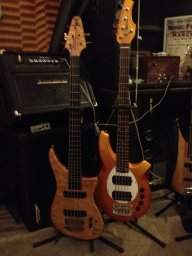
The fretted 5s were what I was comparing as basses with 1 different variable. Ok, there's quilt vs. flamed maple, but I highly doubt there's any audible difference in tone. The fretless sounds different, mostly because it's blue.Those 2 bass's in the first pic have very different maple tops and if you know plastics different pigments can have a great influence on the properties of the finish so your basses are very different in ways you've dismissed as identical. But this isn't an argument of science
Also you're ignoring any possible difference between a 4 & 5 string and between fretted and fretlessTo be honest I'm not sure which basses you think are almost identical here.

Two last week and three the week before....
My take:
I played two MTD's all exactly the same body wood and top the only difference was one had a maple neck/maple board and one had a maple neck/rosewood board the difference in sound was very big.
Nope. Your basses sound different because they're different basses...not because of "wood" bah. Although your basses really sound the same, you're just not aware of it and/or didn't get the memo.


The fretted 5s were what I was comparing as basses with 1 different variable.
Sorry, but you haven't proven that the difference in tone is due to that one variable.
Here's why: anyone who has owned "identical" basses will tell you that they can sound distinctly different. Right now, I own two pair of "identical" basses: a pair of Fender RB5s (both built in 1997), and a pair of Benavente 51 model fivers (alder body, maple neck). Even when freshly strung with the same strings, these basses sound very different, even when unplugged. My blue RB5 is warmer, my gold RB5 is snappier. I'll bet fifty bucks that in a blindfolded test**, most bassists would loudly proclaim that the gold one must have an ash body and/or maple board, while the blue one is alder and/or rosewood. Nope, both are alder with maple/pau ferro necks.
My Benaventes also sound different when played unplugged. I've A/B'd plenty of other "identical" instruments that sounded different, but seeing as how I didn't own them I can't say that they had identical strings.
** Ok, most bassists know that all RB5's are alder/pau ferro, but they wouldn't have to know they were hearing an RB5.
Sorry, but you haven't proven that the difference in tone is due to that one variable.
Here's why: anyone who has owned "identical" basses will tell you that they can sound distinctly different. Right now, I own two pair of "identical" basses: a pair of Fender RB5s (both built in 1997), and a pair of Benavente 51 model fivers (alder body, maple neck). Even when freshly strung with the same strings, these basses sound very different, even when unplugged. My blue RB5 is warmer, my gold RB5 is snappier. I'll bet fifty bucks that in a blindfolded test**, most bassists would loudly proclaim that the gold one must have an ash body and/or maple board, while the blue one is alder and/or rosewood. Nope, both are alder with maple/pau ferro necks.
My Benaventes also sound different when played unplugged. I've A/B'd plenty of other "identical" instruments that sounded different, but seeing as how I didn't own them I can't say that they had identical strings.
** Ok, most bassists know that all RB5's are alder/pau ferro, but they wouldn't have to know they were hearing an RB5.
I understand that the same config can potentially sound different...therefore a different config can also sound different by that same theory.

Bass Player (I think) had an interview with Justin Chancellor. He said that he had a second Wal bass made to the exact specs of his main bass (as a backup). Both have mahogany bodies, birdseye maple facings, maple necks (actually some sort of maple-something-maple laminate), rosewood fretboards and the Wal electronics.
He claims that they sound completely different.

I am sure that the woods have something to do with the sound, but I am not sure that you can always count on any certain combination to get you the exact sound you want. Thus, as others have said, test it yourself, and A/B any number of basses to get your sound.
He claims that they sound completely different.
I am sure that the woods have something to do with the sound, but I am not sure that you can always count on any certain combination to get you the exact sound you want. Thus, as others have said, test it yourself, and A/B any number of basses to get your sound.

and/or didn't get the memo.
It was stapled to the TPS report.....

Absolutely, the wood definately makes a difference.
You answered your own question in the first post. The pickups pick up vibrations. Its not just the strings that vibrate... The bridge transfers that vibration into the body of the bass (thats why Traben use those huge bridges...based on that principle) and that whole vibration is picked up by the pickup. Also fretboards make a difference because when the string is pressed against them, they change the way the string vibrates from surface to surface.
Its similar to if you fret a note with the tip of your finger, or the fattier part. The tone changes. The body of the bass along with everything else, creates the overall tone.
Its not so much that you can hear a bass and say "thats an alder body", because there are so many other variables at play, but to think that different densities of woods etc that carry vibrations differently to each other, won't affect the overall tone (especially when you understand the principal that the pickups pick up vibration), is kinda silly
EDIT: After reading through some other posts, I would also agree that identical basses can sound different to each other...
You answered your own question in the first post. The pickups pick up vibrations. Its not just the strings that vibrate... The bridge transfers that vibration into the body of the bass (thats why Traben use those huge bridges...based on that principle) and that whole vibration is picked up by the pickup. Also fretboards make a difference because when the string is pressed against them, they change the way the string vibrates from surface to surface.
Its similar to if you fret a note with the tip of your finger, or the fattier part. The tone changes. The body of the bass along with everything else, creates the overall tone.
Its not so much that you can hear a bass and say "thats an alder body", because there are so many other variables at play, but to think that different densities of woods etc that carry vibrations differently to each other, won't affect the overall tone (especially when you understand the principal that the pickups pick up vibration), is kinda silly
EDIT: After reading through some other posts, I would also agree that identical basses can sound different to each other...
Its not so much that you can hear a bass and say "thats an alder body", because there are so many other variables at play, but to think that different densities of woods etc that carry vibrations differently to each other, won't affect the overall tone (especially when you understand the principal that the pickups pick up vibration), is kinda silly
Well put. It is never my intent to say that wood doesn't make a difference in tone... of course it does. But density and weight can vary significantly even within woods of the same species... this is why identical basses made of identical woods can sound so different.

I used to believe that about the wood. Then I recorded all my basses and discovered how similar all my P's sound regardless of wood or make, and I discovered how similar my Guitar Factory 4 and 5 string basses sound even though one's a 4 with a small body and a Kahler whammy, and the 5 has a large body with Kahler fixed bridge. On tape they sounded absolutely identical, and they couldn't sound more different unplugged.

Hmmmmmm, wasn't this a thread last week?
The answer is that dang near every component of the bass can make an impact in the overall tone of the bass. Some things have more impact than others. Some guys can't hear the difference.
Does this really have to become a 16 page thread... again????

All this plywood talk has me wanting to glue two pieces together (to get the thickness) and shape/rout it into a body, clear finished to emphasis it's origins.
I had a plywood bass. Two big tone chambers (actually made just to make it lighter), short scale, beech neck. It was very long ago, but friends back then told me it had a nice tone. Not much sustain, though, it was a different kind of nice tone
 . A quality plywood must be a good material. Good sustain (due to glue's density) and not many resonances. I wish I had that bass back... Just got a GAS for a graphite neck to combine it with a plywood body...
Does this really have to become a 16 page thread... again????
Of course. Someone needs to tell me I'm wrong and why.
The fretted 5s were what I was comparing as basses with 1 different variable. Ok, there's quilt vs. flamed maple, but I highly doubt there's any audible difference in tone.
If lightweight maple versus heavy maple has no difference in tone why does the weight of ash have a "huge" differences in tone? Do we need to call it swamp maple to make the tone obvious? If the flame maple was called sycamore could the difference then be heard?
If lightweight maple versus heavy maple has no difference in tone why does the weight of ash have a "huge" differences in tone? Do we need to call it swamp maple to make the tone obvious? If the flame maple was called sycamore could the difference then be heard?
The weight on my Cirri are nearly identical. My shoulder can't tell the difference, but I don't have a nice digital scale. I was more/less joking about the tonal difference of quilted and flamed maple, as well as the color blue.
Does this really have to become a 16 page thread... again????
If we can stop all the posts trying to stop the thread it would be shorter and then you being forced to read it would be less torturous.
 If science is frightening read something else.
The weight on my Cirri are nearly identical. My shoulder can't tell the difference, but I don't have a nice digital scale. I was more/less joking about the tonal difference of quilted and flamed maple, as well as the color blue.
I know you think you're joking on the color making no difference but if you had knowledge of plastics and the difference pigments make it wouldn't seem so silly to anyone who claims finish will make a perceptible change in tone.
As for the weight it would be a good idea to actually weigh your basses, then you can see just how big a difference you are un-able to detect.
My position on this kind of stuff is always that if you hear a difference then it is real to you. What is irrelevant is whether anyone else thinks that the difference you hear is "real" or not.


