• TalkBass has been independent since 1998. Add your voice.
    Create a free account to reply to discussions, view embedded media, and browse with fewer display ads.
    Join freeLog in
    Want zero display ads or expanded classifieds tools? Compare plans.

Double Bass Bow control when slurring from higher pitch to lower pitch

It's really interesting to compare them. My teacher pointed out a while back that Sankey's fingerings in many ways were ahead of his time and I think I see that as I've been working on this.

Cobb's approach is similar to @neilG's but not quite the same. The last three 8ths of bar 19 go + - 3 - + and he goes upto 3 for the E-flat, but he descends with 1 - 1 - 4, which I take to mean that he's playing the C in position, shifting down to the A-flat with his first finger, and so far as I can tell, shifting again down to catch the lower E-flat with his fourth finger.

My approach may be riskier, but my thumb basically never leaves the A-flat from the end of bar 19 until I need to go down to the E-flat on the last 8th of bar 20. I like the fixed hand frame but it's riskier because it's a bit spread out and the static hand positions means that if I land any of the notes off, the other ones are going to be off and harder to adjust.

I'll try out some of these other options later today and see if any of them are more reliable.
Do you have the Petracchi book? I am working a solo by Granados right now. It is pretty tough, but then becomes easy if I use the right handshape at the right time. I end up moving between a minor diatonic, a chromatic and a semi-chromatic lefthand shape and then it all lays in the hand perfectly.
 
My approach may be riskier, but my thumb basically never leaves the A-flat from the end of bar 19 until I need to go down to the E-flat on the last 8th of bar 20. I like the fixed hand frame but it's riskier because it's a bit spread out and the static hand positions means that if I land any of the notes off, the other ones are going to be off and harder to adjust.
I don't see how you can get a decent vibrato on the high Eb with your thumb stuck on the Ab. You should try shifting in thumb position more or less the same way you do in the lower positions. In my suggestions, I shift my whole hand when going from the Ab to the Eb.
 
1. The contact point (where the bow is placed) is too far NORTH toward the fingerboard. For the register of those 2 notes, you should be somewhere near the midpoint (midway between the bridge and end of the fingerboard.) The "angle" of the bow is not as crucial as the contact point for sound production.
2. Your bow is "skating" (losing contact with the string.) This could be the result of not enough, (or inconsistent) right arm "weight" into the string, lack of rosin, too fast of bow speed, or a combination of all of the above.
I admire your courage in asking for help/opinions and posting video/audio.

As I see and hear it, changing the angle of the bow won't help.
Again, it is a bow that is too fast or too light for the lower note. Too fast and too light is actually the same, given you don't change the bow placement. How you adress it will result in a different dynamic. If you adress it with more weight, you will get a jump in volume. So slowing the bow down (perhaps with a tiny gap/stop in between the notes, as Damon Smith writes) might be a better solution.
But in general, you might try playing with more weight and a closer to the bridge (as Don Kasper wrote). Even if you are not into that kind of sound, you are certainly going to learn a lot by doing so. If you do not like to play close to the bridge, you might actually play close to the bridge and try to get warmest, least scratchy sound possible. Don't go for a penetrating, soloistic sound. Just a "normal" bass sound, but much more dense and firm than you are used to, not louder or brighter. You will immediately feel in your, when the hairs are loosing contact on certain notes. These are the notes, where you have to slow the down. Once learned, you can apply this to all kinds of other contact points.

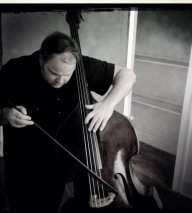
I know I play too close to the fingerboard. It's a combination of a couple things - I'm not very tall and don't have a great reach, so it takes some attention to sit in way that makes playing lower easy to do without tension. On top of that, I haven't ever been satisfied with my sound and bow changes when I do. It's time I fixed that. I put some real attention into it during today's practice session, ending with some just sustained notes, close to the bridge, at a variety of regions of the bass and a variety of volumes and timbres. I also made a new recording of the opening to see how it sounds with the bow a little lower.

Ack, you made me practice this piece for the first time in decades. Here's some food for thought.

I adopted a slight variation on your first fingering. I am still landing on 4 for the E-flat to lead into the D turn. I also noticed your 3-3 fingering in that third bar, which I think is neat, I like the slight slide I can get by doing it.

Screenshot 2025-07-10 at 6.01.24 PM.png


Bars 19–21 of the Schubert I think when I played it last I played the C with 3, shifted for the Eb with 3, and shifted back to the C with 3. It's a little clumsy with the double shift, but in my experience it's not too hard to hide the sliding during the thumb > 3 shift from Ab to Eb.

Completely tangential for bars 155–8, I'm a little suspicious of that bowing and the phrasing it creates: the original slurring is either by groups of 4 or 8 eighth notes if I'm remembering it correctly. Regardless of which it is, the intention is for bars 156–158 to be one long phrase, and in my opinion it's harder to make that long phrase slurring in groups of 2 and also slurring across the beats since 2-note slurs tend to emphasize the first note, which when combined with the syncopation will accent the offbeats and de-emphasize the beats. I'm not trying to denigrate the edition at all since I'm sure there are good musical reasons to use that bowing, but for me it's easier to achieve the long melisma by slurring in groups of 4.

If you want to play open Gs for that one bar during the theme, the bow will definitely need to slow down during the course of the D and Eb in order to make the open G speak: this is probably my favorite recording of this sonata, and at this bar you can see how he slows the bow down at the tail end of the E and F before he plays the A's


See my updated fingering above, which matches your suggestion (and @neilG's). I like it. The groups of 2 at 155 come from the Cobb edition. I didn't even notice that Sankey did something else, but I'm going to try slurring in 4s tomorrow.

Do you have the Petracchi book? I am working a solo by Granados right now. It is pretty tough, but then becomes easy if I use the right handshape at the right time. I end up moving between a minor diatonic, a chromatic and a semi-chromatic lefthand shape and then it all lays in the hand perfectly.

I have a copy of Petracchi that I bought in the mid 90s when I was a high school bass student. I also have practiced Rabbath's and David Allen Moore's techniques, but Petracchi is "home base" for me. I like those other approaches but I find that when I do too much expansion beyond "cr, s.cr, diat" it's hard to reach and tune. DAM's Fractal Fingering is nice for other reasons, though - it's a slightly larger organization of fingering approaches with a lot of great exercises.

Here's the recording I made today with as much feedback from you all incorporated as possible. The tuning today isn't quite as good but that's because I was really thinking hard about my right hand. I think the problem I originally complained about is much better. The timbre overall is different - not categorically better (yet) but maybe a step in the right direction. The big change I hear is the bass is more resonant but it's also a little less warm.

Thanks again for all your thoughts and ideas. I have a lesson next week and will be curious to hear what my teacher thinks, too.
 
I also made a new recording of the opening to see how it sounds with the bow a little lower.
It sounds much better - no more bow "skating".
Your right arm "weight" is more consistent throughout the bow strokes, resulting in a bigger sound.
IMFO, of course.
Good Luck.
Thanks for allowing me to opine.
 
Thanks again for all your thoughts and ideas. I have a lesson next week and will be curious to hear what my teacher thinks, too.

This sounds much better. What I think it is missing movement in the right hand at each bow change.
A sort of flick of the hand and fingers with transfer the same energy you already have in the bass rather than restarting the whole process with each bow change - it is also issue with plywood basses. They don't hold the vibration long enough for that transfer.
It sounds like your bass is nice. I would spend sometime getting your hand and wrist moving. Once you get a nice bass going, you don't have to do much to keep it going whether arco or pizz.
If you work on this transfer of the energy that is already there, I think it will sound pretty good.
 
This sounds much better. What I think it is missing movement in the right hand at each bow change.
A sort of flick of the hand and fingers with transfer the same energy you already have in the bass rather than restarting the whole process with each bow change - it is also issue with plywood basses. They don't hold the vibration long enough for that transfer.
It sounds like your bass is nice. I would spend sometime getting your hand and wrist moving. Once you get a nice bass going, you don't have to do much to keep it going whether arco or pizz.
If you work on this transfer of the energy that is already there, I think it will sound pretty good.

It's not a plywood bass! Any tonal deficiencies are purely my fault, because the equipment is good. I have been working a bit on letting my fingers and wrists work a bit more in the bow strokes, too, but that's a work in progress.
 
It's not a plywood bass! Any tonal deficiencies are purely my fault, because the equipment is good. I have been working a bit on letting my fingers and wrists work a bit more in the bow strokes, too, but that's a work in progress.
For me the right hand movement between bow changes is two things: there's the finger movement of pulling the frog in at the end of a down bow and pushing the frog out at the end of an up bow, and there's a bit of a rotation of the hair (but keeping the stick in the same place, so using the ring finger and pinky to manipulate the frog rather than the wrist moving the stick) where at the end of a down bow and at the very beginning of an up bow I use slightly flatter hair from my normal hair tilt (which is about a 60˚–70˚ angle towards the fingerboard I think?) and then at the end of the up bow and beginning of a down bow I use slightly less hair than my default.
 
  • Like
Reactions: Don Kasper
there's the finger movement of pulling the frog in at the end of a down bow and pushing the frog out at the end of an up bow,
This is GOLD...My first teacher, Roger Macchiaroli, Buffalo Phil., (with who I studied privately/weekly for my first 4 years), would speak (yell?) "The Wrist Leads!", meaning the whole RH mechanism is always anticipating the change in bow direction.
It proved to be the single most important concept of German bow mechanics and sound production.
IMFO, IMFE, of course.
Thanks!
 
This is GOLD...My first teacher, Roger Macchiaroli, Buffalo Phil., (with who I studied privately/weekly for my first 4 years), would speak (yell?) "The Wrist Leads!", meaning the whole RH mechanism is always anticipating the change in bow direction.
It proved to be the single most important concept of German bow mechanics and sound production.
IMFO, IMFE, of course.
Thanks!
Simandl New Method for String Bass, Part 1. Page four has photos of German "Down-bow" and "Up-bow" hand shapes, modeled by a young Gary Karr. It was one of the first things my teacher, who studied with Karr, tried to drill into me.
 
  • Like
Reactions: Don Kasper
This is GOLD...My first teacher, Roger Macchiaroli, Buffalo Phil., (with who I studied privately/weekly for my first 4 years), would speak (yell?) "The Wrist Leads!", meaning the whole RH mechanism is always anticipating the change in bow direction.
It proved to be the single most important concept of German bow mechanics and sound production.
IMFO, IMFE, of course.
Thanks!
It's something I wasn't taught for a long time, but being able to have that kind of wrist flexibility has been so helpful for my bow technique since one of the "traps" of German bow playing is keeping all the movements in the upper arm and forearm, which removes all the finesse that comes to French bow more naturally.
 
the "traps" of German bow playing
Another concept that Roger M. introduced me to was the concept of the bow moving in an (extremely) elongated figure 8 pattern - NOT in a flat-line back-and-forth pattern - the concept of keeping a "flat...." bowstroke both upbow and downbow was the enemy of this "wrist-leading/finger-anticipating" concept.
This was another game-changer for me, though it took "a while...!" for me to master the concept.
Roger used to say - "a Downbow should (feel) like it is heading towards the floor!" This would allow my/your wrist to feel & make that loop at the end of an upbow. And vice versa.
IMFO, of course and I"ll fight you!
Thanks for upping the level of discourse here on DB/TB/OrchTech.
 
Last edited:
  • Like
Reactions: AGCurry
It's not a plywood bass! Any tonal deficiencies are purely my fault, because the equipment is good. I have been working a bit on letting my fingers and wrists work a bit more in the bow strokes, too, but that's a work in progress.
I'd be careful with "letting my fingers and wrists work a bit more". It is important to differentiate between active and passive movements.
"Active" meaning doing the work, using the muscles, to actively do the motion. "Passive" meaning, allowing the motion to happen to the degree, chosen by your flexibility/tension as a result of momentum and inertia.
It can be very helpful, to practice wrist and finger movements actively, before using them mostly passively.
 
  • Like
Reactions: AGCurry
I am still digesting some of the excellent advice shared above, but I wanted to write back now that I've had a lesson since my original question. My teacher agreed largely with some of the things that were said, and honestly some of the problem areas, when I played them for him, simply were no longer problem areas. I'm recording them here now as much to contribute to the discussion as I am for posterity, so when I have time for a longer practice session tomorrow I can remember everything.

He suggested that I not focus too much on playing closer to the bridge and cautioned me to use arm weight carefully as the bow approaches the bridge, to keep the sound warm and beautiful. That said, I think his sound concept is a little more sul tasto than other people's. His main takeaway for bow placement was something that maybe was alluded to above but (to my knowledge) not said explicitly - that is, that you need to place the bow between the bridge and the fingerboard thinking about the next notes as much as the ones you're playing. What I take away from that is that among the classic 5 variables of bowing (a former teacher, Patrick Neher, gave me the acronym SWAP - speed, weight, angle, placement), I need to be actively considering these continuously, but with an eye towards the notes coming up as much as the notes I'm currently on (especially for those notes that are coming before the next bow change).

We talked a bit about adjusting bow speeds and angle - our classic discussion about flat hair versus angled har is about controlling bounce, because flatter hair is bouncier. We didn't talk much about wrist and hand, but it's something we have spoken about in the past. We didn't get to rosin, but my lesson started with the recit from Beethoven 9 (we're playing it soon) and my bow had a lot more rosin on it than I'd usually use for the Arpeggione sonata because I needed it for the Beethoven. Usually I practice "high rosin" stuff at the end so I have the right amount on for whatever I'm doing.

Another change I'm trying out is an update to my sitting posture. Last Friday, I was observing some players at the local music festival and the principal bassist (Nina DeCesare) was standing with an angled endpin. I spent some time on Saturday refreshing my memory on standing with an angled pin and decided to go back to sitting, but I reconfigured my stool and kept the angled pin in. This is having the bass a bit higher on my body but also making it a bit easier to play closer to the bridge without stretching my arm so much. This mostly is feeling good, and I'm going to work with it for a while. I don't think I absolutely need the angled pin for this setup, but I need to figure out the right amount of extension for the traditional pin to match.
 
Last edited:
  • Like
Reactions: Don Hergert
I'd be careful with "letting my fingers and wrists work a bit more". It is important to differentiate between active and passive movements.
"Active" meaning doing the work, using the muscles, to actively do the motion. "Passive" meaning, allowing the motion to happen to the degree, chosen by your flexibility/tension as a result of momentum and inertia.
It can be very helpful, to practice wrist and finger movements actively, before using them mostly passively.
Agreed, get them moving, with as little "work" as possible.


He suggested that I not focus too much on playing closer to the bridge and cautioned me to use arm weight carefully as the bow approaches the bridge, to keep the sound warm and beautiful. That said, I think his sound concept is a little more sul tasto than other people's.
One idea I like is seeing what the bass "gives you" and what you have to "take" from it. There is going to be an optimal spot for a clean clear tone for each note - that is the tricky part. Once you find that, you should also be able to clean up all the other locations between the bridge and fingerboard. I studied with a Gary Karr student for a bit and she got me playing every note on the bridge like Karr. While it is not always the optimal tone, once you can do it, cleaning up the rest is easier. I also was close friends with Patrick Neher student and I learned a ton from her! I probably should have paid her for lessons, but it was mainly just hanging out and playing and I asked a lot of questions. She brought Patrick to the Bay Area back then, he is fantastic player.
 
  • Like
Reactions: Don Hergert
Agreed, get them moving, with as little "work" as possible.


One idea I like is seeing what the bass "gives you" and what you have to "take" from it. There is going to be an optimal spot for a clean clear tone for each note - that is the tricky part. Once you find that, you should also be able to clean up all the other locations between the bridge and fingerboard. I studied with a Gary Karr student for a bit and she got me playing every note on the bridge like Karr. While it is not always the optimal tone, once you can do it, cleaning up the rest is easier. I also was close friends with Patrick Neher student and I learned a ton from her! I probably should have paid her for lessons, but it was mainly just hanging out and playing and I asked a lot of questions. She brought Patrick to the Bay Area back then, he is fantastic player.

I haven't heard from Patrick in a while but last I knew he was living in my town here in Washington. He's a great guy and an excellent player. I attended his retirement lunch last April and found myself sitting next to Gary Karr! I also met John Clayton then - it was a lot of really great bass players in a room, plus me.
 
  • Like
Reactions: damonsmith
When I studied with Gary Karr in the 1970s, sufficient resistance to the bow by its position in relation to the bridge was always a key focus. I learned from Gary Karr some warmup exercises to slow the bow down that gets traction and that projects the sound for soloing. Playing a few double-stop whole notes (A3 with open D2, then E2 with open A2) locks in traction and slow bow speed. Also, the slow glissando exercise (which he later called vomit) helps you get a feel for bow resistance as you slide the same finger from low on the G-string upward toward the end of the fingerboard, and back down. Up high on the G string you try for the same resistance by moving the bow closer to the bridge. As you slide back down you feel the tug from the bow resistance increasing naturally, so the bow needs to slowly move upward to maintain the same sweet spot as the highest note. “Voilà!” Instant concerto sound!
 

Latest posts