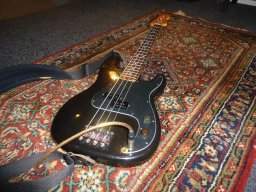
I play metal, with fingers.. near the saddless...
my amp is kinda small, and strings generally are old and bad quality, i didnt think THAT to be one of the big reasons of my problem.
about the saddless, i guess it needs some service...
And then when you started the OP, you said:
"Hi there, i'm playing from a few years and in this last months i've been breaking strings too often, I mean, once a week. A, E, B strings, from a fender mb-5."
How can strings generally be old, and then you break them once a week and have to buy new ones? You did not answer if this happened with D'addaros too. As it has started to happen last months, we can't tell if you break them with an old set of strings, or new ones. One thing though, that the set that you buy, the cheap Argentinian one MAY be one of those ROUND CORE strings. D'addario hasn't this but
this is a far fetched one, since I know of only the brand DR that makes them.
Basically the bass string is wound around a round core instead of a hex core. A round core string is more prone to unravel and turn loose, if you don't take good care and certain process to it, when stringing them on your bass. Not to go into details, 90 percent of all strings are on hex core in order to protect the string from unravel. Usually it should say so on the packaging. If it says "hex core" then rule this one out completely. It's not that. Round cores are only for those seriously experienced and professional, and can detect the advantages of these. However, this is another topic. Here's a picture:
However, since you're saying you're buying some cheapo Argentinian brand, we don't know whether those are of round core or hex core. I can very well think that round cores tends to break up and unravel at the bridge saddle MORESO than a hexcore one.
- - - - -
Here's a tip of reversible experiment that will not damage your bass.
If it looks like the bridge on the Fender picture I put out above you can do this.
1. Take off the B and E strings.
2. Take off the bridge saddle for these string and reverse them front to back (not upside down). If they're EQUALLY ROUND the angle of which the string leaves the saddle towards the neck and back to the string ball end, should remain and stay the same. Just as well as the slot should be equally as big for that given gauge.
3. String them on back again.
4. You may have to intonate your bass again. And adjust the HEIGHT screws again to accomodate radius and string height.
5. Do this with the rest of the strings too, if needed.
6. You can check with a magnifying glass if there's any nicks or dent inside that saddle groove that erodes its way into the string.
However, this is provided that the bridge and saddles allows for this! It isn't sure it will work. Some has the intonation screw at the side of the strings, and then you will whack the alignment and it will not be able to change it like that. If it looks like this:
Then there's no room for turning it around at all. Then drop my tip above.
You MAY be able to turn each saddle upside down instead, but I am not sure this will work either. It is only to be sure of that there's no dent or unevenness in the slots. The underside of these saddles may have been completely smooth and not "rugged up" by any string. This may or may not work as a test. I don't think these saddles are made round, and equal round all the way around. The may be flat at the bottom (underside) so you can adjust string height to maximum low and so on. Someone else may chime in on this and tell us how they're made.
I do think however, is that you're hammering it. Since it has happened the last months, your stamina and muscles may have reached a point were you hammering so much that it is beyond the elasticity of the string. Do you have grown small biceps on your picking fingers?

Just kidding. Jokes aside, you said you used a "small amp" which I think may be the culprit as someone else have said early on. Since you're using a 5 string and a Low B, that note isn't very well heard at all on any small amp. You should check out the distance between the string and pickups too if needed. If they're too far away from the string it will produce a low and soft note, and you need to hammer it to get heard.