• TalkBass has been independent since 1998. Add your voice.
    Create a free account to reply to discussions, view embedded media, and browse with fewer display ads.
    Join freeLog in
    Want zero display ads or expanded classifieds tools? Compare plans.

Brian Wilson/Carol Kaye


You can hear two basses on that, with some separation of parts but generally the same.

Speaking from personal experience, I am in the process of recording an album, where I composed several pieces which have multiple instruments playing counterpoint in the bass. It is not easy to accomplish this well due to the lower freqs not separating as well. In one song I have a cello playing a low line, electric bass and a synth all counterpoint. The electric is playing the most active line (most melodic driving the song and in counterpoint with the vocal melody) There are 5 cello parts on that song all playing counterpoints in various spots, sometimes stacked 3-4 cellos at a time in conjunction with electric bass and synth bass. Its a pop song believe it or not with all parts written around the vocal melody designed to compliment and not conflict with. Pure counterpoint not doubling the same part is not easy to do in a mix...in fact its rather complicated to pull off but is very cool if you can get it to work. Using different sounds and sometimes effects on an instrument makes it work.

Brian used different sounds so well and if you can pick up The Pet Sounds Box Set, released in 1997.... you can hear deep in to the mix and understand how Brian was very innovative on his low end in composing and orchestrating.
 
Last edited:
*Facepalm.* Thanks for this. I've been attempting to practice that bassline using double stops...now I understand why it's so HARD. I'll likely keep at it though as it's good practice on the upright. Guess I should have listened more closely to the original recording. :thumbsdown:

Reminds me of attempting to learn the guitar harmonies on the intro & outro of "And Your Bird Can Sing," before I figured out that it was two guitars (or perhaps two tracks?).

You've probably got this far already, but here's a vid showing a how-to on electric. There's also a vid on the same page where Herbie Flowers talks about the track. And... I love that "And Your Bird Can Sing" riff.

 
Here is the Kay/Wilson conversation from "Love and Mercy":


Here is a fantastic video showing the creative process of "I'm Waiting for the Day." I don't hear "two basslines in two different keys" but it is cool to hear the different layers of overdubbed bass:


Great video , listening to the video it really shows also how essential the reverb/delay was to the bass tone

On a side note is that reverb or delay that is being used with the bass ?
 
Last edited:
You've probably got this far already, but here's a vid showing a how-to on electric. There's also a vid on the same page where Herbie Flowers talks about the track. And... I love that "And Your Bird Can Sing" riff.


Cool, thanks yet again. And yes I had gotten that far...but on upright, sliding and holding those double stops is a b**ch. Glad I guessed correctly on the fingering. Great vid in any case. I'll keep trying to play it on the upright.
 
Not sure if there's any harmonizing bass lines etc but I know a DB and EB was used on Nancy Sinatra's 'These Boots Are Made For Walking' Great bass line in the chorus from the upright. Duh Duh Duh Duh Duh Duh Duh Duh Duh, Dum, dum dum, dum, dum dum :woot:
 
Here is the Kay/Wilson conversation from "Love and Mercy":


Here is a fantastic video showing the creative process of "I'm Waiting for the Day." I don't hear "two basslines in two different keys" but it is cool to hear the different layers of overdubbed bass:


I think it's a bit of dialogue meant to display Brian's out of the box thinking. CK would have understood perfectly well theoretically what he was attempting and I doubt the conversation would have gone down exactly that way.

Amazing movie.
 
She herself claims that she was making more money than the President of The United States, so I ask...How bad could it have been???
I can't imagine what she had to go through in the beginning.

Mostly what she had to deal with was a whole lot of blankness, parking lots, empty hallways, blank stairs. Then she played her part and it was "ok lets do another". There were fewer people doing anything anywhere then, the whole advertising hype machine was just getting started. So she found the perfect niche. There were women musicians back when too, so it wasn't like she was from mars or something. I think what musicians go through these days is harder, competition, judgment, lack of value, crowded bandwidth and because in digital utopia everybody is a musician.
 
Last edited:
They indeed were referring to playing in relative keys to each other. A common practice in Orchestral music (which Brian Wilson definitely incorporated into his music, though far from the only one of his generation). They could be playing almost anything relative to each other, but often you'll find contrapuntal (it's a real word and one of my favorites :D ) melodic or harmonic parts.

For example, one bass line walks up while the other walks down in different keys (or the same) and essentially arpeggiate different chord tones at the same time. This is just one of 1000 examples of how this could be done, but can be difficult to understand until you come across it or specifically hear it isolated.
 
Every time I have seen it mentioned to her or heard her discuss it, she bristles at the notion that it was a struggle and insists that then, as now, all that mattered was your playing. I get the idea that (to her) acknowledging her as a special 'female' bassist/pioneer is more insulting/demeaning/representative of the bigotry of lowered expectations, than anything she heard in a studio or on stage.

Yeah, there's no having to qualify Carol's playing. She's one of the best, period.
 
  • Like
Reactions: pudgychef and Esoge
I think there is some confusion in this thread what "playing in different keys" means.

If we are playing harmonized bass lines a 5th apart, we are not "playing in different keys."

If we are playing counterpoint (your line moves up, my line moves down, my line moves down, your line moves up) we are not "playing in different keys."

If I play a pedal note while you imply different chords over that pedal, we are not "playing in different keys."

If one of us throws in a blue note or chromatic passing tone, we are not "playing in different keys."

"Playing in different keys" means that our parts have different tonal centers and key signatures, for example you are playing a progression that resolves to A Major while I play a progression that resolves to D Major. This type of music certainly exists, but it is very rare: Polytonality - Wikipedia, the free encyclopedia
 
Cool, thanks yet again. And yes I had gotten that far...but on upright, sliding and holding those double stops is a b**ch. Glad I guessed correctly on the fingering. Great vid in any case. I'll keep trying to play it on the upright.

+1
A few years back I tried to get both parts of the song down, but to get any kind of consistency with the intonation on the upright ... having to hammer-on in two different places at once to get audible notes and then slide them in opposing directions. I improved over a few months, but not enough to keep it up.


I saw Will Lee do both parts simultaneously on his slab, which is what inspired me (that and the Flowers clip) to try both parts simultaneously on upright.

Time to get back on that horse...


This thread inspired me to watch "The Wrecking Crew", too.
 
  • Like
Reactions: RedVee and Jeshua
+1
A few years back I tried to get both parts of the song down, but to get any kind of consistency with the intonation on the upright ... having to hammer-on in two different places at once to get audible notes and then slide them in opposing directions. I improved over a few months, but not enough to keep it up.


I saw Will Lee do both parts simultaneously on his slab, which is what inspired me (that and the Flowers clip) to try both parts simultaneously on upright.

Time to get back on that horse...


This thread inspired me to watch "The Wrecking Crew", too.

Yeah. I started watching it yesterday too. I can't believe how many songs they played on. It is ridiculous. It is also interesting to look at how the business and technology has changed since then.

Thanks for clearing that up Mushroo. I know my technical vocabulary is not always on point, so any clarification is always appreciated.
 
Over the weekend I watched the movie Love and Mercy. In one scene Brian Wilson and Carol Kaye are talking about the bass track on a song. She asks him about a part where she is going to play one bass line on the electric and another person is going to play a different bass line on the upright.

The way she phrased the question made me think the two parts were going to be a harmony of some sort. Is this correct? Can someone explain this? Was this common practice back in the day?

Probably different sections of the song
 
Thanks for clearing that up Mushroo. I know my technical vocabulary is not always on point, so any clarification is always appreciated.

No worries, you were just repeating the dialog from the movie. I would imagine Kaye and Wilson had many technical conversations about music, which the script writers wanted to boil down to a single exchange that would be understandable to a wide audience. (Most people are familiar with the expression to play or sing a song "in key.")
 
  • Like
Reactions: Killed_by_Death
I can't imagine what she had to go through in the beginning.

Mostly what she had to deal with was a whole lot of blankness, parking lots, empty hallways, blank stairs. Then she played her part and it was "ok lets do another". There were fewer people doing anything anywhere then, the whole advertising hype machine was just getting started. So she found the perfect niche. There were women musicians back when too, so it wasn't like she was from mars or something. I think what musicians go through these days is harder, competition, judgment, lack of value, crowded bandwidth and because in digital utopia everybody is a musician.
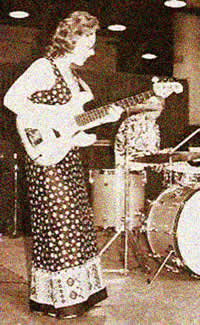
And if you see pictures or Carol from those days, it wasn't exactly like she was trying to be some sort of bass playing wallflower...She proudly paraded around in mini skirts, go go boots and dark hippie shades...Certainly seeking to be noticed...Lets just say paid a lot more attention to her wardrobe than most of the guys on those sessions...
 
I think there is some confusion in this thread what "playing in different keys" means.

If we are playing harmonized bass lines a 5th apart, we are not "playing in different keys."

If we are playing counterpoint (your line moves up, my line moves down, my line moves down, your line moves up) we are not "playing in different keys."

If I play a pedal note while you imply different chords over that pedal, we are not "playing in different keys."

If one of us throws in a blue note or chromatic passing tone, we are not "playing in different keys."

"Playing in different keys" means that our parts have different tonal centers and key signatures, for example you are playing a progression that resolves to A Major while I play a progression that resolves to D Major. This type of music certainly exists, but it is very rare: Polytonality - Wikipedia, the free encyclopedia

You do realize that counterpoint can be in different keys though correct? I only ask because you explicitly pointed out counterpoint (which I made a post about as an example), but the difference is I explicitly stated "playing in relative keys to each other" as the qualifier to my statement.
 
And if you see pictures or Carol from those days, it wasn't exactly like she was trying to be some sort of bass playing wallflower...She proudly paraded around in mini skirts, go go boots and dark hippie shades...Certainly seeking to be noticed...Lets just say paid a lot more attention to her wardrobe than most of the guys on those sessions...

This is definitely OT, but CK didn't do anything different than some of the modern young female pro bassists -- when you've got it, you flaunt it. I dare say "music" today is FAR more focused on bodies and athletic performances than musical talent. Anyway, here are a few pics of Carol "flaunting it" in the old days. Guess she could afford the wardrobe since she's said her earnings were more than the President of the U.S.:

[Invalid or Expired Link Removed]

carol-kaye-1.jpg


hqdefault.jpg


Library.jpg