

Enjoy the benefits of a premium membership!
Upgrade Account
-
TalkBass has been independent since 1998. Add your voice.
Create a free account to reply to discussions, view embedded media, and browse with fewer display ads.
Join free Log in
Want zero display ads or expanded classifieds tools? Compare plans.
You are using an out of date browser. It may not display this or other websites correctly.
You should upgrade or use an alternative browser.
You should upgrade or use an alternative browser.
Broke Down and bought a DI
- Thread starter iriegnome
- Start date
More options
Who Replied?
I'm surprised at the cost of the Radial JDI. With a look inside, there is no way the components could cost up to 200 buck, could it? Still, I'll be getting one.
Jensen sells the transformer retail for $73 + shipping. This is a top of the line model with double faraday shielding (double sealed metal case). It would cost you a lot more the $200 to build a DI around the transformer and do it right.
Another feature of this DI is that it can tap into the speaker output so the DI can send a signal out that includes the tone contribution of the power amp. The Countryman can do this as well. With many DI's you take the pre-out to the DI and then to the board. Power amp output as well is a nice feature to have.
Given the cost of the circuit board, case, switches and connectors, and other components in the JDI Passive DI, it really is a fair price.
Last edited:

A point that is worth stressing is the low distortion and phase deviation specs of the Jensen transformer.
I noticed in the JDI manual that they claim that when comparing products, the phase distortion is comparable in products from different manufacturers at 1KHz but at 20Hz theirs has a 4 degree deviation, their competitor's products have deviations of 20 and 40 degrees out of phase. This is an important point.
Non linear phase deviation over the frequency range of the device should be minimized. It helps keep the signal cleaner and notes time aligned. Otherwise, combined notes in the low end sound indistinct, mushy, less clear. Additional details are in the Invalid Link Removed on the JDI site. This contributes to one product sounding better than another.
As was mentioned, impedance is another big factor. If impedance is not matched, the bandwidth of the signal from the instrument is diminished. You loose high end, you loose harmonics. These contribute to a rich sound. When you roll off your passive tone control, you change the impedance of the instrument. Depending on the amp or DI that you are plugging into, it will affect the bandwidth of your signal. Even the instrument cable capacitance plays a roll. If you plug directly in (no wireless), don't use a cable that is longer than you need. Snake the cable back and forth on the floor, don't roll it up in a loop. Fortunately, these issues are less predominant in the low end, but still a factor.
Everything is important. It pays to invest in quality.
I noticed in the JDI manual that they claim that when comparing products, the phase distortion is comparable in products from different manufacturers at 1KHz but at 20Hz theirs has a 4 degree deviation, their competitor's products have deviations of 20 and 40 degrees out of phase. This is an important point.
Non linear phase deviation over the frequency range of the device should be minimized. It helps keep the signal cleaner and notes time aligned. Otherwise, combined notes in the low end sound indistinct, mushy, less clear. Additional details are in the Invalid Link Removed on the JDI site. This contributes to one product sounding better than another.
As was mentioned, impedance is another big factor. If impedance is not matched, the bandwidth of the signal from the instrument is diminished. You loose high end, you loose harmonics. These contribute to a rich sound. When you roll off your passive tone control, you change the impedance of the instrument. Depending on the amp or DI that you are plugging into, it will affect the bandwidth of your signal. Even the instrument cable capacitance plays a roll. If you plug directly in (no wireless), don't use a cable that is longer than you need. Snake the cable back and forth on the floor, don't roll it up in a loop. Fortunately, these issues are less predominant in the low end, but still a factor.
Everything is important. It pays to invest in quality.
Last edited:

- Feb 12, 2006
- 60,949
- 5
- 220,576
- Disclosures
- Development Engineer-Mesa Boogie, Development Engineer-Genzler (pedals), Product Support-Genz Benz
Do not use this DI with speaker outputs from any of the class D amps on the market that use a bridged topology (just about all). 1/4" Shield connects to chassis ground through the ground lift switch which then connects to pin 1 which connects internally to the mixer ground. This effectively short circuits the amp output to ground through the mixer which can destroy circuitry and pcb traces in the mixer because of very high currents.
Doing something like this, especially to somebody else's mixer is just wrong. It might damage your amp as well.
Doing something like this, especially to somebody else's mixer is just wrong. It might damage your amp as well.
Do not use this DI with speaker outputs from any of the class D amps on the market that use a bridged topology (just about all). 1/4" Shield connects to chassis ground through the ground lift switch which then connects to pin 1 which connects internally to the mixer ground. This effectively short circuits the amp output to ground through the mixer which can destroy circuitry and pcb traces in the mixer because of very high currents.
Doing something like this, especially to somebody else's mixer is just wrong. It might damage your amp as well.
Good point and it is always good to keep this in mind.
I believe that in this case they use isolated jacks. They appear to be rean type that are plastic and hopefully are not grounded to the chassis.
- Feb 12, 2006
- 60,949
- 5
- 220,576
- Disclosures
- Development Engineer-Mesa Boogie, Development Engineer-Genzler (pedals), Product Support-Genz Benz
Good point and it is always good to keep this in mind.
I believe that in this case they use isolated jacks. They appear to be rean type that are plastic and hopefully are not grounded to the chassis.
It's how it's wired. Even with isolated bushing jacks, the sleeve goes through the ground lift switch solidly to pin 1 ground.

agedhorse, thanks for taking the time to share your knowledge and experience. This is very interesting.
It's how it's wired. Even with isolated bushing jacks, the sleeve goes through the ground lift switch solidly to pin 1 ground.
I get it now.
You'd think that manufacturers would alert folks of potential issues like this in their user manuals.
Last edited:
- Feb 12, 2006
- 60,949
- 5
- 220,576
- Disclosures
- Development Engineer-Mesa Boogie, Development Engineer-Genzler (pedals), Product Support-Genz Benz
Agreed, this warning will be included in all of my/our future product manuals that use BTL class D technology... thanks to the reminder by the TB community.I get it now.
You'd think that manufacturers would alert folks of potential issues like this in their user manuals.

Bumping this for question:
That's the inside of my old Whirlwind IMP 2. As you can see it's about as passive as it gets.

So, aside from the lack of built in tone shaping/fattening up of the sound, that bland, weak sound we/I get with these things, especially with passive basses, pretty much must come down to the transformer, no?
Would a noticable improvement be had by replacing that transformer with some different spec/better quality one? And if so, any ideas as to what particular one?
Would a noticable improvement be had by replacing that transformer with some different spec/better quality one? And if so, any ideas as to what particular one?
Yes, a better transformer would make a difference. This is a good one, JDI passive DI, it sells for $73 but the Invalid Link Removed that uses this transformer would be a better alternative for $199. The unit is built properly to minimize noise and offers more features.
Yes, a better transformer would make a difference. This is a good one, JDI passive DI, it sells for $73 but the Invalid Link Removed that uses this transformer would be a better alternative for $199. The unit is built properly to minimize noise and offers more features.
Thanks. Was wondering if this could turned into a "DI I like" for $50-$60 or so, or smarter to just get something else.
Oddly, I haven't had much noise problems that could be blamed soley on this DI, mostly just sterile/bland/weak tone.
My ART TubeMP has much better tone (fuller, fatter, "tone instead of twang") but can get a bit noisy depending on how high you have to set the gains. Sometimes use the +20db switch and keep the gains very low, then it's quiet.
I suppose this Whirlwind might work better as is at the end of a pedal chain.
Just now experimenting with some pedals. Have mostly been a plug-n-play guy, getting coloration/overdrive, etc. via amps and speakers....and a mic.

Jim Carr
Dr. Jim
- Jan 21, 2006
- 16,223
- 7,613
- 76
- Disclosures
- fEARful Kool-Aid dispensing liberal academic card-carrying union member Musicians Local 72-147
The Radial JDI and Countryman type85 are my favorites. Just found a type85 for $132 to replace one that has been permanently borrowed. Nice.
Last edited:
Oddly, I haven't had much noise problems that could be blamed soley on this DI, mostly just sterile/bland/weak tone.
By noise i also meant distortion, muddiness or lack of clarity, as well as noise noise which can come from layout and shielding. I should have been clearer.
Pedal are always fun to play with. It takes me a while to get used to them, dial in sounds, and learn to use them. I saw a demo recently where the player was turning a fuzz on and off throughout the song to help emphasize passages. It was really effective. I tend to just turn it on and leave it once it is dialed in.
The Radial JDI and Countryman type85 are my favorites. Just found a type85 for $132. Nice.
Probably what I'llend up doing, if I purchase something else, mostly for the speaker level DI capability...next best thing to a mic.
It'll be a bit before this band is ready for gigs. My Tube MP works fine as a DI, but I like using it for whatever little "thing" it puts on my clean tone.
Will try going TubeMP---> pedal 1---> pedal 2---> Whirlwind---> board and see how that does. Then see what, if anything I need to change.
I like running a line level out from my GK as that gets the Boost/growl effect in their too. Doing whatever was no problem when I ran my own PA with the cover band, but this is an original rock project, likely be doing some 4-5 band bills with quick set changes and just need to be able to throw and go an xlr with at least bass and pedal tone in it to soundguy and hit the downbeat.
Jim Carr
Dr. Jim
- Jan 21, 2006
- 16,223
- 7,613
- 76
- Disclosures
- fEARful Kool-Aid dispensing liberal academic card-carrying union member Musicians Local 72-147
The Radial JDI is passive. No battery. The Countryman type85 is not passive, and has a 9-volt battery. No EQ one either one.
By noise i also meant distortion, muddiness or lack of clarity, as well as noise noise which can come from layout and shielding. I should have been clearer.
Pedal are always fun to play with. It takes me a while to get used to them, dial in sounds, and learn to use them. I saw a demo recently where the player was turning a fuzz on and off throughout the song to help emphasize passages. It was really effective. I tend to just turn it on and leave it once it is dialed in.
This guitar player loaned me a Wayhuge Porkloin to mess with for a bit. I'll probably end up getting one of my own. Cool pedal. It splits your signal inside so it can keep all your lows full and intact and add varying amounts if drive on top of it, then sum it back together and send it on. A bit like having a clean rig/dirty rig setup all in one little box.
That would be an "on most of the time" pedal, only switching it off for purely clean passages. Then I'd have the ART warming up my clean tone, then I have an old Arion Tubulator which is kind of a poormans tube screamer that doesn't suck away all the lowend either, that could be used for an occasional additional drive/boost for grittier passages, then put the Whirlwind at the end of the chain to send it all to the desk.
That still doesn't get the GK growl in there though. Will also try putting the ART after the amps line out to catch that tone and just use it to convert to an xlr run to the desk.
Trying different things with what I have. Not opposed to getting a different DI if it's really needed though.
Those pedals are all variations of "overdrive", nothing dirty enough to be called distortion or fuzz, though their dirtier settings sit pretty well in our mix. A bit dirtier than I'd set it running solo.
Another cool effect is splitting the signal off the bass and running one straight in my Valve Jr. and micing it up to blend with the rest of my tone. Real tube amp/guitar speaker dirt to mix in. That's fun when I'm running the board, but I don't know that some club soundguy would want to mess with it. Requires 2 channel strips for the bass, or me sending him a submix, requiring a little micro mixer in addition to the pedals.
Thinking it'd be more likely to get good FOH tone just throwing him 1 xlr with everything in it.
Weaving in and out of distortion adds a nice dynamic and sense of urgency to the sound. I like the idea of the valve jr split out.
Dunlop has a nice demo of a fuzz face:
This is what I meant by dynamics but it can equally apply to bass.
Dunlop has a nice demo of a fuzz face:
This is what I meant by dynamics but it can equally apply to bass.
Weaving in and out of distortion adds a nice dynamic and sense of urgency to the sound. I like the idea of the valve jr split out.
Dunlop has a nice demo of a fuzz face:
This is what I meant by dynamics but it can equally apply to bass.
I really like what the VJ/guitar speaker thing does being able to mic It and mix a little in with "regular bass rig tone".
It doesn't seem like much hassle to me, but I'm used to handling 12 channels or so of everybody from stage, though those were 4-hour gigs with an hour/hour-and-a-half of setup/soundcheck time beforehand.
I haven't done these sort of rapidfire multi-band bill gigs in quite a while. Looking forward to it again, but that sort of setup could most likely bring with it ease/quickness of setup issues, as well as having soundmen I've never met before being willing to take a feed off my submixer with me having lots of control over what's going on before it gets handed off to them.
I think I'd be remiss if I didn't have a quick, easy, couple/few pedals with a DI after them for a simple "plug this in and go" solution.
I basically can't stand having some cheap, crappy DI straight off the bass for them to bury under a wall of guitars.
The guitarists in this band are good musicians as well, not the type that try to bury the band with their "awesome tone through huge stacks". They have very good tone, but also like hearing the group and not just have it serve as a vehicle for wankery. I've actually asked the one to turn up a bit and the other to take more lead.
... cool. I might keep the whole 2-amp submix thing in my back pocket for some gigs, but need a simple setup to insure good sound out front quickly and simply.
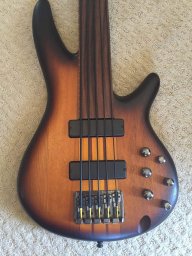
I recently spent months tweaking the sound of one of my basses. Got it EXACTLY where I wanted it. Playing in the band, it may as well have been a Squire with old strings. The subtle nuance is just not apparent in the mix...Seriously, the cheap DI boxes (like the IMP-2) sound like junk compared to the Radial, Countryman, and etc... However, would anyone hear the difference during a gig through most cheap club PAs... most likely not.


