

Enjoy the benefits of a premium membership!
Upgrade Account
-
TalkBass has been independent since 1998. Add your voice.
Create a free account to reply to discussions, view embedded media, and browse with fewer display ads.
Join free Log in
Want zero display ads or expanded classifieds tools? Compare plans.
You are using an out of date browser. It may not display this or other websites correctly.
You should upgrade or use an alternative browser.
You should upgrade or use an alternative browser.
Buying "upgraded" basses
- Thread starter Micha84
- Start date
More options
Who Replied?


Interesting thread ,. I have been told my that for the quality of my work and "end product sound quality" that I should be asking around 500-600$ for my full custom short scales based on bronco necks and bodies.
This is by serious professional musician (50's years of playing pro ) who works with very big name people and who has Multiple Juno awards and grammy noms My builds include re-machined bridges to accept 4 saddle set ups- new pickups, layouts ,electronics- handmade custom Pg's, reshaped headstocks- some parts hand made on my lathe- plus of course -fret jobs- setups-refinishing tinting necks etc etc. My builds are always outside the box of what fender has done and are not like anything on the shelf.
This is by serious professional musician (50's years of playing pro ) who works with very big name people and who has Multiple Juno awards and grammy noms My builds include re-machined bridges to accept 4 saddle set ups- new pickups, layouts ,electronics- handmade custom Pg's, reshaped headstocks- some parts hand made on my lathe- plus of course -fret jobs- setups-refinishing tinting necks etc etc. My builds are always outside the box of what fender has done and are not like anything on the shelf.
Last edited:


All mods lower the value for me.
Same.
Modded basses are like modded vehicles. Usually an easy pass for me unless it’s cheap enough.

good for you!My builds include re-machined bridges to accept 4 saddle set ups- new pickups, layouts ,electronics- handmade custom Pg's, reshaped headstocks- some parts hand made on my lathe- plus of course -fret jobs- setups-refinishing tinting necks etc etc. My builds are always outside the box of what fender has done and are not like anything on the shelf.
 but i'm not sure that your specimens fit into the concepts that the thread is discussing --- especially if you're offering your work to others for sale. you'd be selling them your creation, not just a "modded bass," right?
i think i saw your work in another thread, but some pics would be cool!
 TIA
TIA
As mentioned, they've got to be mods someone else is likely to want.
It also helps to have clear, colorful, well-lighted pics that help draw a buyer into seeing himself/herself-as-owner.
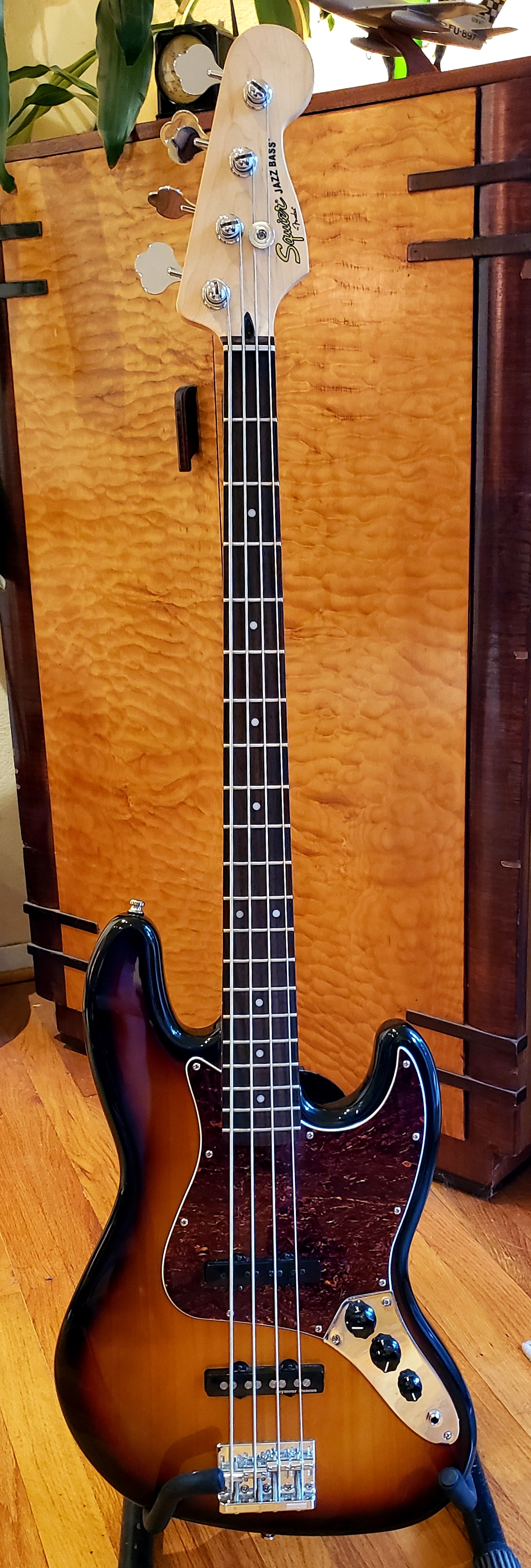
Last year I sold a 12 year old Squier VM Jazz that over that time, I'd replaced the very meh pickups, completely rewired and replaced the crappy dime-pots, installed a more robust NOS switchcraft jack (I bought a box of them from a closing electronics store 30 years ago) and put on a high-mass bridge. My soldering and wiring skills are good, and the bass had a classic sunburst finish, which probably helped broaden its appeal.
I was able to sell it for $150 over the bass's used market value.
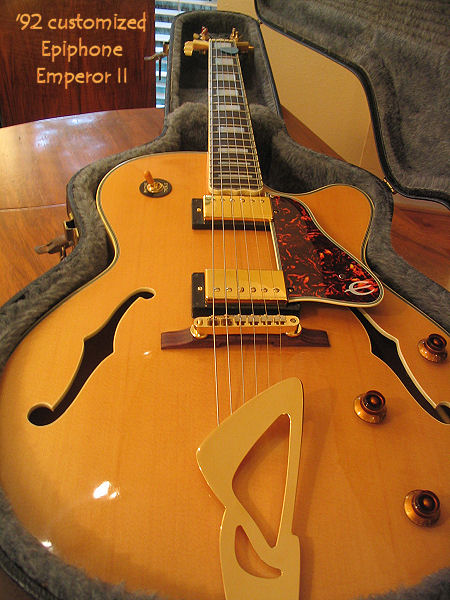
Decades ago, I owned and gigged with a blond Epiphone Emperor II jazz guitar (what later became their Joe Pass model). I replaced the pickups with Gibson '57 Classics, I replaced the rattling-coat-hanger tailpiece with a solid one from All Parts, replaced the wood bridge with an ABR-1 and rewired/replaced the pots and jack.
When it came time to sell, it went for $200 over market value to a guy who told me these were the mods he would've done.
It also helps to have clear, colorful, well-lighted pics that help draw a buyer into seeing himself/herself-as-owner.
Last year I sold a 12 year old Squier VM Jazz that over that time, I'd replaced the very meh pickups, completely rewired and replaced the crappy dime-pots, installed a more robust NOS switchcraft jack (I bought a box of them from a closing electronics store 30 years ago) and put on a high-mass bridge. My soldering and wiring skills are good, and the bass had a classic sunburst finish, which probably helped broaden its appeal.
I was able to sell it for $150 over the bass's used market value.
Decades ago, I owned and gigged with a blond Epiphone Emperor II jazz guitar (what later became their Joe Pass model). I replaced the pickups with Gibson '57 Classics, I replaced the rattling-coat-hanger tailpiece with a solid one from All Parts, replaced the wood bridge with an ABR-1 and rewired/replaced the pots and jack.
When it came time to sell, it went for $200 over market value to a guy who told me these were the mods he would've done.

Well let me put my tuppence worth in. I've modded quite few basses, the most expensive being a Harley Benton RB-414 that cost £200 new when I bought it and I've spent almost £800 modding it.
The thing is many people don't have the wad to go out and buy a Fodera or Rickenbacker in one fell swoop. However you can add to your current bass in increments over a period of time to suit your pocket and your monthly disposable income. Kudos to those that have the money to buy what they want, whenever they want. Yeah we can save for five years too to buy the dream guitar while those savings are eroded by real life, washing machine needs fixing, car repairs all this sort of rubbish that mere mortals have to deal with. So modding a guitar over time and with a budget to suit you is the option for many of us. Now the RB has come out grand, and in a blindfold taste test I reckon there's not many of you would be able to tell the difference between that and a real Ric.
However, if I ever came to sell it on Reverb I'd be barking at the moon if I asked a grand for it. I'd get at best £210 and that would be a miracle. That's why you generally keep your best modded guitars, because YOU'VE put the love, blood, sweat, and tears into it, YOU'VE made it unique and YOU'VE learned how to make that so so instrument into something really good. You can never understand that if you can just go into a boutique luthiers and order two at the same time. That's where satisfaction lies.
Anyway, don't buy modded guitars unless you trust the person who's modded it, and don't pay more than the list price new.

The thing is many people don't have the wad to go out and buy a Fodera or Rickenbacker in one fell swoop. However you can add to your current bass in increments over a period of time to suit your pocket and your monthly disposable income. Kudos to those that have the money to buy what they want, whenever they want. Yeah we can save for five years too to buy the dream guitar while those savings are eroded by real life, washing machine needs fixing, car repairs all this sort of rubbish that mere mortals have to deal with. So modding a guitar over time and with a budget to suit you is the option for many of us. Now the RB has come out grand, and in a blindfold taste test I reckon there's not many of you would be able to tell the difference between that and a real Ric.
However, if I ever came to sell it on Reverb I'd be barking at the moon if I asked a grand for it. I'd get at best £210 and that would be a miracle. That's why you generally keep your best modded guitars, because YOU'VE put the love, blood, sweat, and tears into it, YOU'VE made it unique and YOU'VE learned how to make that so so instrument into something really good. You can never understand that if you can just go into a boutique luthiers and order two at the same time. That's where satisfaction lies.
Anyway, don't buy modded guitars unless you trust the person who's modded it, and don't pay more than the list price new.

In my case, it depends. I bought a modified, MIA Fender Jazz that had the Sadowsky pickups/preamp put in it. It played fine, but I didn't care for the Sadowsky preamp and mostly did not use it. So I sold it. Later I bought a used, MIM Fender Jazz and had my luthier put in Fender Pure 65 pickups in it, and it was a total improvement in tone. So, as usual with many things in life, it depends.
Those kind of changes always seem like a healthy, learning growth phase. Hopefully no chainsaws involved!Hi everybody,
inspired by the thread "Would you buy a $950 Squier Precision" I wondered: When buying a used instrument, what is your take on upgrades or modifications that have already been done?
Are you more likely to buy a "lower tier bass" if tuners or pickups have been replaced? Do you mind if somebody swapped the pickguard? How about a paint job or a changed neck?
Have you ever bought a heavily modified bass that turned out to be amazing?
I find that I avoid basses that have been modified in any way. I just don't trust the handywork behind it. I know that you can't really do damage when changing a pickguard, for example, but still. Was the soldering done right when the pickups where changed? Has the new bridge been properly aligned? There is a lot of things you can't really know unless you have the bass in your hands. I am not too great with tools myself, so if I were to discover a modification done badly I'd have to bring the bass to a shop which will increase the overall price significantly.
Apart from that, I wonder: If somebody had an instrument that he or she wasn't happy with, so they spend money and time on it, and then they are selling it... chances are that this is not going to be a great instrument.
So, what's your take?
Cheers,
Michael

I think collectible vintage instruments are the only thing where you can get full value or more for the sum of it's parts.
For example, a loaded all original 63 P body paired with a nice, straight 65 p neck would probably fetch more than selling the body and neck as parts.
I think it was Rhett Shull who said something along the lines of "$2k in mods might make your $700 guitar into a $750 guitar."
For example, a loaded all original 63 P body paired with a nice, straight 65 p neck would probably fetch more than selling the body and neck as parts.
I think it was Rhett Shull who said something along the lines of "$2k in mods might make your $700 guitar into a $750 guitar."


First of all, thanks everybody for your views! Lots of different perspectives, really interesting stuff!
If you had read my post more carefully you might have noticed that I especially acknowledged that changing a pickguard can't do much damage. As for soldering jobs, well of course they can be done badly and even damaging other parts, as other posters have mentioned as well. And as you seem to be a seasoned player yourself and not a newbie at all I am a bit surprised that you don't seem to know that bridge changes require the drilling of new holes quite often.
Also a valuable opinion that I feel could have been phrased more respectfully. You don't agree with my gut feeling that somebody might have damaged something by making changes, that's fine. I don't care too much for the word "newbie", though, as I feel it is derogatory (now I come to think of it, I don't read it a lot on TB).OP is clearly a newbie who is equating very basic changes with somehow devaluing an instrument. If you don’t like the change, don’t buy the instrument. But to otherwise indicate harm has been done? Eh, no. A pickguard is plastic and some screws. Soldering? Easily accomplished by a newbie but I bet most have a tech install. Bridge replacement? Seems like OP is unaware that this is a drop in task that uses the original screw holes as a mounting point.
If you had read my post more carefully you might have noticed that I especially acknowledged that changing a pickguard can't do much damage. As for soldering jobs, well of course they can be done badly and even damaging other parts, as other posters have mentioned as well. And as you seem to be a seasoned player yourself and not a newbie at all I am a bit surprised that you don't seem to know that bridge changes require the drilling of new holes quite often.
I ALWAYS try and inspect thoroughly any bass I intend to buy.
If it sounds great for me, playability is good and doesn’t look like it’s been butchered, then I don’t really care if it’s been modded or not but I won’t pay more than its market price no matter the value of the upgrade.
This applies to low to medium value instruments though ,certainly not for a USA Fender or Lakeland let’s say where I want these to be original.
If it sounds great for me, playability is good and doesn’t look like it’s been butchered, then I don’t really care if it’s been modded or not but I won’t pay more than its market price no matter the value of the upgrade.
This applies to low to medium value instruments though ,certainly not for a USA Fender or Lakeland let’s say where I want these to be original.
I prefer stock and then just do a setup I'm comfortable with. I've never modded any of my guitars.
Outside of 2 acoustic guitars I have never purchased an electric guitar/bass that I have not held and played first. I did demo the acoustic models at a box store before I eventually found a deal online and ordered.
I'm in the "leave them as designed" camp (outside of setup/adjustments/maintenance/repair) if you like its playability.
Session/Studio call musicians know the Studio/Engineer are particular of instruments they use in a mix so hotrodded instruments can send a musician packing and losing a gig.
You can shape/scoop the sound with external preamps, amps and a soundboard, therefore I'm happy with the simplicity of passive instruments.
That's what works for me.
Outside of 2 acoustic guitars I have never purchased an electric guitar/bass that I have not held and played first. I did demo the acoustic models at a box store before I eventually found a deal online and ordered.
I'm in the "leave them as designed" camp (outside of setup/adjustments/maintenance/repair) if you like its playability.
Session/Studio call musicians know the Studio/Engineer are particular of instruments they use in a mix so hotrodded instruments can send a musician packing and losing a gig.
You can shape/scoop the sound with external preamps, amps and a soundboard, therefore I'm happy with the simplicity of passive instruments.
That's what works for me.
Last edited:
I usually avoid modified basses because to me it means the person wasn't really happy with the bass, then changed it from original, then still didn't really like it so now they are ditching it. I know that isn't always the case but ya. And mods lower the value of most basses most of the time imo.
First of all, thanks everybody for your views! Lots of different perspectives, really interesting stuff!
Also a valuable opinion that I feel could have been phrased more respectfully. You don't agree with my gut feeling that somebody might have damaged something by making changes, that's fine. I don't care too much for the word "newbie", though, as I feel it is derogatory (now I come to think of it, I don't read it a lot on TB).
If you had read my post more carefully you might have noticed that I especially acknowledged that changing a pickguard can't do much damage. As for soldering jobs, well of course they can be done badly and even damaging other parts, as other posters have mentioned as well. And as you seem to be a seasoned player yourself and not a newbie at all I am a bit surprised that you don't seem to know that bridge changes require the drilling of new holes quite often.
Starting an interesting discussion thread is an art form, take a bow for a opening up a compelling discussion.
As mentioned, they've got to be mods someone else is likely to want.
It also helps to have clear, colorful, well-lighted pics that help draw a buyer into seeing himself/herself-as-owner.
Last year I sold a 12 year old Squier VM Jazz that over that time, I'd replaced the very meh pickups, completely rewired and replaced the crappy dime-pots, installed a more robust NOS switchcraft jack (I bought a box of them from a closing electronics store 30 years ago) and put on a high-mass bridge. My soldering and wiring skills are good, and the bass had a classic sunburst finish, which probably helped broaden its appeal.
I was able to sell it for $150 over the bass's used market value.
View attachment 5379802
Decades ago, I owned and gigged with a blond Epiphone Emperor II jazz guitar (what later became their Joe Pass model). I replaced the pickups with Gibson '57 Classics, I replaced the rattling-coat-hanger tailpiece with a solid one from All Parts, replaced the wood bridge with an ABR-1 and rewired/replaced the pots and jack.
When it came time to sell, it went for $200 over market value to a guy who told me these were the mods he would've done.
View attachment 5379845
Did you have several moments of pause before you dove into the mods on that guitar, or did you know what you wanted to do with it when you bought it?

I upgraded a lot of MIM J basses and always made money when I sold them. The trick was to have the bass for sale, and a stock bass of the same model side by side so a prospective buyer can fully appreciate the upgrades. I’ve also sold a few that needed to be shipped and every one of those were very satisfied buyers. The trick is to improve performance and appearance, and never be desperate to sell. It also helps to start with a bass most people think of as a starter or “bargain” bass, then improve both performance and appearance.
MIM basses are notorious for having rough neck/fret edges, a local guy will clean up and roll the edges for $80. Scour the web for deals on humbuckers for J basses, or deals on nicer single coils. Clean up the unsightly gap between the control plate and scratch guard. Insure the frets are level and you can get a super low action without buzz. I always swapped out the OE bridge for a Fender Pure Vintage bridge with threaded saddles, and replaced the saddle height adjustment slotted screws with stainless allen head hardware and the guard and control plate screws with stainless screws. I never messed with the machine heads because they always worked with no issues. I did disassemble them and make them shine like a diamond in a goat’s butt, as did every piece of plated hardware, frets, etc. i never tried to touch up minor finish flaws because every attempt I’ve seen drew attention to the flaw. My hats off to those who can make those flaws vanish, but I’m not one of them so I didn’t try.
MIM basses are notorious for having rough neck/fret edges, a local guy will clean up and roll the edges for $80. Scour the web for deals on humbuckers for J basses, or deals on nicer single coils. Clean up the unsightly gap between the control plate and scratch guard. Insure the frets are level and you can get a super low action without buzz. I always swapped out the OE bridge for a Fender Pure Vintage bridge with threaded saddles, and replaced the saddle height adjustment slotted screws with stainless allen head hardware and the guard and control plate screws with stainless screws. I never messed with the machine heads because they always worked with no issues. I did disassemble them and make them shine like a diamond in a goat’s butt, as did every piece of plated hardware, frets, etc. i never tried to touch up minor finish flaws because every attempt I’ve seen drew attention to the flaw. My hats off to those who can make those flaws vanish, but I’m not one of them so I didn’t try.

In my opinion, there's no such thing as upgrades, only modifications. A modified used instrument's market value is somewhere between the market value of the same instrument completely stock in mint condition and the same instrument completely destroyed into a non-functioning pile of scrap. In other words, it's never worth more, but it might be worth less due to modifications.
Did you have several moments of pause before you dove into the mods on that guitar, or did you know what you wanted to do with it when you bought it?
My plans with the Epi jazz guitar were pretty much in my head when I bought it. I was looking for one with good action/frets at a low used price that I could upgrade; The Epiphone pickups from that era were not known to be good. A comparable Gibson ES-175, a similar sized, similar laminated-top guitar, would've cost me 10x what this one did.
Different story with the Squier VM Jazz Bass; I picked it up for $200 at a GC blowout sale and just played it a while. Great neck and action, but the stock pickups were pretty inarticulate, so I rewired and replaced everything since I was already under the hood and it seemed a shame to waste time re-soldering cheap, flimsy components.
Last edited:


