• TalkBass has been independent since 1998. Add your voice.
    Create a free account to reply to discussions, view embedded media, and browse with fewer display ads.
    Join freeLog in
    Want zero display ads or expanded classifieds tools? Compare plans.

cabinet frequency response

Today, soundproofing bass is still an expensive ordeal. In a multiplex You'll hear some bleadthrough from the theater next door, but not as much as you would be if Sensurround was being used. Today it's about Maxxbass, and pseudo psycho methods where the bass isn't really there. The pseudo bass processing is on the soundtrack. Local processing isn't needed.

If your woofers crap out on the lows, you can try Maxxbass. Even if your woofers do lows fine, you can still do Maxxbass in situations where you need to isolate bass from adjoining venues.

Either way, I hope someday bass gear consumers demand charts and measurements from manufacturers that show what the cabinets are capable of providing. Good cabs cost enough, why not ask what it can actually do.

I really don't get the attitude that you have to listen to every cab to know what it sounds like. There's really not a lot of information in "bass" frequencies. It's like all sine waves, they are there or not. If it's not, there may be no way to actually add it if the cab just can't do it. If I want a cab that can produce bass, I expect the manufacturer to show me it can. I can compare charts from known reference cabs and my brain knows what the difference is. Like reading music.

The cabinets upper bass, mids, and highs, may add "voicing", but even there, I may not want it added by the cab itself. Too much artsy fartsy in all the subjective descriptions of how a cabinet sounds. I'll provide the Artsy as long as the cab doesn't Fartsy.

I guess seamonkey did intend to reply tp sombody else's post?
 
GRollins said:
If you feel it in your chest, it's not that deep--you're looking at 75Hz, plus or minus a bit. The Earthquake roadshow wasn't all that deep, just chest-vibrating. But given that the hoi polloi don't know the difference, it made a grand impression. I remember a review extolling the low end.

Also wrong - let me quote Wikipedia for the (lazy?) people that do not have the energy (or bother) to open the page themselves:
The original Sensurround design used for "Earthquake" employed a pseudorandom noise generator, designed by D. Broadus "Don" Keele, Jr., to create the low-frequency rumble, with the waveform matching that of the 1971 Sylmar earthquake.[citation needed] Two low frequency control tones were printed on the film's mono optical or magnetic track; from the projector, the tones entered a control box in the projection booth, which fed low frequency pseudorandom noise to 1,600 watt BGW 750 audio amplifiers driving the speakers.[5] The control box generated a pseudorandom noise signal with energy between 17 and 120 Hz. The control track method was employed because there was no way to accurately record bass lower than 40 Hz on an optical or magnetic film soundtrack at the time.[2] When receiving the noise signal, the amplifier and subwoofers responded with sound pressures ranging from 110 dB at the center of the theater to a maximum of 120 dB measured 4 feet in front of any horn.[6] The resulting rumble could be felt by audience members as well as heard.[2]

For the film Earthquake, Sensurround was activated during the quake scenes to augment the conventional soundtrack.[7][8] In addition, portions of the main soundtrack were redirected to the Sensurround horns to create a partial surround sound effect. The control tones recorded on the film's optical or magnetic track triggered the rumble or surround sound effects as well as controlling their volume and the overall blend of the main soundtrack and low frequency noise effects. Two tones of 25 Hz and 35 Hz were used: these two tones allowed different effects to be activated when desired: the rumble could be turned on or off in the Sensurround horns, the main soundtrack could be sent to the Sensurround horns, the level of both the rumble and the soundtrack coming from the horns could be varied by varying the level of the control tones and the theater's main audio system could be increased in level by up to 8 dB at select points to create a greater dynamic range (MCA called this the "Step-Gain" function.)
 
steve rolfeca said:
When I first got into 5-string basses, I went on a quest for the perfect low B, and at one point, I built a cab according to a 6th order Thiele alignment. It needed an external processor to get there, but it was theoretically flat down to 30Hz. I had to build my own preamp as well, because I couldn't find a bass head that didn't have a built-in rolloff.

The cab didn't play very loud, and it was a royal pain to transport. Also, the fundamental still wasn't produced at an equal level to the second harmonic, because my basses weren't flat down to that frequency.

Regardless, there was a noticeable and pleasurable difference when you heard (and felt) the actual fundamental at the level that it was coming off the bass. I was playing a lot of quiet acoustic music at the time, and it sounded GREAT in that context.

Contrary to TB myth, it didn't sound muddy at all. In fact, because the cab didn't have the usual midbass hump, it sounded surprisingly articulate. It didn't cause problems in bad halls, and I got lots of compliments for the way my tone complemented acoustic piano and guitar.

This is very similar to my own experience (but from a bi-amped rig with a sub woofer of my own design and build, that was basically flat to 32 Hz).
 
Mike Arnopol said:
In my experience the Eminence Kappalites while going insanely loud before smacking the voice coil, tend to get "farty" sooner than a lot of the Faitals.
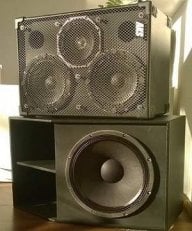
This is exactly my experience with the Eminence drivers I have encountered - robust and can take abuse but start to sound "farty" rather early. This also goes for the 3015LF. I am used to drivers that sound clean higher up and then have a smaller "transition area" before reaching destructive Xlim. For a pro rig (limiter and/ or speaker processor) I prefer the the "cleaner" option every time.
 
Mike Arnopol said:

This is exactly my experience with the Eminence drivers I have encountered - robust and can take abuse but start to sound "farty" rather early. This also goes for the 3015LF. I am used to drivers that sound clean higher up and then have a smaller "transition area" before reaching destructive Xlim. For a pro rig (limiter and/ or speaker processor) I prefer the the "cleaner" option every time.

These kinds of posts suggest that operation beyond Xmax by bass players may be common, if not routine, and that cab makers may need to consider how their cabs behave when operated with BL loss. It's nice to be able to choose to design for operation within Xmax, but players may have other ideas. Perhaps this could be addressed with some kind of 'hybrid' approach (generous Xmax and some overdamping). Some drivers allow for this with a motor design having some stray field outside the gap to provide a soft transition. I have heard of this, but never seen mention of it in the driver specs.
 
These kinds of posts suggest that operation beyond Xmax by bass players may be common, if not routine, and that cab makers may need to consider how their cabs behave when operated with BL loss. It's nice to be able to choose to design for operation within Xmax, but players may have other ideas. Perhaps this could be addressed with some kind of 'hybrid' approach (generous Xmax and some overdamping). Some drivers allow for this with a motor design having some stray field outside the gap to provide a soft transition. I have heard of this, but never seen mention of it in the driver specs.

Speaking as a player, the other thing that designers new to the bass backline category should realize is that it is pretty easy for the professional player (i.e., a player who plays in reasonable volume situations with good technique (i.e., control of transients, etc.) to achieve the maximum volume typically needed (i.e., appropriate balance with an unmic'd drummer) with a 'typical' cab available on the market.

For example, I have never, ever run into 'farting' or even power compression with a good, honest 500 watts pushing a reasonably high quality 212 cab (i.e., it balances perfectly with a relatively loud drummer in a busy stage mix). Anything more than that (again, assuming it is not a kid in a garage or maybe a dub player needing massive low end extension) is kind of a waste, at least to reproduce a live tone that mimics they typical post production sound of a bass in a well engineered recording through a decent stereo system (which is always my goal when playing live). Remember that those recordings are often made by mic'ing an old school rig into the board.

Just kind of a reality check for designers (especially engineers with little experience in the bass amp category).

I've found that there are significant tonality issues when one starts to blindly apply audio theory developed for pure sound reproduction at lower volumes (i.e., hi fi) versus the much more interactive nature of an 'organic' system (i.e., a rig that is designed to shape and amplify a solid body electric instrument that has no true inherent tone of its own prior to being plugged into something).

I do have a variety of cabs with different 'types' of drivers, from a 3015LF loaded cab to a cab with LOTS of mid midrange character and a pretty steep slope below around 50hz). They both sound great, both deliver similar max volume, and sound totally, utterly different. No amount of knob twisting can make them in any way sound the same due to the interesting stuff that is being talked about here.

Just something again to keep in mind. The idea of maximum low end extension with the least amount of compression or 'blowing through mechanical limits' is a noble goal, but not necessarily the only goal. IMO and IME!
 
  • Like
Reactions: downlowuponit
Speaking as a player, the other thing that designers new to the bass backline category should realize is that it is pretty easy for the professional player (i.e., a player who plays in reasonable volume situations with good technique (i.e., control of transients, etc.) to achieve the maximum volume typically needed (i.e., appropriate balance with an unmic'd drummer) with a 'typical' cab available on the market.

For example, I have never, ever run into 'farting' or even power compression with a good, honest 500 watts pushing a reasonably high quality 212 cab (i.e., it balances perfectly with a relatively loud drummer in a busy stage mix). Anything more than that (again, assuming it is not a kid in a garage or maybe a dub player needing massive low end extension) is kind of a waste, at least to reproduce a live tone that mimics they typical post production sound of a bass in a well engineered recording through a decent stereo system (which is always my goal when playing live). Remember that those recordings are often made by mic'ing an old school rig into the board.

Just kind of a reality check for designers (especially engineers with little experience in the bass amp category).

I've found that there are significant tonality issues when one starts to blindly apply audio theory developed for pure sound reproduction at lower volumes (i.e., hi fi) versus the much more interactive nature of an 'organic' system (i.e., a rig that is designed to shape and amplify a solid body electric instrument that has no true inherent tone of its own prior to being plugged into something).

I do have a variety of cabs with different 'types' of drivers, from a 3015LF loaded cab to a cab with LOTS of mid midrange character and a pretty steep slope below around 50hz). They both sound great, both deliver similar max volume, and sound totally, utterly different. No amount of knob twisting can make them in any way sound the same due to the interesting stuff that is being talked about here.

Just something again to keep in mind. The idea of maximum low end extension with the least amount of compression or 'blowing through mechanical limits' is a noble goal, but not necessarily the only goal. IMO and IME!

Ken,

+1 for all of this.

The discussion here may seem a little too 'engineering' and 'geeky', but I think this is a reflection of the thread's topic. Also, that the topic inevitably attracts people with an interest in the topic.

A thread on cab voicing (but not voicing vs hifi which I think is simply a matter of personal preference) would bring out some of the issues you bring up.

WRT required spl, there has been an emphasis on the benefits (even the need for) for 'super' drivers, and on their vast superiority over all the others. I don't have a need for really high spls and so would like to see cabs designed for voicing (tone) and a good measure of the fundamentals, all at spl capabilities suitable for small to medium clubs, bars and other non stadium-like venues. Lower power (handling) cabs can be made that sound every bit as good as the 'heavy hitters'. That too is another topic.
 
Ken,

+1 for all of this.

The discussion here may seem a little too 'engineering' and 'geeky', but I think this is a reflection of the thread's topic. Also, that the topic inevitably attracts people with an interest in the topic.

A thread on cab voicing (but not voicing vs hifi which I think is simply a matter of personal preference) would bring out some of the issues you bring up.

WRT required spl, there has been an emphasis on the benefits (even the need for) for 'super' drivers, and on their vast superiority over all the others. I don't have a need for really high spls and so would like to see cabs designed for voicing (tone) and a good measure of the fundamentals, all at spl capabilities suitable for small to medium clubs, bars and other non stadium-like venues. Lower power (handling) cabs can be made that sound every bit as good as the 'heavy hitters'. That too is another topic.

+1 I enjoy the topic! I always learn something by perusing these type of threads.
 
I think that there may be a couple of contributing factors towards bassists pushing the limits with speakers.

One is that you can get a 12" cab that will go the same perceived volumes as a lot of 15's that we're used to.Or a single 15 to go as loud as previous 215's.
Part of the small size/lightweight phenomena that we're seeing. Everyone talks about how loud the cabs can go but as we've stated---some of the drivers used aren't at their optimum at this level.

The other is that a gazillion watts are cheap and light. Andy comments on his site about guys using amps with too much power and then popping speakers. In my experience---let's take a speaker that sounds good with a 400 watt amp pretty close to its limits. And that the speaker is pretty close to its limits.Then you use an 800 watt amp at the same perceived volume. You notice that the speaker sounds more dynamic with a stronger envelope at the start of the note. It all sounds good until you pop the speaker. At the same perceived volume.

The smarter guys can chime in, but it seems to me that you might be getting 2 to 3 db more volume---because of the power available ---which results in a bigger, more powerful "thump" at the start of the note. But you could also be dumping 800 watts into the driver. I've noticed this many times when at the same volume when I switched to a more powerful amp that I could get"coil smack" at the same perceived volume. So if you're using a Markbass 1200 and humming along---if you hit a note too hard---even if you weren't that loud---goodbye speaker.

I think it's a matter of players being educated about the difference of a speaker "going really loud" and a speaker behaving in a linear fashion within its optimum range.

And also being cautious with wattage---it's not necessarily the overall volume---but the power transients being asked for with too hard of an attack. Of course you can blow up a speaker with too small of an amp---players need to understand matching the wattage available to their needs---if you have an amp that can put out twice the wattage your speaker can handle---you had either be very careful or use a limiter.
 
In my experience the Eminence Kappalites while going insanely loud before smacking the voice coil, tend to get "farty" sooner than a lot of the Faitals. Greenboy commented on how the Faitals tend to "clip"--or whatever more gracefully. When building little cabs with the Faital 8 it didn't give much warning before it smacked. A good and a bad thing. It didn't display the 'fartiness" that I'm used to with other drivers--it went very loud for it's size (claiming an 8.1 xmax---but Faital and others use a different way to measure xmax---more like 6mm as compared to an Eminence) but when it was done--it was done. I prefer this, but one does need to be more careful.

In comparing an enclosure with 8 5" Faitals against a 3015lf loaded cab---the lf went just a tad further before smackdown but the cab with the 5's went a lot louder than the lf before sounding really farty. The 5's smacked just a tad earlier but sounded good until.

Arjank---you were saying in another thread on the difference designers choose as far as the magnetic field extending further or something like that.Is that what's going on here? (comparing Faital's to Eminence's design choices)


I've got the same experience with most of the Eminence drivers compared to others (e.g. Oberton or Faital or Beyma).
The magnetic field extension can have something to do with it, among with other variables (e.g. progressive or linear suspension)
As far as my experience goes, the Oberton 10B200 can take a lot of beating before the voice coil smacks against the poleplate (have not yet encountered that). But before this point the fartines grows gradually whereas the Deltalite 2510 MkII is a ticket to fart-city when it exceeds the 4mm xmax, it sounds awfull...
The suspension of the Deltalite seems to stay linear for a few mm's after xmax, it doesn't act a counterforce on the voice-coil movement(I think). Though linear suspensions are good for Hifi (they are less prone to add harmonic distortion) they are not well suited (IMO) for PA use where the driver should be able to take a beating without farting out. I rather have a bit of harmonic distortion due to a progressive suspension then the fartines of a unit with a linear suspension where the voice-coil leaves the airgap....just my opinion.
It's a design thing, I think a combination of a progressive suspension that stays linear within xmax but gets progressive beyond xmax is ideal for PA use. Combine that with a well defined magnetic field (e.g. add shorting rings) and you have a great bass-driver, sounds so simple....haha (whish I had the tools to build my own drivers....)
 
Can any of the Speaker Cab gurus let me know if a 3015 would work OK in this Bag End Cab . S15B-D
Its the Deep (24") 115 cab by Bag End not the smaller cube one that most people have// ...
I dont know the internal dims.

[Invalid or Expired Link Removed]

Image [Invalid or Expired Link Removed]
 
Seeing the BL vs excursion curve of a motor (you can model it accurately with FEA) can tell you a lot about how a speaker will perform at high power. The other parts of the puzzle are the suspension non-linearity and the port non-linearity - all three aspects have to be considered to get optimum performance.

Inductance linearisation parts such as shorting rings are certainly nice to have but their significance becomes much much greater with speakers that are running into the treble region, and if you're running a large cone into the treble region it's a complex task to get good response in all aspects (frequency, time and space).
 
Inductance linearisation parts such as shorting rings are certainly nice to have but their significance becomes much much greater with speakers that are running into the treble region, and if you're running a large cone into the treble region it's a complex task to get good response in all aspects (frequency, time and space).

(single, double or triple)Demodulation (shorting) rings minimize harmonic distortion, thats the reason they are used in woofers by Faital, Oberton, 18Sound and others ( also read Invalid Link Removed )
The classic shorting ring was/is used a lot with full-range drivers to smooth out the impedance rise so the driver can "absorb" more energy in the highfrequecy range.
 
(single, double or triple)Demodulation (shorting) rings minimize harmonic distortion, thats the reason they are used in woofers by Faital, Oberton, 18Sound and others...

Indeed. You can also do a lot to lower harmonic distortion by reducing the static inductance of the voicecoil, so that as the inductance varies with displacement the effect it has is smaller. And neodymium magnets reduce harmonic distortion too because they're conductive, unlike ferrite magnets.

If you go for a shorter gap with higher flux within the gap you'll get lower inductance (less metal near the coil) and less of the excursion will be reliant on the fringe field where the inductance variation is largest. Using a longer gap will push the inductance up and increase the variation with displacement so is more likely to need shorting rings to bring the THD back down.

You might guess that much of my R&D time over the last couple of years has been on the driver side of things! ;)