• TalkBass has been independent since 1998. Add your voice.
    Create a free account to reply to discussions, view embedded media, and browse with fewer display ads.
    Join freeLog in
    Want zero display ads or expanded classifieds tools? Compare plans.

Can you ID this vintage guitar amp?

Reedt2000

Supporting Member
Apr 26, 2017
9,261
22,453
49
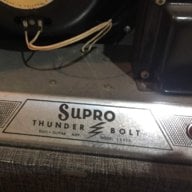
My friend asked me if I could find info on this amp (yes, pictures are crappy, it's all he sent me...)

Screenshot_20220516-111340_Messenger.jpg

Screenshot_20220516-111311_Messenger.jpg

Screenshot_20220516-111322_Messenger.jpg

Screenshot_20220516-111355_Messenger.jpg


It's all tube, has a Jensen 12" speaker. From what I've found it may be made by univox, likely early 60s? I found a similar amp badged Orpheum

Vintage-1950S-Orpheum-Guitar.jpg


The omega brand is tough to research. I found another model that was apparently used on a Radiohead recording session.

Anybody have any insights?
 
  • Like
Reactions: S-Bigbottom

Wow, that second picture gave me an intense feeling of deja vu...if that had only had three knobs I would swear it's the same amp that the guitar player in my junior high school band had, circa 1974. But I have no recollection of what brand his amp was. "Omega" doesn't ring a bell at all, and I know his wasn't labeled "Univox" because his next amp was a Univox. Weird.
 
  • Like
Reactions: Reedt2000
They seem to be 50's early 60's copies of Gibsons or typical , the early Gibsons copied Fender , I have a 54 or 58 ?? GA8T 12 watt 10 " that KILLS on gtr. they are called Tweed killers .
MAny of these amps at that time were copies of other amps and were around for a short time so ????
That's awesome, I've never seen one of these but I have played other similar things like supros and magnatone amps and they've mostly been great. Your attachment doesn't work for me, says I don't have permission. Can you post another pic or two?
 
  • Like
Reactions: S-Bigbottom
Some of them (like that 12" combo with the kitchen furnishing look) had accordion input jacks. What the heck's the impedence of an early 60's electric accordion? What's the best electric accordion for metal?
 
  • Like
Reactions: Reedt2000
Some of them (like that 12" combo with the kitchen furnishing look) had accordion input jacks. What the heck's the impedence of an early 60's electric accordion? What's the best electric accordion for metal?
Most inexpensive amps from the 1950s had accordion inputs. Accordion and lap steel were almost as popular as guitar - probably more so in some circles.

Most Japanese tube amps from that time (and I haven't seen many) were loosely based upon simple circuits used in American amps of the time. It's not easy to find any data on them. In most cases it's easier to just reverse enginner them and draw your own schematic.

the early Gibsons copied Fender

While it's easy to simplify things and say that Gibson copied Fender's circuits (and sometimes they did - so did Rickenbacker), something worth remembering is that all the major tube manufacturers - especially RCA - published basic circuits in their tube manuals and those circuits were considered public domain. The manufacturers wanted people to use them because they wanted to sell tubes.
Leo Fender was not an engineer and he took most of his early (classic tweed) circuits directly out of the RCA Receiving Tube Manual. He didn't make any attempt to hide it. It was pretty much cut-and-paste. He combined some of those circuits in interesting ways based upon his experience as an electronics technician - he wasn't electrically ignorant - but he left the engineering heavy lifting to RCA and trusted the circuits to work as advertised... which they did. Gibson, Epiphone (before they were bought by Gibson), Rickenbacker and, especially, Ampeg did more in-house engineering. They still used stock circuits from the manufacturers but they didn't rely upon them as heavily. Ampeg, in particular, had some very clever in-house engineers and that's why they were quick to adopt new tube types and were always updating their models (leading to a zillion versions of every Ampeg amp). It's true that Gibson used a few circuits that were very close to Fender models but they also used a bunch of pentode stages and oddball tubes like 6EU6s that you just won't find in Fender amps. They often did their own thing. Rickenbacker did the same, especially with the M-8 and M-11 amps, which were exact knockoffs of Fender's Champ and Deluxe amps, but then also did several designs of their own. And, of course, Ampeg was out in left field using Baxandall tone stacks and just going a whole other direction with darn near everything!
 
I had a 1 x 12 Univox amp with similar control layout (but not chicken head knobs) and dark, sparkly kitchen-y tolex. Same four-input setup with two-knob trem and a volume and tone for each channel.

As I recall it had (2) 12ax7s, (2) 6973 power tubes and a 6ca4 rectifier. Sounded killer at low volumes for James Bond-theme tones, and broke up early and easily into this weird distortion with vicious snarl up top and total chaotic flub down low. It was a fun amp for home recording but pretty volume limited for what I wanted to do at the time.

My biggest regret in selling it was losing that killer lo-fi trem.