• TalkBass has been independent since 1998. Add your voice.
    Create a free account to reply to discussions, view embedded media, and browse with fewer display ads.
    Join freeLog in
    Want zero display ads or expanded classifieds tools? Compare plans.

Can you really tell your tonewoods?

Brendan said:
Is there a difference? Mayhaps. But it's utterly useless.

Wood, pickups, preamp, strings, cables, preamp, speaker cable, cabinet ($175 power cable too, while I'm at it).

Brendan, how many times have you changed the pickups in a bass or guitar, how many different types of strings have you use on one bass, how many different cables have you tried through the same bass and amp, how many pre-amps have you tried with the same bass.

It all makes a difference, but, the bass will still sound basically the same, all that better pickup, pre-amps, cables and so on do is to give you a clearer amplification of the instrument, if what the instrument's actual sound isn't important, why bother.

In terms of the now dreaded FB wood choice it does make a difference to the sound, but NOT by very much compared to the body and in my opinion the neck it self [a maple neck is a maple neck no matter what FB you add]. Most people that I have talked to are more concerned with how the FB feels [rough vs smooth] then what they do to the sound it self.

In terms of Fender using rose wood; It had NOTHING TO DO WITH SOUND, it was all about looks and how a guitar is and was perceived, back then [and in some cases now] maple FBs were considered cheap and rose wood was [and still is] the standard that ever one used for good of high quality, in fact everything concerning the wood that Fender used early on was about economics more then tone, ash with that blonde [limed ash] was cheep and popular as furniture at the time.

 
I'll chime in here (but it's a warm chime as it's an older beige Dell keyboard).
I feel it's more a "sum of the whole" as opposed to this sound vs. that sound.

My example is my Sadowsky 5. It's maple necked and fingerboarded (necked & fingerboarded-hehe ;) ) with an ash body and maple top.
My new Sadowsky 5 (albeit a Metro-should be no difference in quality, with same pick-ups and pre-amp as my NYC one) is alder bodied and maple necked/rosewood fingerboarded.
This "should" yield a much difference in sound. We'll see! :D

I can't remember if Roger Sadowsky said he couldn't tell much of, if any, difference between rosewood to maple or ash to alder.

Man, would it be cool to have the builders that lurk here pipe up on this subject. A friendly conversation on tone woods from the masters Sadowsky, Smith, Fodera and who ever would blow my mind!!!
Someone who knows them (like one of the moderators) should arrange this as a sort of "Master Thread" or "Round Table" if you will. Keeping out the normal folks such as ourselves to hear/watch them discuss different topics (we could suggest/ask questions but keep it off the thread unless very relevant-who would want that task!?!)

I may copy this to the fine folks here at TB if it isn't picked up on. Anyone else like this idea???
 
Unless your nose is stuffed up, an Apple Tastes different than a Potatoe even though they are the same Denstity.
Then again, there are different types of Apples and different types of Potatoes. It's not just Apples and Oranges anymore !.... lol

If you drop a Potatoe and Apple on the floor, they sound different as well !!!!!

Get the point Erik?
 
KSB - Ken Smith said:
Unless your nose is stuffed up, an Apple Tastes different than a Potatoe even though they are the same Denstity.
Then again, there are different types of Apples and different types of Potatoes. It's not just Apples and Oranges anymore !.... lol?

Not sure how long that old "apples and oranges" analogy is going to be valid, with all these genetic manipulations going on... ;)
 
Browsing through old threads and had to read this one. When I still had a Facebook account I was in a lot of bass related groups. This subject was always being discussed and there were many that claimed they could hear the difference in woods. One day I made a few sound clips of different basses I owned and posted them in the group and challenged anyone to tell me what tonewoods they heard and which wood the fingerboards were made of,if any bass had decals or stickers (after many claims these would affect the tone) which of the basses had been stripped of its finish (I told them there was only one of these) etc. No one would step up. So many had claimed they could hear differences in wood so it stands to reason if you can telll basswood from ash then you should be able to tell me which bass is made from which. One guy hit on my Spector but he knew I owned a Spector and he had many so he had no special powers. I'll admit wood contributes to the tone but no one is going to tell me they can distinguish tonewoods with their ear in a blind test. My maple body,maple neck Spector does have a certain tone and it weighs a ton,is neck through etc so yes,it has a certain sound. A brass nut,brass bridge,a 3 band 19v preamp and active humbuckers definitely takes the woodgrain out of sound though
 
Here we go again...:rolleyes:
OK; can I really tell the difference? In a quiet, sterile "laboratory" environment - yes I can. Most of the time. With nothing better to do - like, say, practice - or laundry, or mowing the lawn - than conduct an essentially pointless exercise. Why do I consider it "pointless"? Mostly because, except for giving folks something to argue about on Talk Bass, and maybe over a beverage of your choice with friends, it has no relevance or meaning in the real, making-music-in-a-band world. Playing on stage, you may "know" there's a difference between an Ash or an Alder body, but I really, really doubt you can hear it, in the middle of playing Mustang Sally. I'll guarantee you - nobody else can. And I'll absolutely guarantee you that NOBODY - except maybe some gear-obsessed bass player in the audience - cares, either.
I currently own - and play - 27 basses, with another one (a short scale Serek Sacramento) being built. Made of all kinds of wood, with all kinds of necks and fretboards; headless; aluminum necks; solid, semi- and hollow body. With all kinds of pickups, and strings...
The one thing they all have in common? They are what they are. Period. You're perfectly entitled to fuss, argue and obsess over "Tone woods" if you want; that's your right and yuor privilege. Personally? I'll just play my basses - and enjoy them for what they are...:whistle:
 
Last edited:
Is there a difference? Can I hear it? With what's left of my 60 + year old rock and roll hearing? Sadly not.

When blending tea, coffee, wine, whisky etc, where small changes in components can alter the whole taste of a product, you need a sensitive palate, which will be developed way beyond the level of the people who buy your products. The better instrument makers are going to have a similarly developed ability to hear differences the rest of us don't. If any of those guys say there can be differences then I'll believe them, whether I can hear it or not.
 
I think folks forget to take into consideration the drastic effects that humidity, barometric pressure, altitude, and lunar phase have on tone woods! People think that it's the different woods that have unique tones, but it's actually environmental impacts on the wood itself!!!

....:rolleyes:
 
  • Like
Reactions: TrustRod
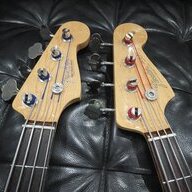
I've had the exact same bass model, same year of production (Precisions in the pic to the left) with the exact same strings, but one was maple, one was rosewood. (one got sold but there was some overlap of owning both) It's definitely different.
 
Last edited:
I've owned about 30 basses in my life and about half of them had maple boards and half rosewood. I also swap necks often.

I honestly can hear a difference between the woods on fretted basses. Maple boards tend to be a little brighter, and I can hear it especially when I slap, or play percussive. I just replaced the neck of my Am. Std P, now it has a maple board and same experience.
 
Last edited:
When blending tea, coffee, wine, whisky etc, where small changes in components can alter the whole taste of a product, you need a sensitive palate, which will be developed way beyond the level of the people who buy your products.
This is a really good analogy. I used to do coffee cuppings all the time - I even helped develop the bottled Starbucks Frappucino drinks. A trick that folks would use when cupping would be to use double (or even triple) strength coffee - using more beans helped to bring out the different tasting notes (made them more apparent and easier to identify). After awhile, your palate would develop to the point where you could easily tell the difference between coffees.

The same kind of technique can be used for fretboard wood. If you can't hear the difference at "normal" tones, try significantly boosting various frequencies - boost the treble a whole lot and you should be able to start hearing the differences between a maple and rosewood fretboard. Use that technique to train your ear.
 
  • Like
Reactions: chris_b
WOW how did this get resurrected...

We need some brave soul to post sounds by 3 different basses with identical setups, then see what nonsense people claim to hear about which one is made of which wood. Then reveal they are all rosewood on maple alder bodied basses, from the same series.

Every bass will sound a little different from another no matter what. Wood impacts it sure but every tree is different, let alone every piece of lumber... Just a ludicrous argument to get into.