I prefer a passive bass because I want the natural sound of the bass, uncolored. Two of my active basses have the ability to play them passively, and I do.I started playing regularly and seriously only last year and I played an already fairly modern passive P+J bass (budget brand, early noughties), so I don't have experience with older guitars.
I think these two statements are true:
• Fully passive instruments have comparably low outputs (though significantly higher than they used to have half a century ago). So putting a phantom or battery-powered preamp in the guitar itself makes perfect sense. The signal is hotter, it has more headroom, interference induced noise has less effect on the signal.
• Bass amps used to have two inputs, one for passive instruments, and the other for active ones. The active input simply padded the signal before the onboard preamp. You could achieve the same result by plugging your active instrument in the passive input and turning down gain. The only time when you needed to use the active input was if your bass runs so hot that it overdrives the preamp even with the gain turned way down.
So far, so good. But I bought an active guitar last year and I was surprised by one thing: the volume in passive and active modes is exactly the same. I read that this is common with all modern active guitars. I can tell for a fact that the preamp is in use because active mode won't work if the battery is close to being dead, and tone controls only work in active mode. When tone controls are in the center position, it's impossible to hear the difference between active and passive mode.
Active signal is not hotter than passive. It's possible that the noise floor is lower and you get higher SNR in active mode, but interference induced noise is additive. It doesn't care how much (or how little) noise there was previously. If there's enough interference, it will cause noise.
What gives? The only two advantages I see running the bass in active mode is 1) tone control; 2) impedance matching with badly designed amp input stages. Theoretically, there might be a third advantage that when used in a noise-controlled studio, your bass will have a slightly lower noise floor, but I'm grasping for straws.
What am I missing?

Enjoy the benefits of a premium membership!
Upgrade Account
-
TalkBass has been independent since 1998. Add your voice.
Create a free account to reply to discussions, view embedded media, and browse with fewer display ads.
Join free Log in
Want zero display ads or expanded classifieds tools? Compare plans.
You are using an out of date browser. It may not display this or other websites correctly.
You should upgrade or use an alternative browser.
You should upgrade or use an alternative browser.
Can't wrap my head around active vs. passive basses
- Thread starter toughluck
- Start date
More options
Who Replied?

<-------- Clueless player who habitually dimes all the knobs. 

If you're modifying the tone on the guitar and the amp, the modified tone of the guitar is still affecting the amp's tone. You're not getting away scot-free. And, for example, adding +10dB to the mid on the preamp and then -10dB on your amp is not going to equal a flat signal, because the EQ bands are pretty much guaranteed to not be identical in terms of frequency center point and Q. You'll probably sound worse; at best, unpredictable.Tone control on the guitar is a good thing if you like to annoy the sound guy running the FOH mix among other things. But too much of a good thing is counterproductive if you dial in completely different contours on the guitar and on the amp, though that might achieve exactly the sound that you're looking for.
Bassists are often drawn to active systems because they provide predictability (for example, pickup buffering) or the opportunity to shape the signal in a particular way, whether it's to compensate for the instrument's or their favorite strings' tendency to have too-strong or too-weak mids, for example, or to deal with audible gaps in a live system.
Bassists have had to struggle to be heard until recently, relative to how long guitarists have, so while guitarists tend to be stuck on how guitarists did things 60 years ago, bassists are more willing to experiment with modern electronics to get loud enough and sound good.
It all depends on how you use them and whether they fulfill a need better. For a lot of musicians, a wholly passive bass is what they want, and that's OK too.

Same here, but regarding active, that's not by choice! My delightfully named Ibanez EHB1005SMS is by far my quietest bass. I have to run it with the "+6 dB mod" to match my other passive basses. That, unfortunately, means its passive mode is all but useless. I feel a pickup replacement coming soon...I never use passive bypass when available on an active bass.
And yet, I never miss having the active circuitry on a good passive bass.
I tend to run my passive basses tone wide open, and roll off when required for subtler moments. As such, I use/used the eq on active basses to tone match the passive basses. Not an exact science, but just to get them sitting in the same place in the mix.

I keep it musical and about tone. Don't get too analytical because nobody listening cares about the math behind things.
Advantage of Active J style bass - the pickups are balanced and many times noise free. So soloing the bridge results in a thicker sound and less low end loss. Also it has more sizzle and high end so it is the sound if you want that fusion style slap sound.
Disadvantage - A good passive J has more mojo in it's sound and is less sterile for me. I have both and switch between them all the time so this is how I hear it. The passive J has more low mid and punches through the mix more for me. It has more of a vibe to it and many times I prefer how pedals react to passive basses. I don't find myself using the Active J's onboard active EQ that often, and prefer a studio quality preamp.
Do you like things simple or like a lot of knobs you can tweak live? I personally prefer to master a few knobs instead of having a lot of options. That is just what I prefer. So my active basses don't really get tweaked much when I play besides pickup switching.
Advantage of Active J style bass - the pickups are balanced and many times noise free. So soloing the bridge results in a thicker sound and less low end loss. Also it has more sizzle and high end so it is the sound if you want that fusion style slap sound.
Disadvantage - A good passive J has more mojo in it's sound and is less sterile for me. I have both and switch between them all the time so this is how I hear it. The passive J has more low mid and punches through the mix more for me. It has more of a vibe to it and many times I prefer how pedals react to passive basses. I don't find myself using the Active J's onboard active EQ that often, and prefer a studio quality preamp.
Do you like things simple or like a lot of knobs you can tweak live? I personally prefer to master a few knobs instead of having a lot of options. That is just what I prefer. So my active basses don't really get tweaked much when I play besides pickup switching.

songwriter21
I have an obsession for wood. The musical kind.
I dig a/p, because while I mostly run passive with pedals, if something happens to my pedal(s), then I have backup eq right on my bass. My pedal chain would go squirrely for some reason here and there, or I'd forget to bring my pedals (yes, I have done that before...twice). I will also use active mode for an l instantly switchable slap or other alternate tone, if I choose not to use a pedal.I started playing regularly and seriously only last year and I played an already fairly modern passive P+J bass (budget brand, early noughties), so I don't have experience with older guitars.
I think these two statements are true:
• Fully passive instruments have comparably low outputs (though significantly higher than they used to have half a century ago). So putting a phantom or battery-powered preamp in the guitar itself makes perfect sense. The signal is hotter, it has more headroom, interference induced noise has less effect on the signal.
• Bass amps used to have two inputs, one for passive instruments, and the other for active ones. The active input simply padded the signal before the onboard preamp. You could achieve the same result by plugging your active instrument in the passive input and turning down gain. The only time when you needed to use the active input was if your bass runs so hot that it overdrives the preamp even with the gain turned way down.
So far, so good. But I bought an active guitar last year and I was surprised by one thing: the volume in passive and active modes is exactly the same. I read that this is common with all modern active guitars. I can tell for a fact that the preamp is in use because active mode won't work if the battery is close to being dead, and tone controls only work in active mode. When tone controls are in the center position, it's impossible to hear the difference between active and passive mode.
Active signal is not hotter than passive. It's possible that the noise floor is lower and you get higher SNR in active mode, but interference induced noise is additive. It doesn't care how much (or how little) noise there was previously. If there's enough interference, it will cause noise.
What gives? The only two advantages I see running the bass in active mode is 1) tone control; 2) impedance matching with badly designed amp input stages. Theoretically, there might be a third advantage that when used in a noise-controlled studio, your bass will have a slightly lower noise floor, but I'm grasping for straws.
What am I missing?
Last edited:

One advantage active basses have is that you can reduce the volume without affecting the tone.
Oooh, I forgot about this. Big advantage to active!
yup, but it's not true for all active basses. basses with active pickups -- yes, basses with an active blend -- yes, basses with volume after the pre -- yes. but a common 'active/passive' bass doesn't fall in any of those cases and has a volume loading the pickups, making them sound darker when you turn it.
luckily, a treble bleed circuit is a thing (and also used in passive instruments).

JazznFunk
Supporting Member
So much hand-wringing, but this is all that matters at the end of the day: Does the bass in question, active or passive, *inspire you to play*? Don't get so far in the weeds that you forget the big picture. Do you like the sound of the bass as it's designed and produced, without getting into the weeds about what you feel you SHOULD like? That is ALL that matters.
I have passive basses that I love. A P-Bass, and 2 Jazz Basses. I have no desire to make them active, but if for some reason I DO need to run them through a preamp, I hit my Sadowsky Outboard Pre. In the case of the P-Bass, I don't really like running it through the Sadowsky. The Jazz Basses benefit from it if I want a certain characteristic. But I'm fine with them straight passive.
Then there are my other active basses.... Several Laklands, StingRay, and my fretless Sadowsky. At no point have I ever purposely bypassed the preamp on any of them and been happier with the sound. They are designed to be active basses. I like them that way. The passive 'bypass' is something I never use, except maybe in an 'emergency' that has never happened, because I replace batteries before they fail. In the case of my StingRay, Leo designed it to be an active instrument. If you want that 'Ray sound, ya gotta deal with the active preamp. It is part of the voice of the bass.
What I like about active vs passive basses is not that I can endlessly tweak tones on stage to the dismay of my bandmates or a sound engineer, it's that I CAN tweak things on the fly to sculpt a particular sound or need without heading over to my amp. Small tweaks go a long way - and I cut before I boost in a lot of cases. With a bass like my Lakland 44-02 Deluxe, I appreciate the coil switching and the ability to approximate many different sounds with one axe, and that usually requires larger EQ changes on the fly to get there. I couldn't do that with a passive version of the same bass. I also never have to worry about any tone degradation on the way to the board/FOH. The EQ on the bass changes/sculpts the sound of the BASS, and I use the amp EQ to tune to the room. With passive basses, the EQ changes the bass in a way that might not fit the room. That's why I like the flexibility of active.
I have passive basses that I love. A P-Bass, and 2 Jazz Basses. I have no desire to make them active, but if for some reason I DO need to run them through a preamp, I hit my Sadowsky Outboard Pre. In the case of the P-Bass, I don't really like running it through the Sadowsky. The Jazz Basses benefit from it if I want a certain characteristic. But I'm fine with them straight passive.
Then there are my other active basses.... Several Laklands, StingRay, and my fretless Sadowsky. At no point have I ever purposely bypassed the preamp on any of them and been happier with the sound. They are designed to be active basses. I like them that way. The passive 'bypass' is something I never use, except maybe in an 'emergency' that has never happened, because I replace batteries before they fail. In the case of my StingRay, Leo designed it to be an active instrument. If you want that 'Ray sound, ya gotta deal with the active preamp. It is part of the voice of the bass.
What I like about active vs passive basses is not that I can endlessly tweak tones on stage to the dismay of my bandmates or a sound engineer, it's that I CAN tweak things on the fly to sculpt a particular sound or need without heading over to my amp. Small tweaks go a long way - and I cut before I boost in a lot of cases. With a bass like my Lakland 44-02 Deluxe, I appreciate the coil switching and the ability to approximate many different sounds with one axe, and that usually requires larger EQ changes on the fly to get there. I couldn't do that with a passive version of the same bass. I also never have to worry about any tone degradation on the way to the board/FOH. The EQ on the bass changes/sculpts the sound of the BASS, and I use the amp EQ to tune to the room. With passive basses, the EQ changes the bass in a way that might not fit the room. That's why I like the flexibility of active.
Last edited:

This^. Drive what you like, like what you drive.At the end of the day, if it sounds good, it is good.

Passive benefit is simplicity.
No battery, and if it breaks at a gig I could probably fix it with wire nuts and electrical tape in a pinch.
As far as the ability to tone shape a passive, a preamp pedal can deal with that.
If you keep the cable reasonable length there is no perceivable difference between a passive bass with an external preamp or an active bass with passive pups and an internal preamp.
If external preamps dies before a show I still have a functioning bass, if an internal preamp dies before a show….not so good.
Now the real difference is active pups vs passive pups.
Active pups have have less winding, less magnetic pull, less chance of noise, and all of these drastically effect the sound of the instrument.
No battery, and if it breaks at a gig I could probably fix it with wire nuts and electrical tape in a pinch.
As far as the ability to tone shape a passive, a preamp pedal can deal with that.
If you keep the cable reasonable length there is no perceivable difference between a passive bass with an external preamp or an active bass with passive pups and an internal preamp.
If external preamps dies before a show I still have a functioning bass, if an internal preamp dies before a show….not so good.
Now the real difference is active pups vs passive pups.
Active pups have have less winding, less magnetic pull, less chance of noise, and all of these drastically effect the sound of the instrument.
Oh, yes. Both of them do that. Now that I replaced the pickups in my passive bass, it's a completely different instrument and I'm aching to try it out more.So much hand-wringing, but this is all that matters at the end of the day: Does the bass in question, active or passive, *inspire you to play*? Don't get so far in the weeds that you forget the big picture. Do you like the sound of the bass as it's designed and produced, without getting into the weeds about what you feel you SHOULD like? That is ALL that matters.
Oh, I agree, that's why I said it might be the sound you're after. I forgot to add: "for all the wrong reasons".If you're modifying the tone on the guitar and the amp, the modified tone of the guitar is still affecting the amp's tone. You're not getting away scot-free. And, for example, adding +10dB to the mid on the preamp and then -10dB on your amp is not going to equal a flat signal, because the EQ bands are pretty much guaranteed to not be identical in terms of frequency center point and Q. You'll probably sound worse; at best, unpredictable.
Low frequencies are a huge problem for PA speakers if you don't have gear that was specifically tuned to low frequency reproduction, so that's always going to be a problem.Bassists are often drawn to active systems because they provide predictability (for example, pickup buffering) or the opportunity to shape the signal in a particular way, whether it's to compensate for the instrument's or their favorite strings' tendency to have too-strong or too-weak mids, for example, or to deal with audible gaps in a live system.
Bassists have had to struggle to be heard until recently, relative to how long guitarists have, so while guitarists tend to be stuck on how guitarists did things 60 years ago, bassists are more willing to experiment with modern electronics to get loud enough and sound good.
I recently realized that the loudspeakers in the church are simply horribly unsuited to low-end reproduction. But if I boost it too much, it will be unpleasant on the live stream that uses the mix output from the main amplifier.
AKA, "my next bass is going to be..."Now the real difference is active pups vs passive pups.
Active pups have have less winding, less magnetic pull, less chance of noise, and all of these drastically effect the sound of the instrument.
I want to try out a 5-string and I want to try out a Stingray(-like) bass with fat humbuckers. But I also want to check out a full active bass, so I'll probably mod my Harley Benton with something like a Fishman Fluence system first.
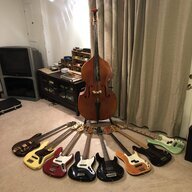
1.) Fully passive instrument do NOT always have comparably low outputs. In a home survey of my instruments, passive and active, one of my active Jazz Basses had SIGNIFICANTLY less output than my passive Jazz Basses (yes, the battery fresh, and electronically fine), and the other newer active Jazz Bass with even TWO 9-volt battery compartments is still slightly less output than those same passive Jazz Basses, and yes, new battery and fine electronics. So NO, active instruments are NOT always hotter output or require the active input when those are available.I started playing regularly and seriously only last year and I played an already fairly modern passive P+J bass (budget brand, early noughties), so I don't have experience with older guitars.
I think these two statements are true:
• Fully passive instruments have comparably low outputs (though significantly higher than they used to have half a century ago). So putting a phantom or battery-powered preamp in the guitar itself makes perfect sense. The signal is hotter, it has more headroom, interference induced noise has less effect on the signal.
• Bass amps used to have two inputs, one for passive instruments, and the other for active ones. The active input simply padded the signal before the onboard preamp. You could achieve the same result by plugging your active instrument in the passive input and turning down gain. The only time when you needed to use the active input was if your bass runs so hot that it overdrives the preamp even with the gain turned way down.
So far, so good. But I bought an active guitar last year and I was surprised by one thing: the volume in passive and active modes is exactly the same. I read that this is common with all modern active guitars. I can tell for a fact that the preamp is in use because active mode won't work if the battery is close to being dead, and tone controls only work in active mode. When tone controls are in the center position, it's impossible to hear the difference between active and passive mode.
Active signal is not hotter than passive. It's possible that the noise floor is lower and you get higher SNR in active mode, but interference induced noise is additive. It doesn't care how much (or how little) noise there was previously. If there's enough interference, it will cause noise.
What gives? The only two advantages I see running the bass in active mode is 1) tone control; 2) impedance matching with badly designed amp input stages. Theoretically, there might be a third advantage that when used in a noise-controlled studio, your bass will have a slightly lower noise floor, but I'm grasping for straws.
What am I missing?
2.) NO, there is generally not the same result of reducing the volume of a hot active bass but running it into the passive input on the amp, because in most bass control circuits I've seen, they are not equipped with a treble bleed circuit, and therefore reducing the volume on the bass pulls a LOT of high end out of the signal/tone. If that is the desired effect and interaction with the instrument and tone you want, that's fine, but NO, approaching the passive circuit that way is not the same, tonally as using the padded active input and the bass volume control all the way up.
You were halfway right about reasons for using an active bass for "1) tone control". Yes, there is tremendous tonal flexibility with an active circuit which I need to deliver VERY different bass tones, show to show, set to set, and song to song. Sometimes it's Motown. Sometimes upright bass emulation. Sometimes it's Marcus Miller slap or Rocco Prestia fingersyle funk. The other part related to that "tone" is that the active electronics encompass a greater frequency range than passive circuits seem to be able to deliver, particularly in the relm of slap bass sound, and those high end frequencies can really add some clarity and detail to playing in ways that pushing more midrange (which is in the realm of some guitar tones and vocals) in a mix is less desirable.
For me, "1) Tone control" is the whole game. It's CRITICAL for what I do. I rarely gig passive basses any more.

On my instruments with high output pickups (like DiMarzio Model PJ and my Seymour Duncan JB on my guitar) 10 vs 20 feet definitely sound noticeable.The impedance matching thing is academically true but probably overthought. Generally we think a guitar cable can be 20 feet long before any loss of high end becomes perceptible in a passive pickup situation. Not sure how many of us use cables longer than 20 feet between bass and amp.
Of course it's not so much the length of the cable as it is the capacitance, so that.probably where the deal difference lies, they are totally different cables.

Brandon Shea
Commercial User
I think some of the "active is louder" myth can be attributed to the extremes of the EQ knobs. Almost all of the less expensive active basses I've tried boost the volume pretty significantly if you crank up the bass. That's obviously not a universal problem, but it's still pretty common.
With EQ knobs at their center detents, volume should either be the same or just slightly boosted in active mode.
With EQ knobs at their center detents, volume should either be the same or just slightly boosted in active mode.

I think it’s a fallacy that active basses are always louder than passives.I started playing regularly and seriously only last year and I played an already fairly modern passive P+J bass (budget brand, early noughties), so I don't have experience with older guitars.
I think these two statements are true:
• Fully passive instruments have comparably low outputs (though significantly higher than they used to have half a century ago). So putting a phantom or battery-powered preamp in the guitar itself makes perfect sense. The signal is hotter, it has more headroom, interference induced noise has less effect on the signal.
• Bass amps used to have two inputs, one for passive instruments, and the other for active ones. The active input simply padded the signal before the onboard preamp. You could achieve the same result by plugging your active instrument in the passive input and turning down gain. The only time when you needed to use the active input was if your bass runs so hot that it overdrives the preamp even with the gain turned way down.
So far, so good. But I bought an active guitar last year and I was surprised by one thing: the volume in passive and active modes is exactly the same. I read that this is common with all modern active guitars. I can tell for a fact that the preamp is in use because active mode won't work if the battery is close to being dead, and tone controls only work in active mode. When tone controls are in the center position, it's impossible to hear the difference between active and passive mode.
Active signal is not hotter than passive. It's possible that the noise floor is lower and you get higher SNR in active mode, but interference induced noise is additive. It doesn't care how much (or how little) noise there was previously. If there's enough interference, it will cause noise.
What gives? The only two advantages I see running the bass in active mode is 1) tone control; 2) impedance matching with badly designed amp input stages. Theoretically, there might be a third advantage that when used in a noise-controlled studio, your bass will have a slightly lower noise floor, but I'm grasping for straws.
What am I missing?
It is unfortunate that many amps’ active inputs are just padded; in reality they should be lower impedance than the passive input.
The benefits of active are lower output impedance that drives long cords better, transducers to amp or other inputs that don’t have particularly high input impedance, and EQ controls at your fingertips.
Drawbacks are some fuzz pedals don’t work with low impedance pickups, and in general it seems that effects have a slightly different character, although I use effects successfully with active basses all the time.

Active basses aren’t necessarily producing higher output with the onboard controls at noon/unity/flat/etc. But if you’ve got one with an active boost EQ and turn up one of the controls, particularly the bass or mid, you’re going to see the output increase, possibly significantly.
For example, the Aguilar OBP3 specs are below. Boosting 18dB at 40 Hz is going to eat up headroom, if all else equal:
For example, the Aguilar OBP3 specs are below. Boosting 18dB at 40 Hz is going to eat up headroom, if all else equal:
- Bass control: plus/minus 18 dB @ 40 Hz
- Mid control: plus/minus 16 dB @ 400Hz or 800 Hz. User selectable frequency center
- Treble control: plus/minus 16 dB @ 6.5 KHz
JazznFunk
Supporting Member
This right here. And the 'active is louder' myth is perpetuated because people get an active bass and think that because it's there, the EQ should be boosted by default, versus using it for small changes when needed. If one is boosting right off the bat, chances are it WILL be louder overall.I think some of the "active is louder" myth can be attributed to the extremes of the EQ knobs. Almost all of the less expensive active basses I've tried boost the volume pretty significantly if you crank up the bass. That's obviously not a universal problem, but it's still pretty common.
With EQ knobs at their center detents, volume should either be the same or just slightly boosted in active mode.

As briefly as possible:
- active preamps allow you to boost and sometimes cut bass/mids/treble (or a combination). Like active tone controls on 90% of modern bass amps. They also buffer the signal, which makes the bass sound more "independent" from what you plug it into (cables, pedals, amps...), with more consistent sound. For this reason, they may also sound a bit brighter even when flat (depending on implementation). Active preamps may also boost volume, but they are usually designed to be unity gain.
- active pickups are wound with many fewer turns of wire, which, for various reasons, makes the pickups sound much more extended in the treble than passive pickups. They need to be active (so with an internal preamp) because otherwise the signal level would be too low for most amps, and anyway, they benefit from having a preamp right next to the coil (less noise).
- conversely, passive pickups usually sound darker and with more colouration in the upper mids due to the presence of a resonant peak. Active pickups sound brighter and "flatter", passive pickups have that classic character.
- with active pickups and/or an active preamp, you can plug into a passive DI, whereas passive pickups need an active DI (otherwise they sound dull).
- active preamps allow you to boost and sometimes cut bass/mids/treble (or a combination). Like active tone controls on 90% of modern bass amps. They also buffer the signal, which makes the bass sound more "independent" from what you plug it into (cables, pedals, amps...), with more consistent sound. For this reason, they may also sound a bit brighter even when flat (depending on implementation). Active preamps may also boost volume, but they are usually designed to be unity gain.
- active pickups are wound with many fewer turns of wire, which, for various reasons, makes the pickups sound much more extended in the treble than passive pickups. They need to be active (so with an internal preamp) because otherwise the signal level would be too low for most amps, and anyway, they benefit from having a preamp right next to the coil (less noise).
- conversely, passive pickups usually sound darker and with more colouration in the upper mids due to the presence of a resonant peak. Active pickups sound brighter and "flatter", passive pickups have that classic character.
- with active pickups and/or an active preamp, you can plug into a passive DI, whereas passive pickups need an active DI (otherwise they sound dull).
D
I started playing regularly and seriously only last year and I played an already fairly modern passive P+J bass (budget brand, early noughties), so I don't have experience with older guitars.
I think these two statements are true:
• Fully passive instruments have comparably low outputs (though significantly higher than they used to have half a century ago). So putting a phantom or battery-powered preamp in the guitar itself makes perfect sense. The signal is hotter, it has more headroom, interference induced noise has less effect on the signal.
Generally yes, but some "hotter" types of passive pickups have an output comparable to active basses.
• Bass amps used to have two inputs, one for passive instruments, and the other for active ones. The active input simply padded the signal before the onboard preamp. You could achieve the same result by plugging your active instrument in the passive input and turning down gain. The only time when you needed to use the active input was if your bass runs so hot that it overdrives the preamp even with the gain turned way down.
This depends on the amp. On some amps the "active" input is just padded, like you said. On vintage tube amps the hi/low inputs usually have a different impedance, which will affect the tone as well as the signal level. On some tube amps the low input even bypasses a tube stage.
So far, so good. But I bought an active guitar last year and I was surprised by one thing: the volume in passive and active modes is exactly the same. I read that this is common with all modern active guitars. I can tell for a fact that the preamp is in use because active mode won't work if the battery is close to being dead, and tone controls only work in active mode. When tone controls are in the center position, it's impossible to hear the difference between active and passive mode.
That's simply because it's designed to be that way. And the reason it's designed that way is because many bass players find this desirable to avoid a huge jump in volume when changing between passive/active. Active eq can shape the tone VERY differently than a passive tone control, so having access to both will made the bass more versatile (provided that the bass actually has a tone control in passive mode, not all active basses do). An active eq can't do what a passive tone control does, and vice versa. But of course, many active basses have a huge volume boost in active mode, which means passive mode becomes more of a "fail safe" mode (for example if the battery goes dead) than something you would use actively during a gig to get different tones.
Active signal is not hotter than passive. It's possible that the noise floor is lower and you get higher SNR in active mode, but interference induced noise is additive. It doesn't care how much (or how little) noise there was previously. If there's enough interference, it will cause noise.
What gives? The only two advantages I see running the bass in active mode is 1) tone control; 2) impedance matching with badly designed amp input stages. Theoretically, there might be a third advantage that when used in a noise-controlled studio, your bass will have a slightly lower noise floor, but I'm grasping for straws.
What am I missing?
I don't think you're missing anything. The boost/cut eq in an active bass is a HUGE advantage for many players who need that type of tones. That alone is a good reason for many bass players to play active basses. Personally I prefer a passive tone controls, so for me there aren't really any advantage with active basses at all. The other things you mention (noise, impedance) are things I've never had any problems with whatsoever when using passive basses.
Last edited:
All of this - nice summary!As briefly as possible:
- active preamps allow you to boost and sometimes cut bass/mids/treble (or a combination). Like active tone controls on 90% of modern bass amps. They also buffer the signal, which makes the bass sound more "independent" from what you plug it into (cables, pedals, amps...), with more consistent sound. For this reason, they may also sound a bit brighter even when flat (depending on implementation). Active preamps may also boost volume, but they are usually designed to be unity gain.
- active pickups are wound with many fewer turns of wire, which, for various reasons, makes the pickups sound much more extended in the treble than passive pickups. They need to be active (so with an internal preamp) because otherwise the signal level would be too low for most amps, and anyway, they benefit from having a preamp right next to the coil (less noise).
- conversely, passive pickups usually sound darker and with more colouration in the upper mids due to the presence of a resonant peak. Active pickups sound brighter and "flatter", passive pickups have that classic character.
- with active pickups and/or an active preamp, you can plug into a passive DI, whereas passive pickups need an active DI (otherwise they sound dull).
Also, with active electronics:
- remembering to keep spare (in date) batteries.
- keep bass unplugging when not in use.
- doing a gig where your tone starts to change, get fantastic and distorting nicely and then gradually quieter over 4 or 5 tunes until you realise… should have replaced the battery.
Apart from being able to boost frequencies using the knobs on the guitar rather than the bass amp/pre amp (not a benefit I’ve every really needed - played an active Warwick for years, a little bass boost on the guitar sounded lovely to me, but adding it on the bass head was just as good), there’s no reason I can think of to hanker after active rather than passive. But the faff of having a battery is a reason to opt for passive if a everything else is equal!
I did all the cable run-length comparisons back in the day, and there’s a difference there but with a decent cable that’s a few meters long, it’s a bit of a nothing-burger.


