
what does going from a 0.047µF tone capacitor to a 0.05 capacitor do to your tone on a passive harness?

Enjoy the benefits of a premium membership!
Upgrade Account
-
TalkBass has been independent since 1998. Add your voice.
Create a free account to reply to discussions, view embedded media, and browse with fewer display ads.
Join free Log in
Want zero display ads or expanded classifieds tools? Compare plans.
You are using an out of date browser. It may not display this or other websites correctly.
You should upgrade or use an alternative browser.
You should upgrade or use an alternative browser.
More options
Who Replied?

Those are likely 10% tolerance, the 47nF could be as high as 51.7nF, and the 50nF could be as low as 45nF.
So, there probably would be zero change, unless the 47nF is really 42.3nF & the 50nF is really 55nF, then maybe you could hear a difference.
So, there probably would be zero change, unless the 47nF is really 42.3nF & the 50nF is really 55nF, then maybe you could hear a difference.

right, those are close enough to be essentially the same.
also, even if they were way different you wouldn't hear it until the tone knob was below like "4" anyway.
also, even if they were way different you wouldn't hear it until the tone knob was below like "4" anyway.


In simplest terms for that type of circuit:
Higher capacitance and/or lower resistance means less highs.
Lower capacitance and/or higher resistance means more highs.
Since you generally won’t use anything smaller than a 250K pot, if you want more rolloff of the highs you install a higher value cap. An .067 or .1 being the most common choices.
If you want a brighter sound (less highs rolled off) you could decrease the capacitor value (an .033 and .022 being two common choices) and/or increase the resistance by replacing your 250K pots with 500K pots.
Higher capacitance and/or lower resistance means less highs.
Lower capacitance and/or higher resistance means more highs.
Since you generally won’t use anything smaller than a 250K pot, if you want more rolloff of the highs you install a higher value cap. An .067 or .1 being the most common choices.
If you want a brighter sound (less highs rolled off) you could decrease the capacitor value (an .033 and .022 being two common choices) and/or increase the resistance by replacing your 250K pots with 500K pots.
Last edited:
In simplest terms if the capacitor is in a standard tone pot, the higher capacitor value you use, the muddier your tone will sound with the tone pot rolled all the way on.
In simplest terms for that type of circuit:
Higher capacitance and/or lower resistance means less highs.
Lower capacitance and/or higher resistance means more highs.
Since you generally won’t use anything smaller than a 250K pot, if you want more rolloff of the highs you install a higher value cap. An .067 or .1 being the mist common choices.
If you want a brighter sound (less highs rolled off) you could decrease the capacitor value (an .033 and .022 being two common choices) and/or increase the resistance by replacing your 250K pits with 500K pots.
In simplest terms if the capacitor is in a standard tone pot, the higher capacitor value you use, the muddier your tone will sound with the tone pot rolled all the way on.
thanks this is just what i wanted to know.

when you turn the tone knob way down, a smaller cap cuts off the highs starting higher up, meaning it leaves more mids in the sound. if you switched between that .05 (or .047) and like a .022, when you rolled the tone way down you'd hear more of a midrange thing still in the sound.so if the difference between them was high enough to hear a difference what does going from one capacitor to another do to your tone?
does it add top end? cut/add mids? make the bass in your tone deeper?
a different frequency sweep?
if you went to a .1, when rolled way down you'd hear less midrange, it would be super-dark sounding and maybe not as loud.
it doesn't affect actual lows either way, just highs (and as the cap gets bigger, mids).

These videos by TB member @RobbieK are informative
Thanks for posting those two vids from RobbieK, Slater. I'd not seen them before. Taught me some good stuff.

Thread could end here IMO ...Those are likely 10% tolerance, the 47nF could be as high as 51.7nF, and the 50nF could be as low as 45nF.
So, there probably would be zero change, unless the 47nF is really 42.3nF & the 50nF is really 55nF, then maybe you could hear a difference.

The cap is used as a leak. The signal you hear doesn't go through it.

I've seen a lot of bass players just take the passive tone pot out. I saw an interview with the bass player from Heart saying, "It removes the pillow." That's a good way to put it. I haven't tried it yet, but I am going to.
You can get 99% of that by just running your bass wide open with all your pots dimed. Removing the tone cap only made a very small difference beyond that when I tried it.
I also disconnected the tone pot/cap and tried it with just a volume control; and then with just the pickup wired straight to the jack since those mods have both been suggested in the past.
FWIW I didn’t care at all for the way any of those modifications sounded. But YMMV. And as long as you’re going to pop the hood and fire up a soldering iron, you might as well give all three a try. Hands-on is everything, right? “DIY or Die!” as the maker space t-shirt says..

Happy exploring!

Last edited:

I use an on/off switch. Either removed from the circuit or full cut.I've seen a lot of bass players just take the passive tone pot out. I saw an interview with the bass player from Heart saying, "It removes the pillow." That's a good way to put it. I haven't tried it yet, but I am going to.

A tone capacitor is a low pass filter.
Low Pass Filter- Explained
If you look at this graph, the red curves in particular, the one farthest to the right is the lowest capacitor value (10nF). The one farthest to the left is the highest capacitor value (47nF). The one on the right cuts later as a function of frequency (the x axis) and lets more higher frequencies in. I hope this helps.
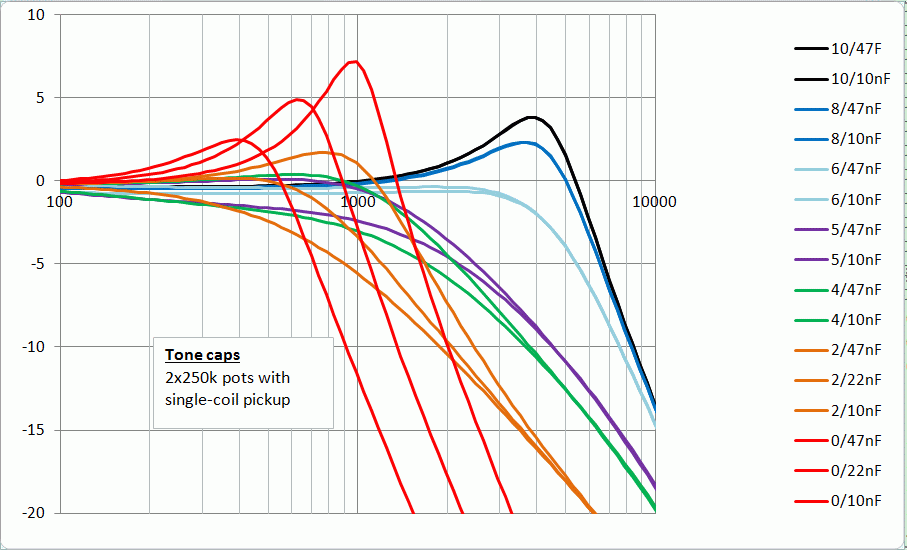
Low Pass Filter- Explained
If you look at this graph, the red curves in particular, the one farthest to the right is the lowest capacitor value (10nF). The one farthest to the left is the highest capacitor value (47nF). The one on the right cuts later as a function of frequency (the x axis) and lets more higher frequencies in. I hope this helps.
Last edited:
An important point in one of the above videos—the cap is irrelevant for most of the pot’s travel. Until the last bit of the rotation, parallel resistance is blunting the highs; at the end of the rotation, the cap determines what frequencies are dumped to ground, and at 0, there’s the bonus of the resonant peak, which is dependent on the LCR values of the rest of the circuit.

I've seen a lot of bass players just take the passive tone pot out. I saw an interview with the bass player from Heart saying, "It removes the pillow." That's a good way to put it. I haven't tried it yet, but I am going to.
I've done that and definitely do not recommend it.
So in a perfect world, a .05 is closer to a .1 than a .047, so that's the direction your tone would head when fully dialed down.when you turn the tone knob way down, a smaller cap cuts off the highs starting higher up, meaning it leaves more mids in the sound. if you switched between that .05 (or .047) and like a .022, when you rolled the tone way down you'd hear more of a midrange thing still in the sound.
if you went to a .1, when rolled way down you'd hear less midrange, it would be super-dark sounding and maybe not as loud.
it doesn't affect actual lows either way, just highs (and as the cap gets bigger, mids).
But as others have mentioned, no one could hear the difference in a .047 vs .05 even if the caps had that exact value.
I put in a .01 tone cap as a test on one of my basses, and when rolled down, it cuts highs, and also cuts a bit of mids. Doesn't cut as much mids as a .047.
The original Precision had a .1, and it cut the highs, and most of the mids.


