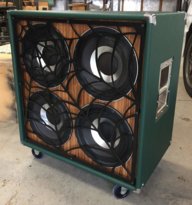
This sounds great!
Cab out of Ext Speaker, and Harmon Kardon Onyx Studio 2 out of Line Output/Phones
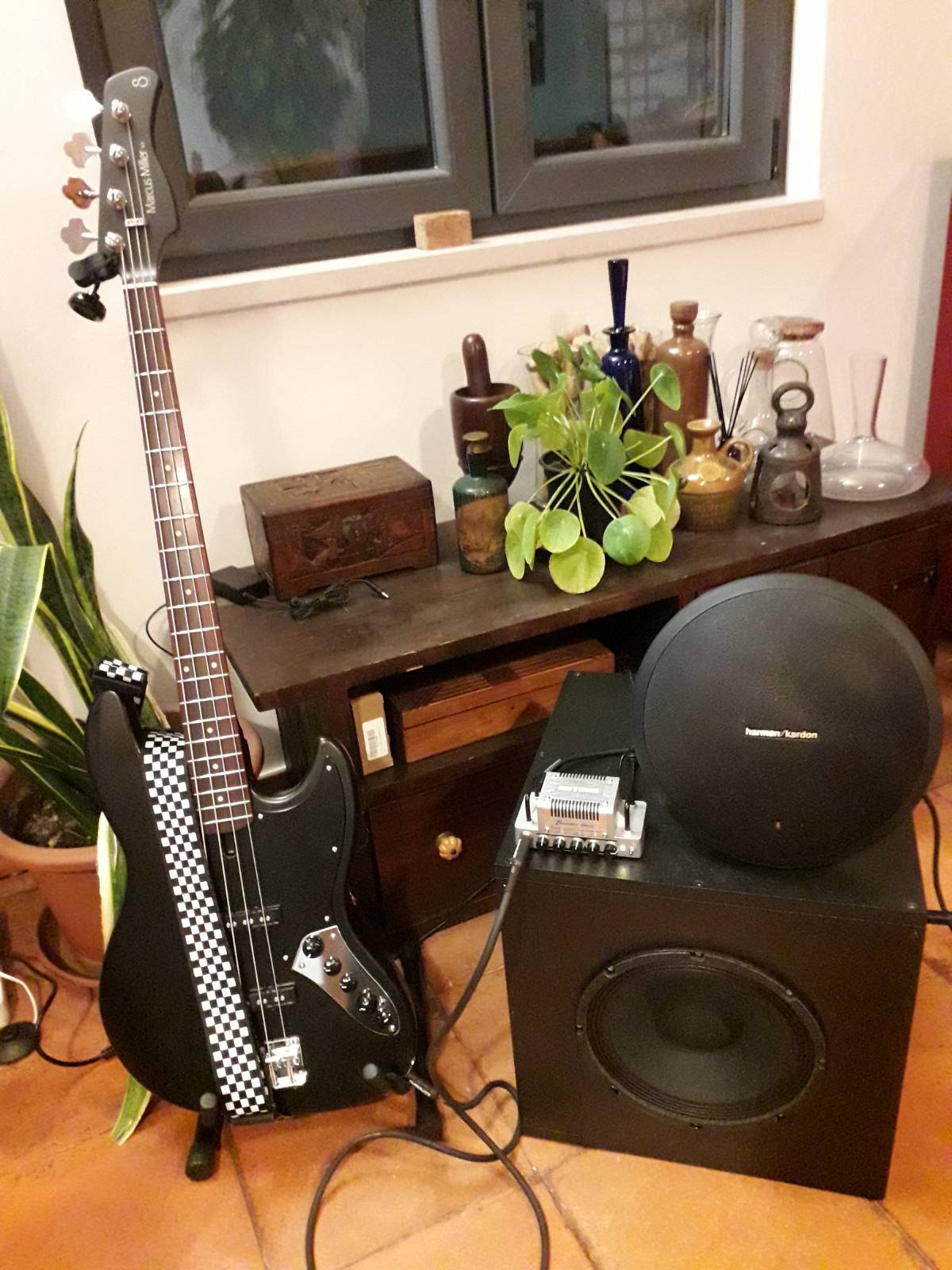
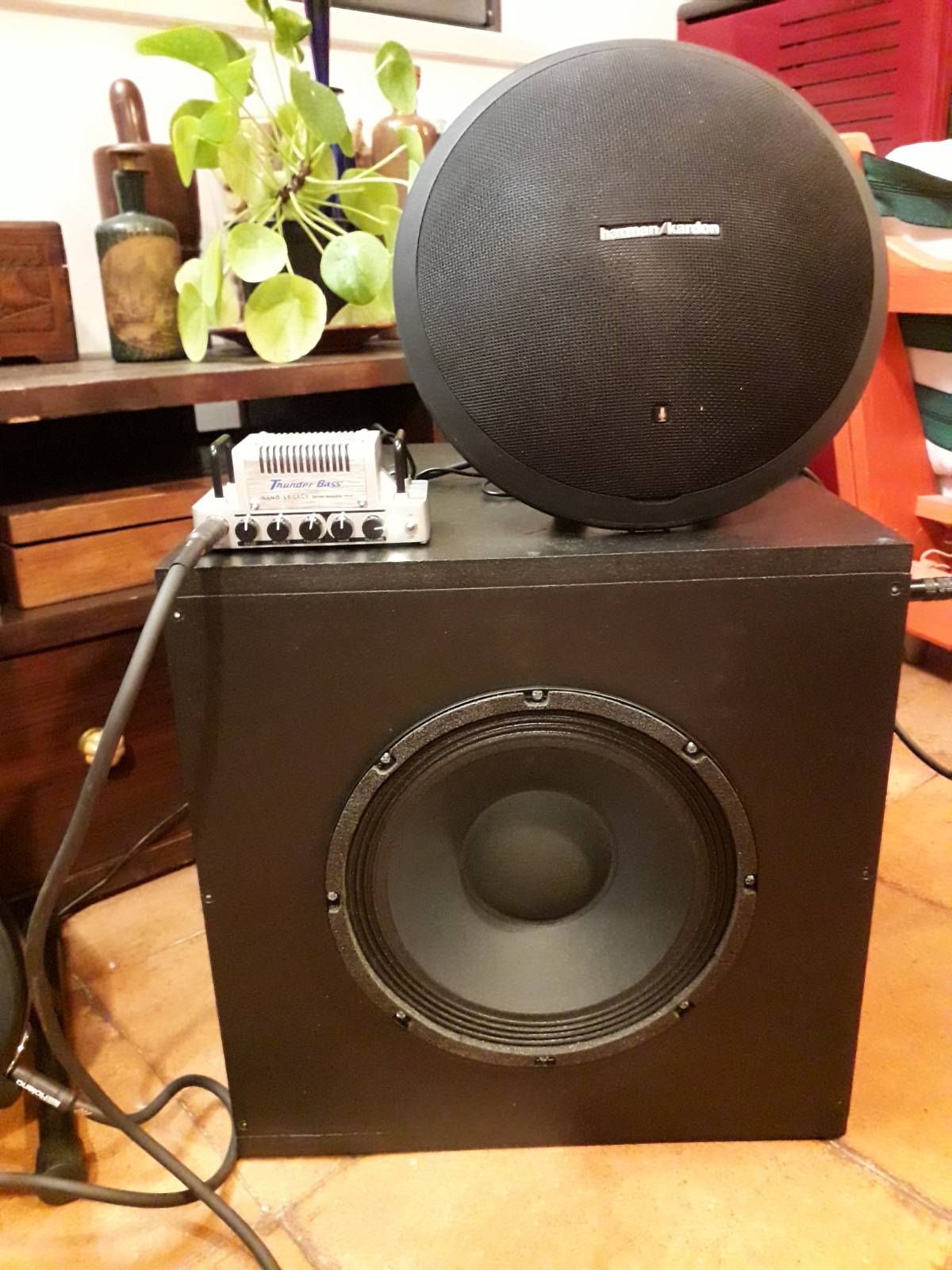
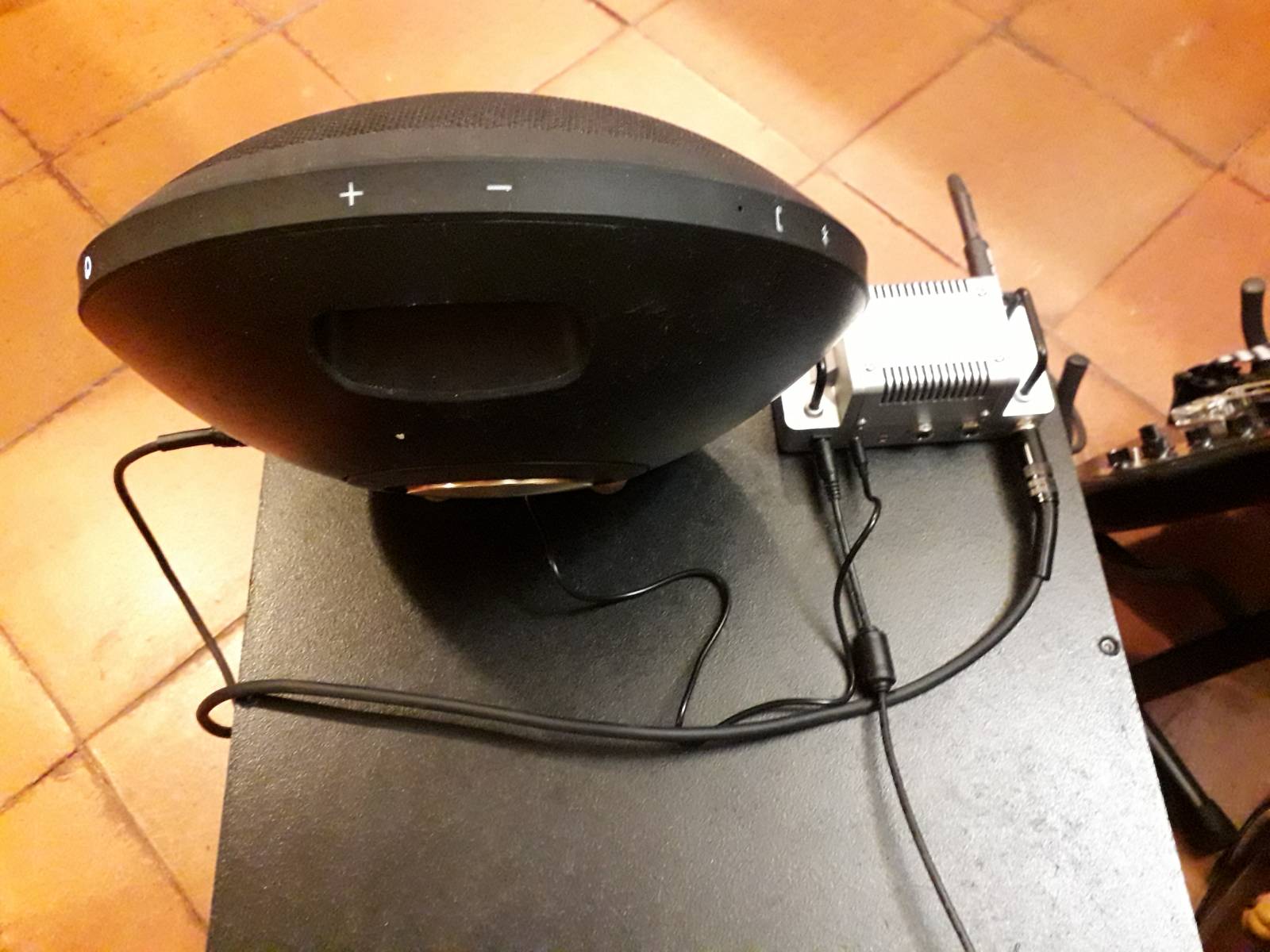
Cab out of Ext Speaker, and Harmon Kardon Onyx Studio 2 out of Line Output/Phones

TalkBass has been independent since 1998. Add your voice.
Create a free account to reply to discussions, view embedded media, and browse with fewer display ads.
Join free Log in
Want zero display ads or expanded classifieds tools? Compare plans.

Thanks! What are the pitfalls? - Pesky impedance?There are proper ways to accomplish the same thing without all the pitfalls:
Link Removed
Thanks!You want what's called an L-pad. If the tweeter is 8ohm, then get an 8ohm 50Watt L-pad. Put the cap in the circuit before the L-pad.

Would the differences in the Transfer function responses between 40 and 50 Hz shown in the plot above actually make a noticeable difference to the sound? And if so, in which way. Perhaps converting quantitative into subjective I guess, but just an indication?Welcome to the forum! I'm a fellow Clash fan and I'm also working (slowly) on a DIY cabinet ... a sealed 2x10 in my case. I'm certainly not an expert in either design or build, but I've learned a lot from some of the resident experts on this forum, a variety of other online resources, and a few of my own mistakes so my comments are well-intentioned, perhaps somewhat useful, and hopefully not completely incorrect! My suggestions assume that you will not be changing the size of the box or the diameter of the port as you've given very valid reasons for those choices.
I've used WinISD for a few years and have become rather familiar with it even though I understand that its results should not entirely be trusted to be accurate. In fact, I've verified this to be the case when I compared the measured tuning frequency of two cabinets to those predicted by WinISD using the same box and port dimensions and found them to be considerably different than the measured frequencies. This doesn't concern me a great deal as I'm building a sealed cabinet, but I still like to check its results against something else. So, I recently began using a free online calculator at Speaker Box Lite and I've based my comments on those results.
The tuning frequency of almost 62 Hz seems quite high and both WinISD and Speaker Box Lite (SBL) show that it results in a very large peak (about 6 dB) around 75 to 80 Hz. This would certainly be quite noticeable and likely difficult to work around with typical eq controls. I'd suggest a much lower tuning frequency and I've attached two plots from SBL showing the effect of lower tuning frequencies on the frequency response and the port air velocity. It looks like lowering the tuning frequency will reduce the sharp peaking, extend the low end response, and slightly reduce the port air velocity. Although your specific Celestion driver is not available in the SBL database, you can simply select another model and then alter its parameters to those published by Celestion for the Pulse XL 10.20.
View attachment 6996325
As for the build of the cabinet, I tried cutting the baffle hole with a jigsaw at first and was not happy with my result. Your result may be quite different than mine as this is entirely dependent on the skill (and patience) of the operator. I ended up remaking the baffle and used a 230 mm hole saw that I bought online. It's not a great quality cutting tool, and will likely never be used again, but working slowly in a drill press and cutting from both sides of the board, it produced a much nicer opening than I was able to with the jigsaw. I also installed threaded inserts for the mounting holes which I marked, drilled, and installed prior to cutting the large driver hole as they come rather close to the edge of the cutout and I was concerned that they might break through during installation.
As for the polarity convention, I believe the tip is typically connected to positive.
My only other comment is that, based on Celestion's published frequency response graph, this driver does will not have a lot of top-end extension and this may result in a rather dark-sounding cabinet. But since you already have the driver, give it a try and see how you like it. Best of luck and enjoy the journey!
YupThanks!
Something like this?
L-Pad Attenuator 1" Shaft 8 Ohm
Explore L-Pad Attenuator 1" Shaft 8 Ohm. Check the main specifications and product details to see whether it fits your audio project at SoundImports.www.soundimports.eu
Thanks, you have been really helpful!!


Based on my limited experience with a few different ported combo amps, I found that the ones with higher tuning frequencies (around 55 to 60 Hz) sounded less defined in the lows (from low E to A). On two combos that had multiple ports, I tried closing one port and found that I preferred the sound. To me, it sounded more defined, tighter in the very lowest notes. Cutting the port area in half has the effect of reducing the tuning frequency by a factor of 1.4, so this would have reduced their tuning frequencies to somewhere around 40 Hz. Being aware that this "experimentation" had the potential to affect the cone excursion, I always kept the volume home-friendly so I have no idea whether my subjective results would have been the same had I repeated this at higher volumes. If you're OK with shortening the pipe to try different tuning frequencies, I definitely suggest trying it to see what you actually prefer. One difficulty you might have though is accurately assessing the difference in sound (for me it was fairly subtle, perhaps due to the low volume I played at) since there is likely to be significant time between the various trials. I was able to simply insert a small, round plastic container with a few turns of vinyl tape around it into the port, so I could very quickly change between one port and two.Would the differences in the Transfer function responses between 40 and 50 Hz shown in the plot above actually make a noticeable difference to the sound? And if so, in which way. Perhaps converting quantitative into subjective I guess, but just an indication?
I could alter the cab tuning by shortening the pipe from 136 to 89 or even 56 mm to increase the Fb from 40 to 45 or even to 50 Hz.
That is my understanding as well.Presumably the cab Fb has nothing to do with the speaker parameters except for the volume it takes up? SubBox Pro seems to very accurately predict Fb (for me, predicted 40 Hz, rice test ~ 40.5 Hz) and there is no other input of driver parameters in subbox pro except for size and volume.
Exactly.Also, @Dino Boreanaz , when you say, 'does will not have a lot of top-end extension', do you mean above around 2 kHz, and hence addition of a tweeter could 'remedy' this?


Thanks David!Probably wise re the re-tuning, unless you're just an inveterate tinkerer
A quick & dirty sim (ie I use WinISD cos it's easy, albeit not the most accurate program) shows the 45Hz tune would have a little less level at the deepest frequencies, and ~1/2 to 1dB more in the 50-150Hz region.
If you had the chance to A-B those back to back you'd hear it, but it would still be fairly subtle.
Without a direct A-B comparison, it'd be even harder to tell the difference.
View attachment 7007004
Re the Markass, the odds are the speaker in the original combo was the limiting factor in how deep it might have reached, rather than the head.
Given how deep the PulseXL is reaching in these sims, I don't think you'll find it lacking in depth.
HTH,
David.
@6thplanet - Just to be sure, by 'Put the cap in the circuit before the L-pad.' you mean to just replace my amateur arrangements of resistances in the figure below with the L-Pad, so cap is between tweeter and L-Pad? (I wont put the switch in the diagram in)You want what's called an L-pad. If the tweeter is 8ohm, then get an 8ohm 50Watt L-pad. Put the cap in the circuit before the L-pad.
Great, Thanks, extremely clearly explained and a great help!Nope; 6thplanet is advising to stick with the conventional layout of input>cap>L-pad>tweeter.
This accomplishes two things: 1; it shields the L-pad from much of the (potential) power output of the amp, allowing the use of an L-pad with lower total power rating and 2: by putting resistance in between the cap and tweeter we get less variation in impedance w.r.t. frequency as seen by the cap, so the actual shape of the roll-off created by the cap becomes closer to the theoretical target.
Herewith 1uF (red), 2uF (green) & 3uF (blue):
I adjusted the L-pad values (shown as the 2 resistors in the schematic view) to keep the levels roughly equal at the top end of the response, with all of them padded down to approximately the level of your 10".
View attachment 7007033