
Then it's a misappropriated term vis the classic definition. Speak to any EE (eg me) and mention a component is a 'choke' and they're going to assume an inductor.but the part in question is a capacitor.

Enjoy the benefits of a premium membership!
Upgrade Account
-
TalkBass has been independent since 1998. Add your voice.
Create a free account to reply to discussions, view embedded media, and browse with fewer display ads.
Join free Log in
Want zero display ads or expanded classifieds tools? Compare plans.
You are using an out of date browser. It may not display this or other websites correctly.
You should upgrade or use an alternative browser.
You should upgrade or use an alternative browser.
Change a pickup's resonant frequency and tone with a loading capacitor
- Thread starter fermata
- Start date
More options
Who Replied?
Then it's a misappropriated term vis the classic definition. Speak to any EE (eg me) and mention a component is a 'choke' and they're going to assume an inductor.
I am a EE, and yes a choke is an inductor - my pint is that the part in a Rickenbacker that takes the low end out of the bridge pickup’s signal is a capacitor.
I'm well aware of that. My point to LIGT was that though Ric misuse the term, it's in no way trademarked or proprietary and can be used with impunity in electronics terms.my pint is that the part in a Rickenbacker that takes the low end out of the bridge pickup’s signal is a capacitor.
Its interesting that you mention this, because in my other jazz basses, i do use .0068, based on similar calculations. Works great! I'll refrain from calling it a choke then, Fender called bass cut a 'choke' on the Bass VI literature. But the effect is as desired, cutting lows. The .0047 or .0068 may get you in the Rick neighbourhood, but i was going for less low cut on purpose. I wanted to find the value that was barely noticed when soloing a pickup, but noticeable when the pickups are blended. .022uf was the right value for me.@vinnydbass, it's an underappreciated idea for other two-pickup basses, especially for those who like Ric tones. Minor point: better not call it a "choke" as that word is already taken!
[For someone who *does* want to approximate the effect of the Ric bass blocking cap (I don't know the real inductance numbers so these are approximate):
If I'm not mistaken, you'd want to keep the product LC the same (the inductance of the pickup x the capacitance of the bass blocking cap). So if the Ric bass blocking cap is .0047uF and the inductance of the Ric bridge pickup is 4H (measured at, say, 1kHz), and the J bridge pickup is 2.8H @ 1kHz, then the cap you would use on the J to approximate the same effect would be about .0047 * 4/2.8 = about .0068. Someone please correct me if I'm wrong.]

Using a .033uf on the neck pickup removes such a small amount of low end, but makes my bass cut when the neck pickup can be too boomy. I find this setup useful on a PJ because the alternative would be a series/parallel switch in the P pickup, which to me doesn't sound great in parallel. I've done this mod to two PJ's and a Yamaha BB414, the results are great.
I put my caps on switches, so stock tones are still available. I can post a video to show what I've got in some of my basses where caps are concerned.
PS: im not electronic engineer, can someone explain why choke is the term used for inductor? I associate the term with engines and fuel.
Last edited:

It could be thought of as a restriction, like a choke on a carburetor.
It's a bit old-fashioned, like saying "condenser" instead of capacitor.
Threw me off for about three seconds. No big deal.
It's a bit old-fashioned, like saying "condenser" instead of capacitor.
Threw me off for about three seconds. No big deal.
Last edited:

I still don't see the difference between a "loading cap" and a regular cap mounted on the tone pot. At least for properly isolated VBT control schemes.
Anyway, I recently switched to 80nF on my fretless jazz and the low mid boost is incredible. I also changed tone pot to A50K-noload which gives proper control over the capacitive loading, instead of it being on/off like on 250k pots.
Anyway, I recently switched to 80nF on my fretless jazz and the low mid boost is incredible. I also changed tone pot to A50K-noload which gives proper control over the capacitive loading, instead of it being on/off like on 250k pots.
I still don't see the difference between a "loading cap" and a regular cap mounted on the tone pot. At least for properly isolated VBT control schemes.
They're put in different places in the circuit. A loading cap is put directly across the pickup, and is usually a fairly low value (though it doesn't have to be). The tone capacitor has a variable resistor (the tone pot) in series with it. At max on the tone pot, the value of the loading capacitor will change your sound quite a bit. At that same setting, changing the value of the tone capacitor within a HUGE range won't produce audible differences. At min on the tone control, assuming the tone cap is a much larger value, the tone cap's value will determine how things sound.
Last edited:
A tone cap on a tone pot sends the high frequencies to ground, thus darkening the tone. This parallel wiring can also be used with smaller value caps to create a mid 'bump', around the 300Hz area on a bass. If one used regular tone cap values, your loading cap would sound like a regular tone cap. Its the value that matters.I still don't see the difference between a "loading cap" and a regular cap mounted on the tone pot. At least for properly isolated VBT control schemes.
Anyway, I recently switched to 80nF on my fretless jazz and the low mid boost is incredible. I also changed tone pot to A50K-noload which gives proper control over the capacitive loading, instead of it being on/off like on 250k pots.
A capacitor wired in series to the pickup will remove low end from the signal. Smaller values than regular tone caps are usually used for this purpose. Example: 0.0047uf
Different wirings and values, different goals and results.
Last edited:

I still don't see the difference between a "loading cap" and a regular cap mounted on the tone pot. At least for properly isolated VBT control schemes.
...
They're put in different places in the circuit. A loading cap is put directly across the pickup,
...
Once the tone control is fully backed off there is no difference - high frequencies are shorted to ground through a capacitor wired directly across the pickup. The differences, such as they are, are in operating frequency and permanence, i.e. always 'on' vs variable. It is the same circuit exploiting the same electrical behaviours just with values adjusted to meet a different objective - see this from @vinnydbass post above:
Its the value that matters.
All other things being equal, smaller caps will operate at a higher frequency than the larger ones more typical of traditional tone controls. Put a smaller cap in a standard tone circuit and back the knob right off and the effect is the same. Same function, just a different operating point (cutoff frequency). Go even smaller and the resonance moves up into the upper mid-range for some really interesting and useful tones.
OK, one more way to think of loading capacitors:
If you measure the impedance of a pickup over all frequencies, and build models from that, you discover that a pickup has (among other things) inductance and capacitance - the capacitance depends on how it’s wound. Put that in a bass, and the sound of the pickup is dominated by the fact that that inductance resonates with the winding capacitance and the capacitance of your cable. OK, so what?
If you wire the pickup in parallel, the inductance goes down by a factor of 4. If it weren’t for the winding part of the capacitive load, the resonance would move up an octave. It doesn’t quite go that far - the winding capacitance goes up in parallel. But it still goes up.
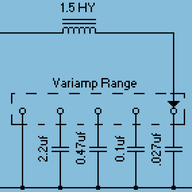
Anyway, from that starting point, a loading capacitor gives you control over the resonant peak - you can tune it to anything you want as long as where you want to go is less thin sounding - it can be brighter than it would be in series, it can be the same, it could even be less bright - it’s all in the choice of the capacitor value. Want a few tones available? A switch and a few capacitors, and you’re there.
If you measure the impedance of a pickup over all frequencies, and build models from that, you discover that a pickup has (among other things) inductance and capacitance - the capacitance depends on how it’s wound. Put that in a bass, and the sound of the pickup is dominated by the fact that that inductance resonates with the winding capacitance and the capacitance of your cable. OK, so what?
If you wire the pickup in parallel, the inductance goes down by a factor of 4. If it weren’t for the winding part of the capacitive load, the resonance would move up an octave. It doesn’t quite go that far - the winding capacitance goes up in parallel. But it still goes up.
Anyway, from that starting point, a loading capacitor gives you control over the resonant peak - you can tune it to anything you want as long as where you want to go is less thin sounding - it can be brighter than it would be in series, it can be the same, it could even be less bright - it’s all in the choice of the capacitor value. Want a few tones available? A switch and a few capacitors, and you’re there.
When I wired up a series/parallel switch on an 3PDT switch, I wired the output from the controls to the 3rd switch terminal, with a resistor engaging at the same time as the series mode. This was to match the volumes between parallel and series. I also used a .0039uf cap in parallel to the resistor, which brought back the highs usually missing in series mode. Also, if the resistor is placed before the tone knob, the tone knob will reduce output when darkened (in series).OK, one more way to think of loading capacitors:
If you measure the impedance of a pickup over all frequencies, and build models from that, you discover that a pickup has (among other things) inductance and capacitance - the capacitance depends on how it’s wound. Put that in a bass, and the sound of the pickup is dominated by the fact that that inductance resonates with the winding capacitance and the capacitance of your cable. OK, so what?
If you wire the pickup in parallel, the inductance goes down by a factor of 4. If it weren’t for the winding part of the capacitive load, the resonance would move up an octave. It doesn’t quite go that far - the winding capacitance goes up in parallel. But it still goes up.
Anyway, from that starting point, a loading capacitor gives you control over the resonant peak - you can tune it to anything you want as long as where you want to go is less thin sounding - it can be brighter than it would be in series, it can be the same, it could even be less bright - it’s all in the choice of the capacitor value. Want a few tones available? A switch and a few capacitors, and you’re there.
The practical effect is that in series mode, the low end comes out of the bass much more easily without having to dig in too hard, but the highs you would hear in parallel still present.
Again, im no electrical engineer, but this scheme worked perfectly. I've seen other series/parallel volume matching wiring, but they usually use two matching resistors to reduce the series volume. But when I look at those diagrams, at least one resistor seems always active. My wiring uses one resistor only engaged during series mode and only affecting the total output. Volume and tone controls work just fine in either parallel or series.
Last edited:
When I wired up a series/parallel switch on an 3PDT switch, I wired the output to the 3rd switch terminal, with a resistor engaging at the same time as the series mode. The resistor went to the output jack. This was to match the volumes between parallel and series. I also used a .0039uf cap in parallel to the resistor, which brought back the highs usually missing in series mode.
I'd have to see the exact circuit you're talking about to understand exactly what the effect is of that - you can't really match "level" with a resistor in a passive circuit around a pickup - the pickup is so reactive that whatever you do, it's going to be frequency dependent - you've made a filter of some sort, unless you're using the input impedance of the amp as part of your attenuator - there would be noise implications if you do that, as well as all kinds of potential level issues if you use a pedalboard. If you like the result, then the discussion is moot from your viewpoint.
I find it easier to wire things in parallel, and then have a capacitor selection that gets me to the "series" sound when I want it - the low end of both modes in that kind of circuit is identical (which the FOH person loves), the sound in the "series" mode is exactly what you would get from a series connection, and I can get different characters without changing level.
Basically what i did is use a 3pdt switch as two switches in one. You can wire up a series/parallel switch on a dpdt switch, so I simply wired two of the terminals like a series/parallel switch. The 3rd terminal simply introduces a resistor to the 'hot' going to the output jack. The resistor is only engaged during series mode. I dont remember which value resistor, but I just experimented until I was satisfied. It's not exactly level matched, but its really close, and I did this because of my use of pedals! Consistent output level helps maintain control and pedal friendliness. Haha.I'd have to see the exact circuit you're talking about to understand exactly what the effect is of that - you can't really match "level" with a resistor in a passive circuit around a pickup - the pickup is so reactive that whatever you do, it's going to be frequency dependent - you've made a filter of some sort, unless you're using the input impedance of the amp as part of your attenuator - there would be noise implications if you do that, as well as all kinds of potential level issues if you use a pedalboard. If you like the result, then the discussion is moot from your viewpoint.
I find it easier to wire things in parallel, and then have a capacitor selection that gets me to the "series" sound when I want it - the low end of both modes in that kind of circuit is identical (which the FOH person loves), the sound in the "series" mode is exactly what you would get from a series connection, and I can get different characters without changing level.
There still is tonal difference. In series, the mids and lows have a certain 'woody' quality in a jazz bass. But I used to think series mode was a bit too dark. Hence the treble bleed thing I tried.
In some instances, when playing over one of the pickups, the character of that one pickup comes to the fore or into focus when in series mode, even though the sound is the blended pickups, just my own observation. Like you can switch pickups just by moving your plucking hand, kind of.
So mathematically, or technically it may be weird, but I'm going by ear and feel here.
Speaking to your series tone from loading caps, I have done similar installations as well with cool results. I usually just just find one cap value that I like, however. For instance .0033uf on a jazz bass's output has this dirty funkiness that i love. I'm not sure which value would get me that exact series tone. After messing with a few values, anything of bigger value just sounded like a position on a standard tone knob, and the darkness is not necessarily the part of series tone that I like. Series just sounds stronger and more focused, even without being louder.
Last edited:
What is it now? Wired in series or in parallel to the pickup?A capacitor wired in series to the pickup will remove low end from the signal. Smaller values than regular tone caps are usually used for this purpose. Example: 0.0047uf

A loading capacitor (like a tone capacitor) is wired in parallel with the pickup since one end is going to ground and one end to hot. In fact “loading capacitor” implies a path from hot to ground (definition of “load” in this case).What is it now? Wired in series or in parallel to the pickup?
A bass-cut capacitor like @vinnydbass is describing is in series with the pickup, as the path to ground from the capacitor only happens through the pickup coil.
What he said @vin97A loading capacitor (like a tone capacitor) is wired in parallel with the pickup since one end is going to ground and one end to hot. In fact “loading capacitor” implies a path from hot to ground (definition of “load” in this case).
A bass-cut capacitor like @vinnydbass is describing is in series with the pickup, as the path to ground from the capacitor only happens through the pickup coil.
Most of this still doesn't make smuch sense.
I am fairly certain a lot of your observations will vanish once tested through a transparent headphone amp.
I recently experimented with many different caps as well and none of these tiny values you guys are talking about change the pickup character in any fundamental way except for rolling off treble.
@vinnydbass Next time you do a series attenuator, add a parallel resistor to ground to form an L-pad. This will minimize the tone loss you experienced due to the impedance increase from the series resistor and you can precisely calculate how many dB will be cut independent of an amp's input impedance.
I am fairly certain a lot of your observations will vanish once tested through a transparent headphone amp.
I recently experimented with many different caps as well and none of these tiny values you guys are talking about change the pickup character in any fundamental way except for rolling off treble.
@vinnydbass Next time you do a series attenuator, add a parallel resistor to ground to form an L-pad. This will minimize the tone loss you experienced due to the impedance increase from the series resistor and you can precisely calculate how many dB will be cut independent of an amp's input impedance.
Most of this still doesn't make smuch sense.
I am fairly certain a lot of your observations will vanish once tested through a transparent headphone amp.
I recently experimented with many different caps as well and none of these tiny values you guys are talking about change the pickup character in any fundamental way except for rolling off treble.
Changing a loading capacitor's value does change where the pickup's rolloff starts, but just below that, there is a resonance where the inductance and the accumulated capacitance resonates. This is not some fictitious thing - it's very real. I designed pro audio gear for my entire career, I know about these things, I have characterizations of pickup impedances, models built from them, simulations galore that show what's going on, and have measured all this stuff. I have basses wired with these circuits, and the resonance effects are very audible. It may not make sense to you, but it exists, and is quite real.
For sure it changes the circuit, just not in a frequency range that is relevant for a bass pickup unless you play piccolo strings.
The things we're talking about are up in frequency - in the overtones of the string's movement. If you ever heard a bass with magnetic pickups that didn't roll off the high frequencies that strings produce (trust me, you haven't) you'd be shocked by how harsh a string sounds without some filtering. The sound of your instrument is definitely altered by changing what goes on well above the intended note that you're playing.
A piccolo bass moves things up an octave. The highest note on a 4 string bass is (if it has 24 frets) about 400 Hz, On a piccolo, that would be 800 Hz. What happens at 2 kHz is definitely overtones, but it's still a very big part of the sound.


