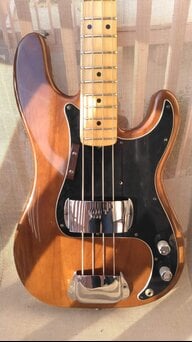
The two posts below by @micguy are so fabulous, I'm popping them into a new thread, in hopes that they can more easily be discovered.
For context, the pickup(s) and related components form LCR circuits, which means changing any of those parameters (inductance, capacitance, or resistance) in a passive bass changes the instrument's tone. A dramatic change comes from adding more capacitance to the circuit, and it's very easy to accomplish (just add a capacitor between the pickup hot lead, where it connects to the volume pot, and ground).
Basically, with an inexpensive capacitor and a few minutes of soldering, one can accomplish tonal changes akin to swapping pickups or wiring (and it can be made switchable). The concept only surfaces from time to time in this forum, but it's so easy, cheap, and effective, that it deserves to be a go-to when talking about pickup/tone mods.
One more note, it's easy to test out different capacitor values without popping the hood (keep the volume and tone controls at 10): unscrew the barrel of the instrument cable where it plugs into the bass; attach one alligator clip lead to the cable's hot tab; attach another clip lead to the ground tab; clip a capacitor between the free ends of the clip leads to hear how it affects the tone; try different values and then hardwire in the one you like.
For context, the pickup(s) and related components form LCR circuits, which means changing any of those parameters (inductance, capacitance, or resistance) in a passive bass changes the instrument's tone. A dramatic change comes from adding more capacitance to the circuit, and it's very easy to accomplish (just add a capacitor between the pickup hot lead, where it connects to the volume pot, and ground).
Basically, with an inexpensive capacitor and a few minutes of soldering, one can accomplish tonal changes akin to swapping pickups or wiring (and it can be made switchable). The concept only surfaces from time to time in this forum, but it's so easy, cheap, and effective, that it deserves to be a go-to when talking about pickup/tone mods.
One more note, it's easy to test out different capacitor values without popping the hood (keep the volume and tone controls at 10): unscrew the barrel of the instrument cable where it plugs into the bass; attach one alligator clip lead to the cable's hot tab; attach another clip lead to the ground tab; clip a capacitor between the free ends of the clip leads to hear how it affects the tone; try different values and then hardwire in the one you like.
OK, a suggestion. You want to have different sounds in your bass (why you have series and parallel connections), but you don't like the volume jump, and you're trying to haul down the output in that mode (which will change the sound quite a bit, and not for the better).
The reason the series mode of your bass sounds different is that the high frequency resonance of the pickup's inductance with the cable capacitance goes down in frequency the pickup (since it has a higher impedance in series mode) is loaded more by the cable, so it sounds different. There is another way to achieve the "series" sound, and completely avoid the volume jump: load the pickup capacitively.
I do thing kind of thing in my basses all the time, and it works very well - multiple sounds, all with the same level. If you like the sound of your bass in both modes, all you need to do is, instead of switching the pickup from parallel to series, use a switch to add a capacitor to the circuit, but leave the bass wired parallel. Since the impedance of your pickup goes up by a factor of 4 when you put it in series, what you need to do is increase the capacitive load by a factor of 4.
Most cables (though there is a lot of variation) have somewhere in the neighborhood of 600 picofarads. You want 4 times that much, you need 2400 picofarads total. 2400 minus 600 (what's already there) means an 1800 picofarad capacitor will do the trick. You connect that capacitor from the top of the volume control (the lug where the pickup hooks up) to ground (the back of the volume pot), but with a switch in the top leg - between the pickup and the capacitor, so you can put it in and out of the circuit.
The only other thing you need to know is that switching a capacitor in and out of the circuit, you can get a little pop when switching - a high value resistor across the capacitor will keep the capacitor from staring charge, so you get silent switching.
The pickup coils, when put in series, add their inductance. In parallel, their inductance is halved by the combination. A pickup by itself does have a resonant frequency (because the coils do have some interwinding capacitance), but that's very much a "tree falling the forest, nobody there to hear it" thing - when loaded by a cable, the resonant frequency is lowered much more than in the theoretical case where....you can't hear it, because you haven't hooked it up to anything.
Rolling back a tone control a "smidge" damps the resonant peak - it lowers its amplitude a bit - you lose some upper mids - say at 2 kHz or so. Above and below that, it does essentially nothing to the response - if the pickup has too much 10kHz, and you roll off the tone a bit, it still does the SAME thing at 10 kHz, even with the tone rolled back a bit. Loading the pickup capacitively MOVES the resonant peak (downwards) in frequency, not in amplitude. In doing that, you increase the lower mids below resonance some, and you lower the high frequencies above the peak - it can be a considerable amount, depending on the values of the pickup and load capacitor. Quadrupling the load capacitor will lower the treble stuff above resonance by 6dB, and move the peak down about an octave (the aforementioned interwinding capacitance makes the math not exact).
A lot of people don't really understand what a tone control on a passive bass does. It's a very common misconception that "it just turns down the treble". That's kinda true, but there is a lot of nuance that that statement misses.
Last edited: