• TalkBass has been independent since 1998. Add your voice.
    Create a free account to reply to discussions, view embedded media, and browse with fewer display ads.
    Join freeLog in
    Want zero display ads or expanded classifieds tools? Compare plans.

Change a pickup's resonant frequency and tone with a loading capacitor

If you have pickups that resonate even unloaded at 8 kHz, that's pretty unusual. Then again, some of the Squier stuff is wound with thicker gauge wire and fewer turns (lessens the chance of breaking the wire, allows them to wind very fast). I know a kid with an Affinity Strat, and I went in and loaded those pickups with loading caps and shorting coils (oops - another secret out of the bag). It went from a strident, thin sounding guitar to a very nice strat tone with about $2 in parts.
Spill the beans, man.
This thread has become one of the more interesting ones in a while.
 
Spill the beans, man.
This thread has become one of the more interesting ones in a while.

Eddy current losses (they happen in the magnetic circuit) are something you can’t control with electrical parts. But you can add some by making shorted turns around the coil. Same phenomenon you get from metal pickup covers on a Les Paul or a Tele neck pickup. If your pickup is too “ice picky” sounding, part of the solution is adding some of this.

My experience designing phonograph cartridges (I’ve been around a while) was valuable in understanding this.
 
To reduce "ice pick", to dump highs, I would naturally think of a capacitor; I wonder how eddy current losses sound compared to trying to do the same with a loading capacitor?

Ah, I also wonder how adding eddy current losses compares in sound to adding an inductor in series.

Adding inductance or capacitance moves the resonant peak to the left in the curve (lower in frequency), and the rolloff above that (which has a 12 dB per octave slope) moves with it. Adding capacitance, in addition lowering the resonant frequency, has the effect of raising that resonant peak in amplitude (but only marginally).

Eddy current losses give you an oddball thing - not available from resistors, capacitors, or inductors - a 3 dB per octave rolloff. Yes that's weird. But they also act differently around the resonant peak - they lower that peak somewhat in amplitude - they're a damper on that.
 
Thank you. I'm pretty certain that I've always strongly disliked that upper peak (on 6-string guitars too). So, makes sense.

You're welcome. That peak, as it increases in amplitude, sounds better and better, until...it's suddenly too much. And different people have different sensitivities to it. Hope you get yours just where you want it.
 
I've re-read the thread, and it might help to consider the topic as changing the resonance of the system rather than the pickup, which of course cannot be changed. And a pickup in isolation and with no stimulus cannot resonate, any more than the capacitors connected across them. It is the circuit, or system, that is resonant.

YMMV, IMHO, etc...
 
I've re-read the thread, and it might help to consider the topic as changing the resonance of the system rather than the pickup, which of course cannot be changed. And a pickup in isolation and with no stimulus cannot resonate, any more than the capacitors connected across them. It is the circuit, or system, that is resonant.

YMMV, IMHO, etc...

A pickup by itself has inductance and capacitance - it is, by itself, a circuit. The coil is always listening to magnetic fields (which are always around us at some level), so it always has stimulus. While the pickup as part of a circuit does resonate at a different frequency, on its own it absolutely does resonate. It’s a passive device, it doesn’t turn off if not powered; it’s always on.
 
Great thread, thanks to everyone for their contributions! Though I haven't fully digested it yet and I'm no electronics wiz, I understand what we're trying to do.
Would it be possible to put separate switched loading caps on each pickup in a typical VVT jazz bass? Each with it's own switch, giving you a whole bunch of different tonal combinations when the pickups are blended?
 
  • Like
Reactions: Das Jugghead
Great thread, thanks to everyone for their contributions! Though I haven't fully digested it yet and I'm no electronics wiz, I understand what we're trying to do.
Would it be possible to put separate switched loading caps on each pickup in a typical VVT jazz bass? Each with it's own switch, giving you a whole bunch of different tonal combinations when the pickups are blended?

Yes, but you would need to isolate the pickups from each other, either by backing off the volumes a tad or installing summing resistors as in the original stack-knob jazz bass.
 
Yes, but you would need to isolate the pickups from each other, either by backing off the volumes a tad or installing summing resistors as in the original stack-knob jazz bass.
Thanks, I've always been curious about that stack-knob wiring scheme. But I don't play my Jazz bass enough to really justify monkeying with it right now. I'm more of a P bass guy to start with, and I guess I get what I need from a standard Jazz wiring when I decide to use it.

I do have a series-parallel switch in my jazz, but I use it more to get the extra volume push from it, rather than for the change in tone. If anything I want that series boost but to retain more high end. Not necessarily losing the high end but maintaining the volume (as was discussed on the first page),
 
Great thread, thanks to everyone for their contributions! Though I haven't fully digested it yet and I'm no electronics wiz, I understand what we're trying to do.
Would it be possible to put separate switched loading caps on each pickup in a typical VVT jazz bass? Each with it's own switch, giving you a whole bunch of different tonal combinations when the pickups are blended?

This works well if you have a pickup switch - not a VVT circuit. There are several reasons I like switches more than VVT circuits, this is one of them.
 
  • Like
Reactions: 11-11 and NKBassman
I do have a series-parallel switch in my jazz, but I use it more to get the extra volume push from it, rather than for the change in tone. If anything I want that series boost but to retain more high end. Not necessarily losing the high end but maintaining the volume (as was discussed on the first page)
Isolating the pickups wont be necessary in that case. Caps are definitely more flexible than series wiring, even with just one value. I like mine in the place of the tone cap so that I can vary the effect.

Assuming an average Jazz bass pickup inductance of 3.3H and a 470pF cable a 1.8nF capacitor will have the same resonant peak in parallel.
 
This thread is great. I tried the series/parallel switch on a VVT passive J, 250k pots stock Squier pups. It was fun but the volume swell alone made it practically impossible to sort the bio/psycho acoustics from the actual frequency resonance changes.

Ive been going crazy playing with caps, resistors and alligator clips and have tried all sorts of values and configs. Am now about to do the following (will let u know how it works out).:

Tone cap down to 25 nF (from stock 47).
Already did this! It really works for me, I was surprised how noticeable (and loveable) the frequency resonance change was when the tone is rolled say 70%. Stock 100% roll off was way too "deep underwater" sounding for my taste. This value still "shallow dives" when nearing 100%, and when at 0% just a little brighter as an option.

Push/Pull switch1: Engaging a treble bleed on both volume pots. Using 1.36 nF cap and a 220kOhm resistor in series (Kinman treble blees) did a lot more than just the pass filter. At many different volume/tone pot settings ("safecracker" tone sculpting) it produced pretty extreme resonance changes. Very cool, but I definitely want to turn it on/off. Because of the fear of "pop" when switching, I am going to go try resistor in parallel ("Duncan"? treble bleed) and at a lower level. Will see...

p/p switch2: 2nF load caps from each pup hot to jack ground, resistor in parallel to stop rice crispies when switching. Everything full up this filtered out the (now even brighter with reduced tone cap) brightest harmonics and emphasized some slightly warmer ones, really nice, and this is why I am posting this here. Thanks to this forum (and other talkbass posts) I dont need to consider Pup swaps. When I want it I can choose: a bass GUITAR, or a BASS guitar. And still play with pup ballance (unlike series/parallel).

Am very excited to hear the untested interactions when both the Bleed and the Load switch are engaged.
 
Last edited:
Forgetting my last post about caps for individual pickups on a Jazz bass, where would one start with adding just a single cap to a Jazz bass to lower the resonant peak? My Geddy Lee jazz is very bright and clacky with the pickups in parallel, and way too zingy for anything that I'm playing these days. I assume that a loading cap would help take care of this.
 
Read the post I put just before you at practically the same time (you were likely typing as it went up) for what I "liked" on mine.

Do alligator clips from hot lug to jack ground with different caps (get a cheap ceramic cap kit) alligator in line and see what u like. Maybe start 0.5 a nF ish, try up to 5 or even 10 nF. When you get to "Goldilocks" between two values, remember: You can put capacitors parallel to each other and the values add, so with a typical kit you can create custom values by soldering (or just twisting) the cap leads together.
 
  • Like
Reactions: fig and NKBassman
Did all my mods, everything works well, especially the switchable loading cap. Just a really nice change to the overall tone.

The switchable (resistor parallel with capacitor) treble bleed works exactly as "advertised,". In fact far better overall than I expected. Volume pots sweep less dramatic, but fairly even treble retention, bass loss only minor. If I was going to wire it again I might go back to the high value Kinsman (series resistor) version I tried earlier, because that produced more "weird" mid resonances, but might get a pop when switching. Either is a really nice option.

All four switch combinations produce unique tones as you sweep the pots around, no real problems, just lots of choices. I was calling this bass "Podrick Payne" (cause he's a... squire), but I might refer to this mod set as "Odysseus" (cause he's polytropos).

Cheap, did spend all day working on the bass and building my components, so honestly, if you want to buy prewired versions of these kind of things, you actually save $ vs your labour value. Was fun and educational for me, and if you were only soldering on loading cap lines, that would be pretty quick and easy to do yourself.
 
Last edited:
  • Like
Reactions: Nebula24 and Lo-E
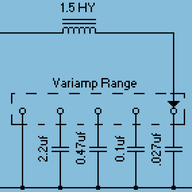
Heres my crude clean up of my "cocktail napkin" circuit diagram.

Couple notes:
TB= TrebbleBleed unit (make2)
PL= PickupLoad unit (make2)
Use whatever capacitor values (and resistor in TB) you want for different results. This is just what I used this time. You can just use a single cap, I just diagramed what I had, remember you can stack multiple caps like that (PARALLEL) and the values ADD, so those are the same as a single 2nF and 1.36nF. The 10MegOhm is just an anti pop measure. You dont need at all if not on a switch.

For the PL, load I may go.higher in the future. This value 2nF was a noticeable, but not extreme point.

For theTB I had previously installed a Kinsman version, using 1.36 nF and a 220kOhm in SERIES (and maybe wire a 10MegOhm in parallel to stop pop?). This behaved much less like a trebblebleed and more like a bandpass/bandboost, that really moved around when u started playing with all the pots together. Effect was often pretty extreme like a different bass or pickups, whereas the (regular) one I pictured and am trying now is
20220917_131633.jpg
s subtle, like eq on your bass.

Will also add, if my ToneCap looks weirdly placed, it is but works normally like that. I tried this because some websites said they did it this way in the 50s because they had a theory it slightly eliminates interferance in some circuits. I tried this cause single coils J bass has interference issues. Am not sure it really does anything different. My interference overall after this rebuild is "fine", actually less than before, but new pots and shortened some wires probably explain.
 
Last edited:
26889466[/URL], member: 352126"]@micguy I have to ask.... what's the control you have in your picture?

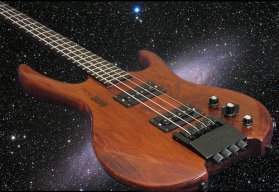
That’s some electronics I did for a client - it’s a very complicated circuit for the space it’s in - it has 4 modes that combine the pickups in various ways. It’s built into a 70’s Fender - a decent physical platform for experimentation.

I have a small group of local players I’ve done this stuff for - all custom circuits, no two are the same. My instruments have benefitted greatly from this - every time I do one of these, there’s a new twist or two that opens up ways of doing things that aren’t things you normally think about.
 
Last edited:
  • Like
Reactions: Das Jugghead
That’s some electronics I did for a client - it’s a very complicated circuit for the space it’s in - it has 4 modes that combine the pickups in various ways. It’s built into a 70’s Fender - a decent physical platform for experimentation.

I have a small group of local players I’ve done this stuff for - all custom circuits, no two are the same. My instruments have benefitted greatly from this - every time I do one of these, there’s a new twist or two that opens up ways of doing things that aren’t things you normally think about.

It looks cool. I've got a Sire V3 that has a rather cramped control layout. I was considering going passive with a standard J plate. I've been toying with many different circuit ideas to fill out the 4th hole since my jack is on the side of the body. I've got notes for 4 or 5 layouts (some untested) so far. I've looked at a few of Kellingsound88's stuff on ebay too. If you have any ideas that worked particularly well, shoot me a message. I'm all ears.

Of course I could give up and buy a different preamp, but that's not as fun as wiring myself....
 

Latest posts