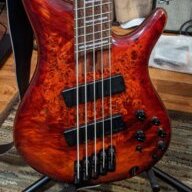
I looked at some resources to see if neck relief and string height were reasonable, and they appear to be. Do any of you have some ideas about what could be causing the buzzing? Thanks in advance.
Neck shim shifted, high spot on one or more frets, action not set correctly at the saddles or the nut (or both), neck relief not set correctly.
There are other things that could cause a buzz, but these are the most common.
Assuming that you measured the relief and action properly and they are both within spec, you've ruled them both out. The first thing I'd check is the fretwork.
I made some adjustments to the truss rod for more relief, and that is definitely helping. Thanks for the suggestion! I guess it will be good enough until I can get somebody reputable to do a full setup. I have two free setups from Guitar Center, but I have no idea how good the people are who do that work there.
D'Addario website says the EXL170-5SL has a total tension of 221.74 lbs, whilst the EPS170-5SL has a total tension of 216.17 lbs. So, regardless of what appears to be the same gauges, there is still a total tension difference of 5.57 lbs between those two sets, though it's rather small. Logically, you did the correct thing by releasing the truss rod tension.
Logically, he did the correct thing by
not trusting Guitar Center to do a setup on his instrument. I've seen some pretty barbaric atrocities committed by their "experts".
As far as loosening the truss rod, I disagree. If he checked the relief and it was set correctly according to the instrument's specs, as he said he did, either the truss rod is not the problem, or he measured incorrectly, which means that he probably shouldn't be messing with it until he has a better understanding of what he's doing. Either way, I wouldn't advise messing with the truss rod at this point.
What I don't know is how much to release the truss rod.
No more than 1/4 turn at a time, tuned to pitch, then let it settle overnight before re-tuning and checking again. But don't do it.
I have decreased the buzzing, but there is still a bit on the B and E strings. Hardly as bad, now, though!
You may have covered up one problem, and created another in the process. It could be any number of things, or a combination of things. For starters, if the buzz is on the two outside strings and not on the inner strings, it indicates that the strings are not properly radiused, which is probably at the saddles, which indicates that the saddles are not properly adjusted, buzz or no buzz.
Again, trying to fix a problem at the saddles by loosening the truss rod is not fixing anything, it's only hiding a symptom.
Before you do anything, tune to pitch, put a capo at the first fret, hold the string down at the fret where the neck meets the body, and measure the action at the eighth fret (from the top of the fret to the bottom of the string). it should be between .3mm and .5mm. If it's not close to this range, you'll want to get it back to where it belongs before doing anything else. No more than a quarter turn at a time, re-tune to pitch, and let the instrument sit overnight before re-tuning and checking again.
Scott is right. You should always do a setup when changing strings, and with seasonal changes.
However, it's never a good idea to go wrenching away at the truss rod unless you know what you're doing.
Get the relief set correctly and we can go from there.
.