Enjoy the benefits of a premium membership!
Upgrade Account
-
TalkBass has been independent since 1998. Add your voice.
Create a free account to reply to discussions, view embedded media, and browse with fewer display ads.
Join free Log in
Want zero display ads or expanded classifieds tools? Compare plans.
You are using an out of date browser. It may not display this or other websites correctly.
You should upgrade or use an alternative browser.
You should upgrade or use an alternative browser.
Changing strings
- Thread starter Daniel921
- Start date
More options
Who Replied?

I do 1 at a time if I’m not cleaning the fret board. Heavy stretching will cause you to loose that new string zing quicker than setting it tight. I put the string through the bridge and create a slight break point on the fatter strings only. Be aware the point will need to move as you tune up so very slight bend if any at all. For the tuner side, I keep a sideways tension w/ my thumb while tightening to keep a nice even relatively tight wrap on the post. I stay off the nut until it starts getting tight to reduce wear, then I pop it in, make sure the bridge side is good as well as string trees if any. I then tune up.
At that point I Slap&pop a bit, apply downward pressure on the bridge saddles to break in the break point on each. I then apply pressure as needed to straighten out any bending on the b,e strings at the tuner and or nut. Make sure all of the posts are wrapped tightly. Generally, a light stretch and I’m ready to rock a piano like tone if need be.
At that point I Slap&pop a bit, apply downward pressure on the bridge saddles to break in the break point on each. I then apply pressure as needed to straighten out any bending on the b,e strings at the tuner and or nut. Make sure all of the posts are wrapped tightly. Generally, a light stretch and I’m ready to rock a piano like tone if need be.

JeezyMcNuggles
Inactive
- Feb 23, 2018
- 14,723
- 20,970
- Disclosures
- I suck, but nobody really notices
Put them on. Slide your finger under the string. Dramatically pull on one string at a time from the bridge all the way to the nut and back a couple times. Push down each string individually at the bridge, and right past the nut. Tune your strings one note high (B to C E to F A to B D to C G to A) play. When done, tune normally. Your strings will officially stay in tune. If you can't do that, tune every 30 seconds til they stay in tune.I'm about to put on a new set of strings on my 5 string bass. I've read something about "stretching" the strings while putting on a new set. I was wondering is it actually necessary to stretch them and if so what is the proper way? I'm putting on a set of Ernie Ball Super Slinky if that matters.
JeezyMcNuggles
Inactive
- Feb 23, 2018
- 14,723
- 20,970
- Disclosures
- I suck, but nobody really notices
I always stretch my new strings when they are being replaced and initially tuned. Been doing it that way for many decades. That process helps the string to stay in tune better as they get broken in. If you don't, you keep tuning the string constantly.
That guy should never string a bass...ever

I don't stretch them, I play them in. When installing new strings I seat them in the tuner ferrule hole as far down as they go, so if you've cut a little short, you have some extra left to play with. I also put a credit card at the back of the bridge to stop the ball ends digging into the bass as you're sliding them out. But for stretch, I tune, play, retune, play, retune then set the witness points.

I know many people recommend stretching the strings when you put on a new set, but I just play them for a few minutes and retune them again and that seems to work fine. Don't have any problems with tuning stability after doing that. I have also heard some people recommending to not stretch the string because then they go dead quicker.

The important thing to know when changing your strings - make sure the wraps go DOWN the tuning peg, as the downward pressure helps to put the strings at a downward angle from the nut.
As far as stretching strings.. you can play bends to help speed that up. Not so much on bass but when I put new strings on a guitar, the first couple of times I pick it up I play bends like crazy just to stretch them out.
If you're going to stretch new strings, play bends, bend those things a whole step.
As far as stretching strings.. you can play bends to help speed that up. Not so much on bass but when I put new strings on a guitar, the first couple of times I pick it up I play bends like crazy just to stretch them out.
If you're going to stretch new strings, play bends, bend those things a whole step.

That's why I hold the string down with my thumb at the first fret while stretching the string. I find it necessary to stretch the new strings. Otherwise, I'll be retuning often for a day or twoMe neither, it looks like a recipe for twisting and overlapping wraps in the tuner post.

After fitting a new string, I tune to pitch and then bend a note around the 8th fret or so by about a semitone. I then retune and repeat until I don't need to retune. This beds the strings in quickly without traumatising them. It's worked a treat for me for a mere 40 years.

I have never “stretched” my strings. I just make sure that they are not twisted when I install them and then I set my witness points once I’m all set up.
This.
Stretching *may* help you if the windings around the tuning posts are a bit loose, but they shouldn't be in the first place if you install the strings carefully.
Setting the witness points (just press the strings behind and in front of the nut and also at the saddles) allows the string to adopt its final shape quickly so that tuning is stable from day 1.
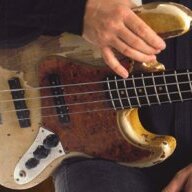
Change 1 string at a time. Do not take them all off at once... unless you are going to polish the frets and or clean/oil the fingerboard.
The reason for this is to keep the tension on the neck.
Stretching is only necessary if your are going to gig the bass right after the string change so they stay in tune....otherwise I prefer to let them settle in naturally.
The reason for this is to keep the tension on the neck.
Stretching is only necessary if your are going to gig the bass right after the string change so they stay in tune....otherwise I prefer to let them settle in naturally.

I'm about to put on a new set of strings on my 5 string bass. I've read something about "stretching" the strings while putting on a new set. I was wondering is it actually necessary to stretch them and if so what is the proper way? I'm putting on a set of Ernie Ball Super Slinky if that matters.
Same strings I use, but only 4 of them.....
I never stretch or set witness. Never had an issue with keeping in tune or with intonation.
As for witness points....what's the point? As soon as you turn the tuning post - those points are now moved.

I typically don't change strings on my stage basses unless I break a string. When I do, I change all the strings out, one at a time. And then that bass comes out of stage rotation and goes into practice rotation for a month or so until the strings have settled naturally.
Same strings I use, but only 4 of them.....
I never stretch or set witness. Never had an issue with keeping in tune or with intonation.
As for witness points....what's the point? As soon as you turn the tuning post - those points are now moved.
I'd read up on it if I were you.

I have also heard some people recommending to not stretch the string because then they go dead quicker.
I don't know if it makes a difference with round-core strings, but I play hex-cores and I have never, ever had one go dead because of stretching.

This. If you don't "stretch" them, they will go flat a couple of times as you play them, because the windings on the tuning pegs will be getting less loose."Stretching" is mostly about taking up slack from around the tuning pegs. I play pretty hard and I bend sometimes, so getting that out as much as possible is important to me; as I change each string, I bring it to tune, and then pull up on it gently but firmly around the twelfth fret while holding it down near the nut, and I repeat that until the slack is out and it stays in tune through the process.

The only thing he does that I don't do is, wrap string around the posts and then start turning the pegs. I use a Peg turner and wing the string properly all the way to tension.That guy should never string a bass...ever


I'm about to put on a new set of strings on my 5 string bass. I've read something about "stretching" the strings while putting on a new set. I was wondering is it actually necessary to stretch them and if so what is the proper way? I'm putting on a set of Ernie Ball Super Slinky if that matters.
I use round wounds and have been stretching sets for years. The reason is they are going to stretch anyway once you start playing, and when you do, intonation is going to be an issue until they “stretch out.
Now, when I’m talking stretch, I’m not talking about yanking the strings from one point like it’s an arrow bow, or tuning the string higher that a normal pitch. Install a string so the sting is taut, but not up to pitch, I put my index finger under the string and lift and push down with your thumb giving it a a little tug working your way from the as close as you can from the bridge, to as close as you can from the nut.
I absolutely agree you don’t want to have twisted strings. The good news is that bass strings are hard to twist. For example, hold the string with both hands between both thumbs and index fingers and try to twist it.
What you do need to do, is to make sure the ball is seated properly in the tail piece seat, and not having too many or too little windings on the tuning pegs.
Anyway, there are a boatload of videos out there on the subject, you may want to watch a few before starting the install.
BTW... these are the babies I use...... no twisting.... and they are installed very carefully.... way too expensive to screw up.