I know it's not basses, but I got an email today from Fender about Channel Bound necks. Are the claims about resonance true or do they just look pretty?
Invalid Link Removed
Invalid Link Removed

TalkBass has been independent since 1998. Add your voice.
Create a free account to reply to discussions, view embedded media, and browse with fewer display ads.
Join free Log in
Want zero display ads or expanded classifieds tools? Compare plans.
 .
. .
.
So they lay the fingerboard into the neck rather than laying it on top?
Since different woods move at different rates would it not be possible for the fingerboard to break the neck if it expands too much?
I'd be very careful with these and wait until they have a track record until I'd get one.



Hi.
From a pure engineering standpoint, the different shrinking/expansion rates of the "binding" and the FB will cause cracks though.
Oh, okay. Does different shrinking/expansion rates cause fretboard binding to crack often?
So, from a pure engineering standpoint, wouldn't the different shrinking / expansion rates of the standard rosewood board glued to a maple neck cause cracks, though?
Do woods move at different rates?
I mean, Alembic makes those 7 piece necks with different woods all sandwiched together and I've never heard of them breaking because of wood expansion. Isn't that the same thing?
You're comparing Alembic and Fender?
Hi.
With the normal way the FB is bound, no.
Glue creeps or gives the required amount of movement.
The grain orientation(s) on somewhat rare wooden binding is also chosen in a way that it'll not break or crack.
In this case when the wooden "binding" is very thin and the grain orientation in the shear plane (where the FB/neck glue line lies) isn't optimal, it possibly will.
On the end of the FB it is even worse, there the "binding" is very fragile.
No, different construction entirely.
No such shear forces that would exceed either the material or glue strength.
As we all know though, the seasonal changes requiring TR tweaking are usually more severe with 2 wood necks than in the single wood variety.
Yes.
Also, within the same species, the way the wood is cut introduces yet another variable.
If Alembic was going with this, I'd be certain that it would NOT crack.
Again, multilams are an entirely different construction method compared with what Fender is getting into the market now.
That said, with poorly chosen or improperly cured multilam wood the surface can go from smooth to a bit bumpy and back when the humidity changes.
Whether the finish will crack a s result depends on the finish.
Regards
Sam


Do woods move at different rates? I mean, Alembic makes those 7 piece necks with different woods all sandwiched together and I've never heard of them breaking because of wood expansion. Isn't that the same thing?
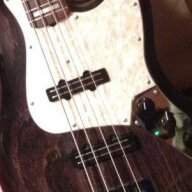

I hope by the time it's introduced on basses it is proven.