• TalkBass has been independent since 1998. Add your voice.
    Create a free account to reply to discussions, view embedded media, and browse with fewer display ads.
    Join freeLog in
    Want zero display ads or expanded classifieds tools? Compare plans.

Cheap power amp and cab with pre amp pedal?

I've used mismatched combinations as mentioned above and fed a poweramp a signal that was well below line level, basically just the output of the last pedal of my pedalboard - I can't remember, but I guess it was a Strymon reverb. This still worked for the application because I brought enough poweramp and cabinet to tear down the house. I had the poweramp cranked to be loud enough.
That's where you don't want to pull out a cable because the plop noise will be a bit louder than you're used to.
 
  • Like
Reactions: mbell75
As a few posters have already noted, it seems the OP wrote “random power amp” when he really meant “random bass head,” and also that he was really only interested in how much putting an SCR-DI in front of something makes it sound like an Ampeg.

But in case I and others misinterpreted the first post, I play bass through a Zoom B2 pedal directly driving an old Peavey power amp, and it works fine. If you turn up the Zoom’s output level to near maximum, its line-level output signal is hot enough to light the clip/DDT light on the Peavey power amp (when the Peavey’s sensitivity knob is full up).

Power amps I’m aware of want to see an input signal of 0.775 volt, 1 volt or 1.4 volts. In my case, the Peavey wants 1 volt and the Zoom can just manage that. If I had a power amp that expected 1.4 volt input signals, I’d need a hotter signal than the Zoom can generate if I wanted to use the power amp’s
full capabilities.
 
Pedals these days have gotten really good. Take something like the Ampeg SCR-DI for instance. Makes pretty much any amp sound like an Ampeg. Anyone ever try getting a random power amp, a good cab and running a pedal like this? Im thinking an older, used Peavey amp with a nice cab or two running the Ampeg pedal might sound pretty good on the cheap. Thoughts?
The output drives an amp just fine. Line out, not the di. Works like a charm.
 
  • Like
Reactions: mbell75
Thanks for the replies. Tried the pedal on a Fender 500 combo (which I currently own) a Peavey Max combo and a MarkBass combo and it basically made them all sound like an Ampeg. I think as long as you have a good tone to start with, the pedal takes it from there. I’m pretty sure it would have the same effect on a cheaper amp i was considering but I’ll probably keep my Rumble. I think I may swap my SansAmp Bass Driver for the Ampeg because I really want the Ampeg tone but don’t want to put out the money for one because I like my Rumble and have no need for two different amps. I can get both with this option.
 
  • Like
Reactions: mexicanyella
Why should a pedal have to power a power amp? I’ve never heard of that

Nobody else has either because it’s not what anyone is saying.

A power amp requires a certain signal level coming into it.

Most require a signal level that’s commonly referred to as “line level.”

Most pedals designed for musical instruments put out a much lower output level called “instrument level” or “mic level” because they’re mainly intended to be plugged into the front input jack on an instrument amp. Their output is somewhere between -60dBV (or 0.001 volts) and -40dBV (or 0.010 volts).

Line level on consumer gear requires around 1 volt or roughly s 1000 times hotter signal than an instrument level signal.

If you plug an instrument level output from a preamp pedal into the input of a power amp that requires a line level signal, you’ll either hear nothing - or get very low volume no matter how high you crank the power amp.

There’s also basically two different standards (consumer and pro) for what constitutes “line level” So just because you have a line level out on your preamp pedal, it doesn’t automatically mean it will work with every power amp.

So you need to check.
 
I’m still not entirely clear on how the various dB measurements interrelate with one another and with voltage...but my Zoom B2/Peavey M-3000 experience tells me that the Zoom’s claimed “+5 dBm” line output is in the neighborhood of one volt...which is what Peavey’s M-3000 manual says the amp wants to see at its input.
 
Should this sensitivity be about the same as one presented in a datasheet of a full (pre+power) instrument level amp ?

Depends upon whether you're talking about the preamp or the power amp. For example if you look at the service manual for a vintage SVT, the Sensitivity for the Preamp is listed as 0.019V and the Sensitivity for the power amp is listed as 0.25V. Keep in mind, one role of the preamp is to amplify a relatively weak signal up to a level that is suitable to drive the power amp to full power.
 
  • Like
Reactions: ihaveaquestion
If in doubt, Just add a boost or gain pedal after the preamp pedal and send that to the power amp. Works fine.
Only if the pedal is capable of a maximum output level greater than the power amp's input sensitivity. Many gain/boost pedals are not.
 
If you have issues matching gain then a small mixer can be useful.
A small mixer is always handy to have around. You'll find many uses for it.
The ones with effect bus or two especially handy.

Some audio interfaces for PCs have a direct monitor out to let them be used as small mixers. Or some small mixers have USB that allows them to be used standalone or with a PC.

Most all can drive a power amp.
 
Just buy a Used bass head.
You see used Peavey or GK lead sleds all
The time. Why waste money on pre pedals.

You can get a 200/400 ish watt head for around 150 to 250 bucks.

Because I don't like the tone from Peavey or GK. I like Fender and Ampeg. So now that Im back with a Rumble 500c, Im going to add the Ampeg pedal for the times I want an Ampeg tone.
 
  • Like
Reactions: agedhorse
I understand what you want to do. I've thought about doing the same thing.

The issue that I ran into is any "cheap" power amp worth buying isn't really much cheaper than a cheap amp head with an effects loop. If you get a head with an effects loop, you can send the signal from the Ampeg Pre to the effects return. You have now skipped the preamp, but the preamp is still there if you ever want to use it, and it is essentially free because, as I mentioned earlier, heads aren't really more expensive than power amps.

Lastly, if you really want to keep it simple, you can get a solid state Ampeg Portaflex head, which, again, is probably going to be cheaper than any "cheap" power amp you can find.
 
  • Like
Reactions: Omiloh and mbell75
I did the preamp, power amp thing at my last gig and it was great. I have a Peavey CS800S running into two 4 ohm Acmes. I used the Tone Hammer pedal and it drives the Peavey nicely.

It looks like you bought the Ampeg pedal but if you're interested, others have derived an Ampeg sound out of the Tone Hammer DI.
IMG_20190727_145834.jpg
 
...Power amps essentially have one big volume knob to control the level of output; they do not have a knob to control the level of input...

As noted above, this is not accurate. I am piling on here because this point is massively important for speaker safely using a
power amplifier. The bottom line is that the input attenuator is not a volume control, and may still allow a large amount of power
to be destructively applied to your speakers.

Generally, I run the attenuators wide open if I am using a single cabinet on one channel, or when I am driving two identical cabinets in Bridge mode, i.e., preamp->Crest ProLITE 3.0->two 15/6/1 fEARfuls.

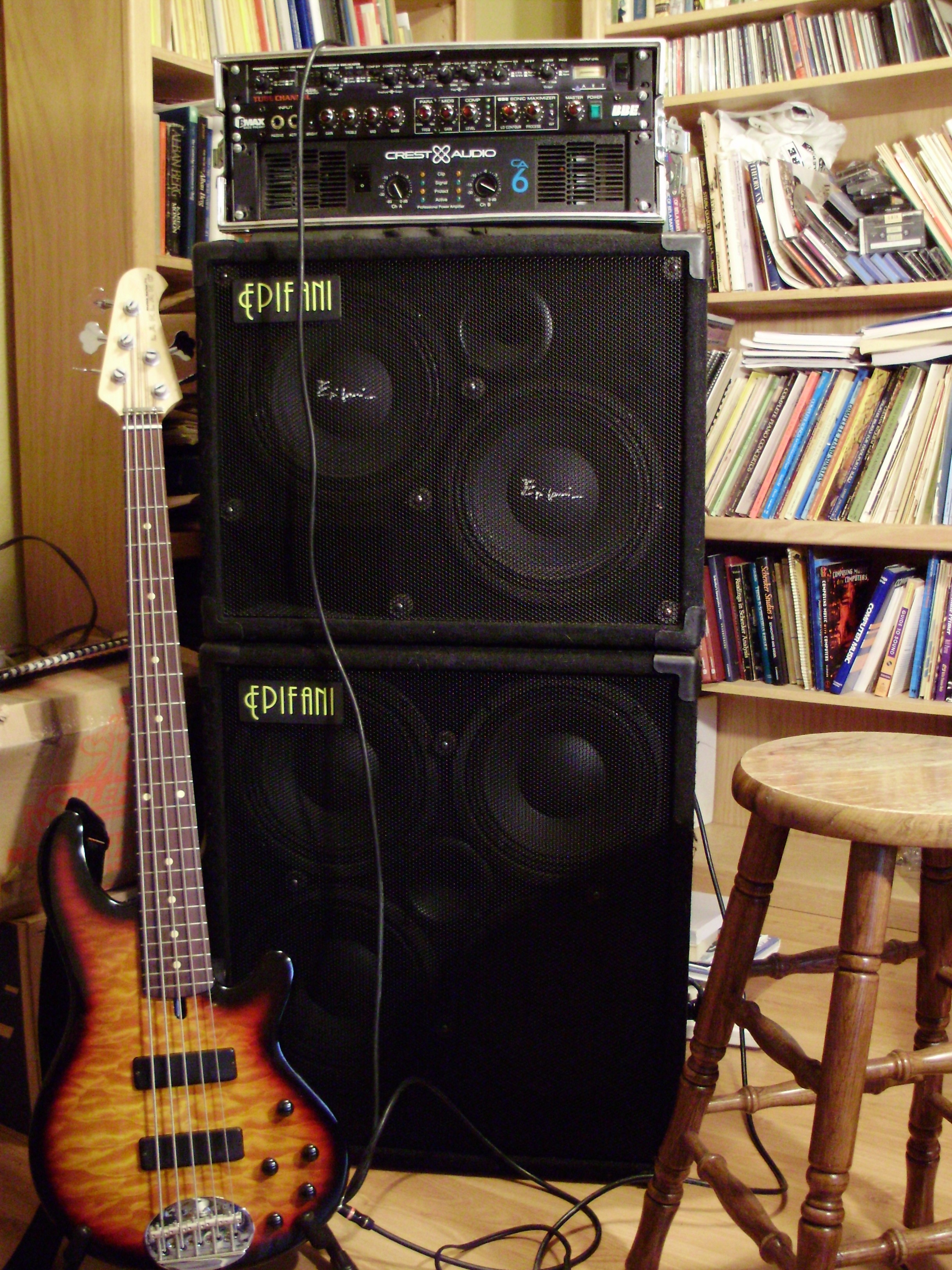
The attenuators are useful when balancing two different, but compatible cabinets. N.B., the position of the two input attenuators on the Crest CA6 below:

BigRig.jpg