I have been playing for about a year and my favorite bassist is Chris Squire. I was wondering how you think he creates his lines to fit so well with Steve Howe and Alan White. I would like to incorporate some of his style into my playing. Any information on how to create basslines like him would be awesome.

Enjoy the benefits of a premium membership!
Upgrade Account
-
TalkBass has been independent since 1998. Add your voice.
Create a free account to reply to discussions, view embedded media, and browse with fewer display ads.
Join free Log in
Want zero display ads or expanded classifieds tools? Compare plans.
You are using an out of date browser. It may not display this or other websites correctly.
You should upgrade or use an alternative browser.
You should upgrade or use an alternative browser.
Chris Squire
- Thread starter GlennPagano
- Start date
More options
Who Replied?
Squire grew up performing in Anglican church choirs. There's a very rich tradition of incredible music in the Anglican church, composers like Byrd, Handel, Morley, Weelkes, Tallis, Purcell, Britten, Elgar, Ireland, Vaughan Williams, Walton, Holst, etc.. In my opinion, the DNA of this music is VERY deeply ingrained in Yes, ELP, and the rest of the classic british progressive rock bands. But you can REALLY hear it in Chris Squire's writing. My advice if you want to write music like he does you should go to the source and listen to some of the same music that he grew up with and it'll rub off!

classical + 50's and early 60's rock = chris squire.
50's? I'm not hearing that at all. I'd say Sgt Pepper and Abby Road are the roots of Squire.
I'll +1 the suggestion to listen to vocal classical music for inspiration. Also, pick up his solo album Fish Out of Water. That's a master class in how Chris 'thinks'. And probably the hardest habit to break is to stop thinking of the bass as strictly a rhythmic/harmonic instrument. Learn melodies and develop the ability to play counterpoint, make the instrument an extension of your voice.
50's? I'm not hearing that at all. I'd say Sgt Pepper and Abby Road are the roots of Squire.
Squire was doing psychedelic music in the vein of Sgt Pepper and Abby Road (with the Syn) before the Beatles were.
Squire was doing psychedelic music in the vein of Sgt Pepper and Abby Road (with the Syn) before the Beatles were.
Lots of people were doing psychedelic music at that time. Sgt Pepper was 1967 when Squire was 18 years old.
ANyway, the point is, he, like McCArtney, is a master of voice leading. That comes from understanding composition and melody -- 2 things many bass players don't explore. Frankly, some styles of music don't require it. You don't need to know voice leading and melody to play with James Brown. You need a completely different skill set. It's good to do it all.
Lots of people were doing psychedelic music at that time. Sgt Pepper was 1967 when Squire was 18 years old.
Squire & the Syn opened for Hendrix at the Marquee club in January 1967. The Beatles were in attendance. Sgt Pepper sessions were just getting going at the time. If you listen to recordings of the Syn, Squire's style was already pretty well defined by this time!
I'm not saying you're wrong that Squire was influenced by Sgt Pepper and Abby Road, but saying that those albums are the "roots" of Squire's style as you did isn't correct.
- Feb 24, 2004
- 4,103
- 642
- 68
- Disclosures
- Endorsing Artist: Phantom Guitars, Eastwood Guitars
My son's a big Squire fan 
(my 4001CS Chris Squire Limited Edition, only 1000 were produced, of which only 3 were left-handed).
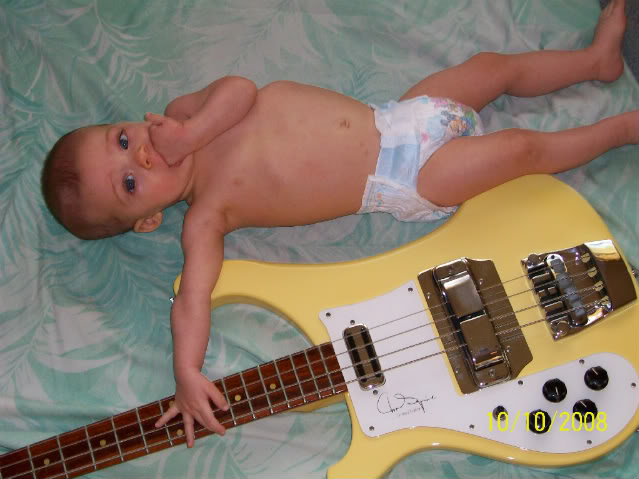
(my 4001CS Chris Squire Limited Edition, only 1000 were produced, of which only 3 were left-handed).
Squire & the Syn opened for Hendrix at the Marquee club in January 1967. The Beatles were in attendance. Sgt Pepper sessions were just getting going at the time. If you listen to recordings of the Syn, Squire's style was already pretty well defined by this time!
I'm not saying you're wrong that Squire was influenced by Sgt Pepper and Abby Road, but saying that those albums are the "roots" of Squire's style as you did isn't correct.
That may be true. Though I think Mac is the beginning of "composed bass" in pop music and Squire took it to the next level.
My son's a big Squire fan
(my 4001CS Chris Squire Limited Edition, only 1000 were produced, of which only 3 were left-handed).
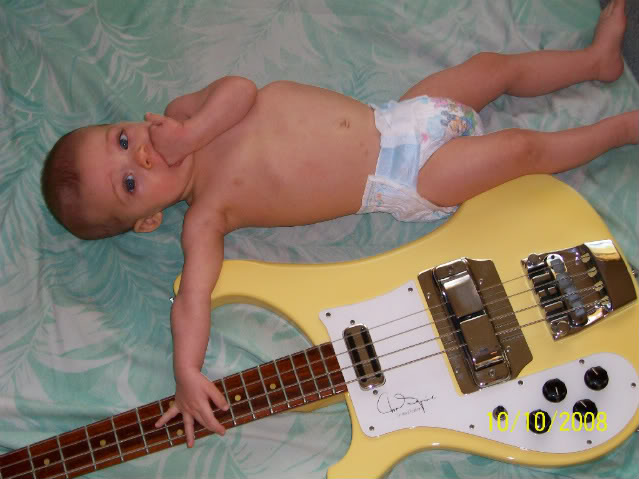
Wow a lefty! Looks very yellow in that photo. On a side note, is your boy trying to swallow his hand there?
Listen to Bach.
and older, pre-Alan White Yes (Fragile/Yes Album/Close to the Edge).
Chris is not all things, but the one thing he does he does REALLY well. He was my favorite bassist for many years.
Chris is not all things, but the one thing he does he does REALLY well.
I'll agree that he's not "all things" -- in fact, I'll go so far as to say he's not a particularly well-rounded bass player when it comes to versatility or comprehensive grasp of disparate styles -- but still, it strikes me as somewhat uncharitible to characterize his bass playing as being "one thing".
Perhaps it's just a semantic quibble, but I can think of at least three things Squire does that are fundamental components of his playing style. And that's just off the top of my head. Might be less confusion if we defined a "thing" first.
eh...
The thing to which I refer is the whole "prog rock" thing. If someone told me to cast a ideal prog-rock band, he'd be the bassist. Funk?? Nope. Jazz? Nope. Prog rock? Yes.
I guess that's why I drifted onto other players - my tastes in music shifted to funkier areas.
The thing to which I refer is the whole "prog rock" thing. If someone told me to cast a ideal prog-rock band, he'd be the bassist. Funk?? Nope. Jazz? Nope. Prog rock? Yes.
I guess that's why I drifted onto other players - my tastes in music shifted to funkier areas.
One of the best (and most singular) rhythm sections of prog, IMO, is Chris Squire/Bill Bruford. You could easily recognize them if you were listening to a recorded jam session.
They're up there with Colin Edwin/Gavin Harrison and Geddy Lee/Neil Peart.
They're up there with Colin Edwin/Gavin Harrison and Geddy Lee/Neil Peart.
I'll +1 the suggestion to listen to vocal classical music for inspiration. Also, pick up his solo album Fish Out of Water. That's a master class in how Chris 'thinks'. And probably the hardest habit to break is to stop thinking of the bass as strictly a rhythmic/harmonic instrument. Learn melodies and develop the ability to play counterpoint, make the instrument an extension of your voice.
I have realized that most of his basslines are not rhythmic and are not at all based around the conventional bass playing. It seems as though everything I have learned having to do with R-5 and R-5-8 etc. etc. should mostly be thrown out the window. I need just play whatever comes into my head. Would it be best to play some Bach bass stuff?
and older, pre-Alan White Yes (Fragile/Yes Album/Close to the Edge).
t.
Chris is not all things, but the one thing he does he does REALLY well. He was my favorite bassist for many years.
Yes (no pun intended), I completely agree. This is my favorite yes era. I love the experimentalish albums. I am not too keen on the 80's style of yes (90125).
Thanks everyone for their inpu
- Feb 24, 2004
- 4,103
- 642
- 68
- Disclosures
- Endorsing Artist: Phantom Guitars, Eastwood Guitars


