I can see it just fine on a mac in Cali....
(not that I condone such things)
(not that I condone such things)

TalkBass has been independent since 1998. Add your voice.
Create a free account to reply to discussions, view embedded media, and browse with fewer display ads.
Join free Log in
Want zero display ads or expanded classifieds tools? Compare plans.

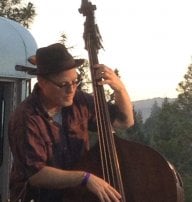
Short Video Clip using the Chuck Israels Mic close to drums and piano
This shows how close I was to the drums and piano. The recording using the 'Chuck' really does sound like my bass (only louder).
It suddenly jut came on, so all is well.


No, Ric. That recording is not just from the bass mic but is from the whole band.
Rick,
Once agian, I'm impressed. It seems to be cutting through the mix with all that lovely ambient
crowd noise, and what sounded like someone else playing drums off camera
You're a real trooper my friend. Thanks agian.
Ric
Thanks, Ric.
To be honest, I'm probably well out of my depth with what I'm trying to do here, recording-wise.
What I can say is that the sound I get from the 'Chuck' through my Genzler AA Golihur Series Amp is the most natural, acoustic sound I have ever been able to get.
I suspect there are practical limitations in terms of how much volume and separation I can get with the mic alone but I have the KNA piezo on the bass for backup, and thankfully, most of my gigs are smaller ensembles - duos or trios - at moderate volumes and it looks like I can mic at least those gigs very successfully with the 'Chuck'.
After this weekends gigs I will be sending it down to you and am anxious to get your take on things.


Has anybody had trouble in viewing this video? It works fine on my computer and on my phone (both android), but I heard from one person that he couldn't view it on his mac or his iphone.
Anyone else?
Is anyone having trouble seeing Rick’s video? Perhaps it’s just an issue with my local network. What say you folks.
Ric
You are very fortunate indeed, to have all those choices. Tell me, what settings do you use or suggest for the Remic Green? It's gain is wonderful, but there
seems to be a low frequency bump, on the E String, that produces a hard attack on the notes centered around half position F, F#,G etc. Most
of us use a Grace Felix which is perfectly capable of zeroing in on the problem, were just having diffuculty narrowing it down. The HPF helps of course
but a little of that goes a long way. Personally, I'd be very interested in your thoughts. Thank you
Sincerley
Ric Vice
A big part of the design mandate for this mic was to minimize 'Bleed'. Being an 'air mic' and not a contact mic or a piezo I expect a total absence of bleed is impossible. So in the real world, the goal is to minimize it to the point where you can have meaningful control (level and EQ) of a separate Bass Track without involving much sound from the other instruments.
Here are two audio clips I made on a gig the other night. One is the 'Chuck', and the other is the ATM350 Cardioid Mic which is placed right next to the Chuck, so the difference in bleed is not due to placement.
These things are somewhat dependent on the bass and the room IME. I use a large old English bass with passione and play arco in very reverberant room. Have not really had issues with feedback, so I have so far not needed the cardioid remic, only the omni. Cardioid is so far just a backup.
Tell you what, when I bring my main bass home from work for the summer I will use the Izotope RX EQ match and make a compensationcurve for matching the profile of the remic omni. If I have a Felix by then, I will make a "neutral preset" for the cardioid remic on my bass and let you know.
Chuck Israels Signature Mic...How Much 'Bleed'
A big part of the design mandate for this mic was to minimize 'Bleed'. Being an 'air mic' and not a contact mic or a piezo I expect a total absence of bleed is impossible. So in the real world, the goal is to minimize it to the point where you can have meaningful control (level and EQ) of a separate Bass Track without involving much sound from the other instruments.
Here are two audio clips I made on a gig the other night. One is the 'Chuck', and the other is the ATM350 Cardioid Mic which is placed right next to the Chuck, so the difference in bleed is not due to placement.
I also included clips of 'Pennies From Heaven' which I recorded on another gig. One clip is the bass track alone (which has a fair amount of cymbal 'bleed' which I could further minimize by cutting the high frequencies which the bass doesn't need anyway). The other clip is the ensemble with all 4 inputs.

Listening to the Sweet and Lovely clips, I notice that the bass really stands out, versus the Piano, Drum, and Crowd bleed, the bass has a lot more character than it does with the AMT. I don't think it's possible to eliminate bleed, but the Xlson is able to relegate it into the background,
while you bass stays in the foreground. Rick, can you remember at all what the volume setting at the mixer was for the Xlson?
Ric
Also, the Chuck has a very full sound while the AMT seems to have a low-mid "hump".
 My personal experience has allowed me to play “drummerless” gigs with no guitars, using the DPA 4099B alone provided the monitor channels had separate sends. The Remic Green FOH into the mains works great, provided the sound person or persons know what their doing. There will be bleed of course.
I’m having problems playing this file and all the audio files you put in this thread so far. I think it is an issue with apple products and flash.Has anybody had trouble in viewing this video? It works fine on my computer and on my phone (both android), but I heard from one person that he couldn't view it on his mac or his iphone.
Anyone else?
I’m having problems playing this file and all the audio files you put in this thread so far. I think it is an issue with apple products and flash.
All the files are MP3’s 
Apple stopped supporting flash on its mobile platform a long time ago for safety reasons - instead, they have moved towards JavaScript and html5.