• TalkBass has been independent since 1998. Add your voice.
    Create a free account to reply to discussions, view embedded media, and browse with fewer display ads.
    Join freeLog in
    Want zero display ads or expanded classifieds tools? Compare plans.

Class D Amps

yes... you are right. I am inquiring about heads. Just wondering if there is any sacrifice inherent with a Class D power section regardless of the pre-amp characteristics/design.
"Sacrifice" is perhaps the wrong word to describe it, but I'm going to take the contrary POV and say yes, just like all-tube vs. regular SS with the big iron power transformers, there definitely are differences with the micro technology.

Of course, that doesn't necessarily mean "inferior," but someone who is used to the razor sharp tightness of a big iron SS or hybrid will often think of micros as not being as tight, and someone used to tube amps will think of micros as missing the great dynamic response and the 3-dimensionality of an all-tube amp. But the funny thing is that a lot of us who prefer tube amps give a thumbs up to micros for their ability to sound somewhat like a tube amp running clean but slightly pushed into the red. I have two micros my own self and I really dig them, though not as much as my tube amps.

But when I hear people saying that there's absolutely no difference in the sound of power amp topology and that it's all in the preamp, I have to laugh. I was around in the days when big iron SS started to get better, and I heard a whole lot of people tell me the same thing about big iron SS power amps vs. tube...there's no difference. HAH! To this day I've yet to play a big iron SS or hybrid amp that sounds like a tube amp and vice versa. Same with the micros.

And I've had many a conversation with soundmen who view the class D technology in pro-level power amps the same way I do...much lighter and making a lot more sense than having a 500 lb rack with a bunch of heavy power amps, but not having the tightness of sound of the big iron.

Again, it's not a question of better or worse, really...just a question of being different. And they certainly are different, just like all-tube and trad SS. Some will favor all-tube as I do, some will favor big iron SS, some will favor micro. But they're definitely different, and it ain't the preamp.
 
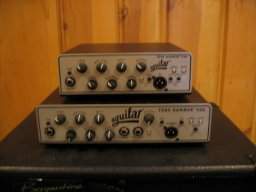
I've found the tube pre side of the GB Shuttles is actually pretty nice. ......
....... it gets nicely warm and full-sounding if you bias towards the tube side of the preamp.

My general feeling is I should've got a class D head years ago.


++1
I got a shuttle myself. Very nice indeed. You can definately crank the gain and push that lil sucker and to some mad flayvaz out of it.
:bassist:
 
Getting OT here. I could be wrong, but that is a lunchbox sized guitar amp powered by two EL34's. I know very little about guitar amplification, so might be not understanding what you are saying.

The Transatlantic (along with many other "micro" guitar heads) are EL84-powered, not EL34-powered.

That said, there are options for "micro" guitar heads that use EL34s. The THD Univalve and Bivalve, for example.
 
I love the Eden WTX260 and my powered NAV WTX1000N. great sound.
It's all in the preamp.
The only downside is IMHO that you have less headroom.
So I would choose a class D with 2-3 dB more power then the SS I would take for the situation.
 
I love the Eden WTX260 and my powered NAV WTX1000N. great sound.
It's all in the preamp.
The only downside is IMHO that you have less headroom.
So I would choose a class D with 2-3 dB more power then the SS I would take for the situation.

Don't understand what you are saying here. I do agree that the WTX260 was probably the worst class D execution ever done (although the preamp is quite nice sounding). Low power (even considering its low power rating), and horrible limiting. However, again, there is NO reason to treat 'class D' watts different from 'class H' watts, or class 'A/B' watts.
 
"Sacrifice" is perhaps the wrong word to describe it, but I'm going to take the contrary POV and say yes, just like all-tube vs. regular SS with the big iron power transformers, there definitely are differences with the micro technology.

Of course, that doesn't necessarily mean "inferior," but someone who is used to the razor sharp tightness of a big iron SS or hybrid will often think of micros as not being as tight, and someone used to tube amps will think of micros as missing the great dynamic response and the 3-dimensionality of an all-tube amp. But the funny thing is that a lot of us who prefer tube amps give a thumbs up to micros for their ability to sound somewhat like a tube amp running clean but slightly pushed into the red. I have two micros my own self and I really dig them, though not as much as my tube amps.

But when I hear people saying that there's absolutely no difference in the sound of power amp topology and that it's all in the preamp, I have to laugh. I was around in the days when big iron SS started to get better, and I heard a whole lot of people tell me the same thing about big iron SS power amps vs. tube...there's no difference. HAH! To this day I've yet to play a big iron SS or hybrid amp that sounds like a tube amp and vice versa. Same with the micros.

And I've had many a conversation with soundmen who view the class D technology in pro-level power amps the same way I do...much lighter and making a lot more sense than having a 500 lb rack with a bunch of heavy power amps, but not having the tightness of sound of the big iron.

Again, it's not a question of better or worse, really...just a question of being different. And they certainly are different, just like all-tube and trad SS. Some will favor all-tube as I do, some will favor big iron SS, some will favor micro. But they're definitely different, and it ain't the preamp.


Again, you will find just as much variance among 'big iron' amps as you will among class D powered amps. There is no 'traditional transformer' sound:smug:

That being said, there are HUGE differences in hi passing, voicing and absolute power between bass amps. It is literally impossible to attribute the difference in performance of different 'all in one' bass amps to the power amp topology.

Of course, if you have a Glockenklang Blue Soul and a Bergantino IP being compared to a similar wattage Thunderfunk TF750a, you would come away saying 'man, those class A/B big iron heads sound wimpy compared to class D/SMPS'. Of course, that would be similarly inaccurate:p
 
Don't understand what you are saying here. I do agree that the WTX260 was probably the worst class D execution ever done. Low power (even considering its low power rating), and horrible limiting. However, again, there is NO reason to treat 'class D' watts different from 'class H' watts, or class 'A/B' watts.
Of course a watt is a watt is a watt, but the soundmen I know with class D amps overbuy wattage compared to what they'd get with lead sleds because of the non-graceful way they run out of headroom when they reach a certain point. And I have totally noticed it with micro bass amps as well. They compress and start to distort and sag at a lower point in the volume than lead sleds and tubers with the same amount of wattage. It's easily compensated for by overbuying micro wattage, but it's a legit concern. Fortunately, since I can gig with a 35w practice amp if need be, not an issue for me!
 
You don't understand but agree to things I didn't say?
The power of the WTX260 is not that bad, I use it @230V ;)

You seemed to be saying that you need more powerful class D amps to match the performance of 'other topologies' of the same wattage. Since that is quite a bit 'off the mark', I gave you the benefit of the doubt that maybe I didn't understand your post.

I again find the WTX260 at the very bottom of 'small amp performance, and if that is what you are basing your feeling about class D on (again, if I'm understanding what you are saying), then that is a 'limited information' mistake.
 
Of course a watt is a watt is a watt, but the soundmen I know with class D amps overbuy wattage compared to what they'd get with lead sleds because of the non-graceful way they run out of headroom when they reach a certain point. And I have totally noticed it with micro bass amps as well. They compress and start to distort and sag at a lower point in the volume than lead sleds and tubers with the same amount of wattage. It's easily compensated for by overbuying micro wattage, but it's a legit concern. Fortunately, since I can gig with a 35w practice amp if need be, not an issue for me!

Tube amps do behave a bit different when pushed. Heavy, traditional power supplies versus SMPS (regardless of the class of power amp)... not so much. I'm giving you the tube amp thing for sure. Definitely a different performance when pushed into distortion, and that can sound quite pleasant to some.
 
You seemed to be saying that you need more powerful class D amps to match the performance of 'other topologies' of the same wattage. Since that is quite a bit 'off the mark', I gave you the benefit of the doubt that maybe I didn't understand your post.

I again find the WTX260 at the very bottom of 'small amp performance, and if that is what you are basing your feeling about class D on (again, if I'm understanding what you are saying), then that is a 'limited information' mistake.
Sorry, maybe my English, I can't explain it good.
But it has nothing to do with my WTX260. I play many amps and I just get that feeling that the headroom of a class D is just less then from a SS.
 
Sorry, maybe my English, I can't explain it good.
But it has nothing to do with my WTX260. I play many amps and I just get that feeling that the headroom of a class D is just less then from a SS.

Your English is a LOT better than my German:) Again, there are crappy executions of class D and SMPS designs, and I know you can find that to be the case between two specific amps. Since you are in Germany, if you ever have the chance to try a Glockenklang Blue Soul or a Puma500/900, I would highly recommend it. Those executions are top of the line, and they perform as you would expect from any high quality amp with their wattage ratings.

Anyway, the cool thing is, lots of products out there, and every amp sounds different. If one likes the tone of a DB750, you are going to have to carry it around. If you like the tone of a Walter Woods, you luck out with low weight!
 
Tube amps do behave a bit different when pushed. Heavy, traditional power supplies versus SMPS... not so much.
Really? They sure seem different to me! I believe it's because of the lack of power available past the RMS wattage in micros that causes it. With a trad SS or tube amp, you get a 2-1 ratio of peak wattage to RMS or thereabouts. But if you look at some of the tests Tom Lees has run for BGM on micros, you see the amount available past RMS is not nearly as high on most micros. Some micros hit their RMS rating and come to a dead stop. Trad SS amps don't deal with peaks quite as gracefully as tube amps, so folks gradually learned to overbuy wattage with them to get the best out of them. Same thing with micros, I believe. I find they run best when you don't come anywhere near pushing them hard, whereas a trad SS amp gives you at least some leeway to push them hard.
 
At the moment I am happy with my Edens. Heavy or light. I thought the class D from the WTX is not too bad since it is engineered by Bang and Olufsen. Of course I tried Glockenklang. But I stayed with Eden. just my tone I guess. At the moment I wait for my 1350. Lets see what that beast can do and how good it is executed.
 
At the moment I am happy with my Edens. Heavy or light. I thought the class D from the WTX is not too bad since it is engineered by Bang and Olufsen. Of course I tried Glockenklang. But I stayed with Eden. just my tone I guess. At the moment I wait for my 1350. Lets see what that beast can do and how good it is executed.

+1 Eden is a wonderful tone, and very different from the Glock. The B&O Ice modules are solid, but again, a lot of it is about execution (as with everything). For example, I believe the Genz 6.2, the GK MB500 and the Aguilar TH350 all use the identical B&O ICE class D/SMPS modules, but I can't think of three different amps that sound more different from each other, and they all vary a bit on low end voicing and absolute volume. Hard to attribute that to the power section when they all use the same one!

Again, didn't mean to push back so hard. There are some 'lead sled' amps that sound simply wonderful. My point is, there are also high end class D executions that can hang with any similarly rated solid state amp out there in low end slam, distortion rates, etc.