• TalkBass has been independent since 1998. Add your voice.
    Create a free account to reply to discussions, view embedded media, and browse with fewer display ads.
    Join freeLog in
    Want zero display ads or expanded classifieds tools? Compare plans.

Class D vs Class A or A/B

This is worthy of repeating.
+1
The "amp" part doesn't matter much. The pre-amp is where the tone is from.

I respectively disagree with the comment that the "amp" part doesn't matter. Yes, the preamp is where most of the "tone" is coming from, but I still believe that the power section contributes a lot to the performance of the amp as a whole. In choosing a power section for the Valkyrie, we experimented with two class A/B modules, a Class H and two different class D modules in that amp. With me playing my bass and various volume levels, all of us were able to detect clear differences in the way the various amp modules behaved and sounded mated to that preamp. Some with very subtle difference between them, some with quite obvious differences between them.

If the "amp" part doesn't make a difference, then why were all of us able to pick them out? I'm not saying that one topology is better than another, all had the pro's and con's, but there are clearly differences to be heard. If the amp doesn't matter, then you should be able to hook any bass preamp up to say a class D Carvin amp and a Crest CA9 and hear absolutely no difference between them, right?
 
I respectively disagree with the comment that the "amp" part doesn't matter. Yes, the preamp is where most of the "tone" is coming from, but I still believe that the power section contributes a lot to the performance of the amp as a whole. In choosing a power section for the Valkyrie, we experimented with two class A/B modules, a Class H and two different class D modules in that amp. With me playing my bass and various volume levels, all of us were able to detect clear differences in the way the various amp modules behaved and sounded mated to that preamp. Some with very subtle difference between them, some with quite obvious differences between them.

I would be curious to know how stringent the gain matching and output voltage matching was during all of your testing. Did all of the modals you tested have the same sensitivity and output potential?

I dont ask to be a dick, only because I am curious as to how power sections are evaluated in the development stages.
 
I respectively disagree with the comment that the "amp" part doesn't matter. Yes, the preamp is where most of the "tone" is coming from, but I still believe that the power section contributes a lot to the performance of the amp as a whole. In choosing a power section for the Valkyrie, we experimented with two class A/B modules, a Class H and two different class D modules in that amp. With me playing my bass and various volume levels, all of us were able to detect clear differences in the way the various amp modules behaved and sounded mated to that preamp. Some with very subtle difference between them, some with quite obvious differences between them.

If the "amp" part doesn't make a difference, then why were all of us able to pick them out? I'm not saying that one topology is better than another, all had the pro's and con's, but there are clearly differences to be heard. If the amp doesn't matter, then you should be able to hook any bass preamp up to say a class D Carvin amp and a Crest CA9 and hear absolutely no difference between them, right?

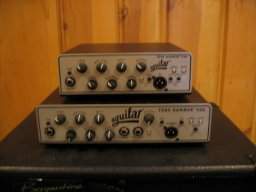
I would guess that, with time and experience, you could have made them sound quite a bit more similar. I agree, if you just 'hook up' different power sections to the same preamp without going the extra step in really integrating it, I'm sure you would hear some big differences. This has little to do with topography IMO. If is why there is SUCH variability in performance in all these amps that use pretty much similar ICE power modules.

And, with the CA9 versus Carvin or whatever, most people 'in the know' attribute any difference to gain matching, hi pass filtering, etc. (including the honesty of the power rating and the power delivery across the entire frequency range). It is amazing how variable the output level of preamps are across manufacturers, and also the input sensitivity of PA type power amp inputs.

If you try to A/B those types of amps with the same preamp volume and amp volume settings, you are in for some mistaken impressions.
 
I respectively disagree with the comment that the "amp" part doesn't matter. Yes, the preamp is where most of the "tone" is coming from, but I still believe that the power section contributes a lot to the performance of the amp as a whole.

I tend to agree. Every single part of the signal path makes a difference, while some parts make more of a difference than others. It is absurd to treat the power amplifier section as if it has absolutely no distortions of any kind. No amplifier is perfect. Nor do spec sheets tell anything close to the whole story.
 
I tend to agree. Every single part of the signal path makes a difference, while some parts make more of a difference than others. It is absurd to treat the power amplifier section as if it has absolutely no distortions of any kind. No amplifier is perfect. Nor do spec sheets tell anything close to the whole story.

+1. I guess from my layman's perspective, and reading a zillion posts by the engineers, I would think that power amps (even different class D designs, etc.) would take a bit of work to 'optimize' within a system.

It makes sense that they all carry at least some tonal characteristics, but I guess that is what good engineering (or at least cutting edge engineerings) is all about... make something small sound like something big, etc.

However, given my hobby of giggin about every solid state bass head every made at one point or the other, I hear absolutely NOTHING consistent based on amp topology. HUGE variance across every integrated bass head. Of course, most of that is preamp voicing, but also there is a LOT going on in additional power management circuitry, etc. I recently picked up a class D Glockenklang unit, and the low end of that is TOTALLY lead sled. I had a Thunderfunk for a long time, and while it sounded great, it had the most compressed low end of any amp I ever owned and it was class A/B with a traditional power supply. IMO it is MOSTLY about the execution, not the topology (at least these days).
 
Hey Ken. You have a valid point and that has to do with the integration of each power module. There's a lot that can happen to the overall sound and performance once the chosen module gets integrated into the amp and my engineer agreed that with enough R&D on his part, he could probably make any of the topologies sound reasonable close to the one that I preferred. It would simply be a matter of picking out the characteristics I liked in the chosen amp and adding additional circuitry to make one of the other amp topologies appear to respond in a similar fashion.

So I guess, if you look at it from that perspective, then yes, given enough additional engineering, any topology can be theoretically be made to sound very similar to any other topology. Because small size and lightweight were not a priority with this amp, it made no sense for us to spend the money on R&D to make an IcePower module try to sound and behave like the class A/B we knew we liked.
 
12bass said:
I tend to agree. Every single part of the signal path makes a difference, while some parts make more of a difference than others. It is absurd to treat the power amplifier section as if it has absolutely no distortions of any kind. No amplifier is perfect. Nor do spec sheets tell anything close to the whole story.

I also agree. Otherwise, why people are obsessed type of tubes used in the power section? Agedhorse Himself said that all parts put together play a role in the tone.
 
However, given my hobby of giggin about every solid state bass head every made at one point or the other, I hear absolutely NOTHING consistent based on amp topology.

As I said previously:

FWIW, I am hesitant to make broad generalizations about the sound and performance of amplifier classes (A/AB/D), rather than specific implementations of each class of amplifier. What I mean is that not all Class AB amps or all Class D amps are the same. Some are better/worse than others.

However, my general point is that it would be silly to treat all power amplifiers as perfectly engineered "Lego blocks" which amplify without altering the sound at least somewhat. While I tend to agree that the preamp is the biggest variable in tone production, the power amp also plays a part. Put another way, no Platonic power amp exists in reality... (referencing Plato's realm of ideal/perfect forms). Also, I'd suggest that tubes have no particular sound.... though people tend to think of them as warm or something.... while circuit design can make a huge tonal difference between tube implementations.
 
Hey Ken. You have a valid point and that has to do with the integration of each power module. There's a lot that can happen to the overall sound and performance once the chosen module gets integrated into the amp and my engineer agreed that with enough R&D on his part, he could probably make any of the topologies sound reasonable close to the one that I preferred. It would simply be a matter of picking out the characteristics I liked in the chosen amp and adding additional circuitry to make one of the other amp topologies appear to respond in a similar fashion.

So I guess, if you look at it from that perspective, then yes, given enough additional engineering, any topology can be theoretically be made to sound very similar to any other topology. Because small size and lightweight were not a priority with this amp, it made no sense for us to spend the money on R&D to make an IcePower module try to sound and behave like the class A/B we knew we liked.

To your point, if an amp 'kicks a$$, then it does'.:D Class A/B or 'real' power transformers will always be around, and there will always be a market (IMO) for a well designed, full weight, slamming head. There are many who just like the feel of those things, and of course, a great execution of an amp like that could be the best thing ever.

Even at 11 pounds and about twice the size of typical micro's (so still small), that Glock just FEELS like it sounds good! And it does. It seems pretty packed full of stuff, so something is going on with having the bigger box for sure.

+1 to 12Bass's comments above also.
 
To your point, if an amp 'kicks a$$, then it does'.

+1000 Agreed. Now, I hate to put anyone one the the spot, but Bob Lee's name get thrown out there quite a bit and he seems like a pretty good sport, so I will go ahead. Bob, if there is no difference in the sound and performance of the various topologies, then why does QSC make so many different lines of amps using different topologies? If any one topology, say class D, does everything the others can do with less weight and higher efficiency, then aside from price points, why bother making any other product lines using different topologies? Is it strictly a marketing thing, or are there actually distinct difference in the way those amps perform that will make users choose one over the other?

And back to the subject I brought up before on the power supply. I've also heard people claim that the power supply itself can't possibly make a difference in the amplifier, yet here is a paragraph right off the QSC website for their RMX series amplifiers - The power supply is the heart of an amplifier, converting raw AC power from the wall to clean DC for the audio circuitry. The RMX uses a powerful high-current toroidal transformer and ample filter capacitance to ensure generous energy reserves. This makes a critical difference in sound quality, allowing the amp to effortlessly punch out high level transients, even when driving abusive 2 ohm speaker loads. Is this just marketing speak, or is there really a difference in how the power supply affects the tone and performance of your bass amp? Does a SMPS behave exactly like a transformer? My experience says no, but I would be interested in your take.

And once again guys, I'm not debating on which topology is best, I'm simply debating the notion that the "amplifier" section of your bass amp (power supply included) has no effect on the tone, or performance of your amp. I agree with those that say the tone of your bass amp is due to a sum of all it's parts. Absolutely true, but I also happen to think that the power supply and amplifier topology do play a part in that sum and can't so easily be dismissed as to simply say that the "amplifier" makes no difference.
 
I also agree. Otherwise, why people are obsessed type of tubes used in the power section? Agedhorse Himself said that all parts put together play a role in the tone.

For me perosonally, because I get the sound and feel from all tube (well 95% tube) that I can not get from hybrid or solidstate.
I've never been able to get a slightly overdriven tone that still has punch and low end out of a solidstate head.
I have only limited experience with hybrid heads. SOI can't comment on those.
As far as amp topologies sounding different. It is kind of hard to say without sinking the coin to own as many amps as Tom Bowlus. (I'm catching up! I don't make lawyer money but IT money is still good!).
 
+1000 Agreed. Now, I hate to put anyone one the the spot, but Bob Lee's name get thrown out there quite a bit and he seems like a pretty good sport, so I will go ahead. Bob, if there is no difference in the sound and performance of the various topologies, then why does QSC make so many different lines of amps using different topologies? If any one topology, say class D, does everything the others can do with less weight and higher efficiency, then aside from price points, why bother making any other product lines using different topologies? Is it strictly a marketing thing, or are there actually distinct difference in the way those amps perform that will make users choose one over the other?

And back to the subject I brought up before on the power supply. I've also heard people claim that the power supply itself can't possibly make a difference in the amplifier, yet here is a paragraph right off the QSC website for their RMX series amplifiers - The power supply is the heart of an amplifier, converting raw AC power from the wall to clean DC for the audio circuitry. The RMX uses a powerful high-current toroidal transformer and ample filter capacitance to ensure generous energy reserves. This makes a critical difference in sound quality, allowing the amp to effortlessly punch out high level transients, even when driving abusive 2 ohm speaker loads. Is this just marketing speak, or is there really a difference in how the power supply affects the tone and performance of your bass amp? Does a SMPS behave exactly like a transformer? My experience says no, but I would be interested in your take.

And once again guys, I'm not debating on which topology is best, I'm simply debating the notion that the "amplifier" section of your bass amp (power supply included) has no effect on the tone, or performance of your amp. I agree with those that say the tone of your bass amp is due to a sum of all it's parts. Absolutely true, but I also happen to think that the power supply and amplifier topology do play a part in that sum and can't so easily be dismissed as to simply say that the "amplifier" makes no difference.

I think you answered your own question. It's basically class AB (IOW, straight linear amplification) for all the amp models but one and class D (PWM switch-mode) for the PL380. They're not chosen for a characteristic "sound," otherwise at least one of them would be unsuitable. Fortunately, these days you can pretty much make any class of amplification as bad or as good as you want.

Does an SMPS behave like a transformer? Does a fuel-injected engine behave like a gas tank? An SMPS has a power transformer. In fact, from the transformer on to the supply rails, it looks just like the line-frequency supply, except it's operating at a much higher frequency. Certainly you can make a poor-quality power supply and put it in a power amp and enjoy the tonal variations of hum and buzz and premature, ripple-modulated clipping, but those are not generally desirable.
 
Hey Bob, thanks for taking the time to chime in. Let me ask you a more direct question then. Assuming all your products are very well designed amps, if you took say a Demeter HBP-1 pre amp and hooked it up to a few of your different power amps, would the sound and feel of each pre/power amp combinations be the same, or would you expect there to be any variations in the tone, feel and control over the speaker between them? If so, do yo attribute any of those variations to to certain characteristics native to the amp's topology, or is it simply a difference between different amps.
 
I respectively disagree with the comment that the "amp" part doesn't matter. Yes, the preamp is where most of the "tone" is coming from, but I still believe that the power section contributes a lot to the performance of the amp as a whole. In choosing a power section for the Valkyrie, we experimented with two class A/B modules, a Class H and two different class D modules in that amp. With me playing my bass and various volume levels, all of us were able to detect clear differences in the way the various amp modules behaved and sounded mated to that preamp. Some with very subtle difference between them, some with quite obvious differences between them.

If the "amp" part doesn't make a difference, then why were all of us able to pick them out? I'm not saying that one topology is better than another, all had the pro's and con's, but there are clearly differences to be heard. If the amp doesn't matter, then you should be able to hook any bass preamp up to say a class D Carvin amp and a Crest CA9 and hear absolutely no difference between them, right?

No need for "respect" :D

I do think Carvin and Crest, even QSC, Yamaha, Crown are very much on the same playing field. Other's too, but not crap brands DJ Hero brands. And many DJ brands are class-ab. They're the old designs just recycled.

Good quality listening test you would not be able to pick out a difference.

I'm talking the same power ratings. Not comparing a 100w to 1000w. Louder always sounds better in listening tests.

You'll always read about differentiators, like what Yamaha does, but that is all marketing. Blind listening, gain matching, etc and they're the same.
 
I would expect that any sonic differences would be so minuscule that they would be undetectable in an uncontrolled listening environment, and very hard to distinguish in a controlled one.

Okay, so sonic differences aside, are there any other factors at play that keep leading me to believe that class D has certain characteristics I can detect? In my experience with the class D amp modules, I find that the notes have a very immediate feel to them. We tried a Hypex module and the punch and attack were so immediate that I kept thinking the notes were flying off the fretboard before I even plucked them. The big transformer based class A/B amps I tried had a more plush, slower response that I seem to prefer.

Another thing I noticed was that the class D amps seemed, to my ears to sound very similar at all volume levels, while the class A/B tended to have a different feel and response as the volume was increased and reached maximum output. Is there a basis for any of this? Maybe some difference in how these different amps control the speakers?
 
Okay, so sonic differences aside, are there any other factors at play that keep leading me to believe that class D has certain characteristics I can detect? In my experience with the class D amp modules, I find that the notes have a very immediate feel to them. We tried a Hypex module and the punch and attack were so immediate that I kept thinking the notes were flying off the fretboard before I even plucked them. The big transformer based class A/B amps I tried had a more plush, slower response that I seem to prefer.

Another thing I noticed was that the class D amps seemed, to my ears to sound very similar at all volume levels, while the class A/B tended to have a different feel and response as the volume was increased and reached maximum output. Is there a basis for any of this? Maybe some difference in how these different amps control the speakers?

One idea might be to insert a measurement process into the testing regime. Find out what the quantitative differences are, and then try to connect those differences to qualitative differences that you experience during playing and listening. If you record the input and output signals simultaneously, then you have a permanent archive of the test that you can go back and review.
 
I've noticed a potential problem with trying to compare amplifiers driven to clipping, which is that gain matching becomes impossible unless all of the amplifiers have exactly identical clipping thresholds. And it's not even possible to establish well defined thresholds if different amps have different clipping response, e.g., "soft" vs. "hard" clipping.