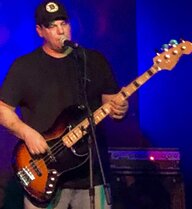
Paul still uses a Rick in his new band Lessor Key. A 4001CS if I'm not mistaken. Combined with a Darkglass B7k = killer tone.
Yeah, I heard his new band. Killer tone indeed.

TalkBass has been independent since 1998. Add your voice.
Create a free account to reply to discussions, view embedded media, and browse with fewer display ads.
Join free Log in
Want zero display ads or expanded classifieds tools? Compare plans.
Paul still uses a Rick in his new band Lessor Key. A 4001CS if I'm not mistaken. Combined with a Darkglass B7k = killer tone.
No. There IS something.........there is nothing less artistic then spending your time and energy attempting to rigidly classify other artists' art
Which is the year that In Rock came out.
And it was recorded with a Rickenbacker 4001.
So, the beginning of metal.
But then, "Communication Breakdown" was pretty heavy and it was recorded in 1968.
Of course JP Jones used a Jazz bass for that, so I'm sure some metal guys are suspicious.
And the song really wasn't about metal stuff, was it? But it was pretty heavy.
Now, Helter Skelter was recorded in 1968. And Macca used a Rick. And the Fall of the Roman Empire could be considered "metal stuff" right? So there you have it.
........
I think he means that the jazz pickup at the bridge is a "neck" pickup.
Can't confirm that it is, but usually the neck pickup is smaller which would make it easier to fit under the Rick assembly.
Ah, yeah. Only the pickup right near the neck is usually called a "neck pickup" on Rickenbackers. The other is the bridge pickup.

Yeah. Everything is really quite fuzzy at the edges. Is Sleep a metal band? I think so, others don't.Naw, not trollin'. Just kiddin'.
You called it the first time, I'm joking. Black Sabbath's debut album came out in 1970 . So the joke lies in the obvious omission of the seminal work that influenced the creation of an entire genre.
But in all honesty, I really don't think that Black Sabbath was the only heavy band at the time. Purple's work on In Rock was just as heavy, tho Machine Head gets more love critically. Zep doesn't get credit for modern metal, but I distinctly remember LZII being referred to as metal back in the 70s. And Communication Breakdown is every bit as heavy as Paranoid. At the time, it was all heavy duty stuff. Now, of course, Zep was quite a bit more diverse than Sabbath, and Purple had keyboards which became unmetal later on, at least in the US. But the only reason that bands that were called heavy metal in the 70s (Steppenwolf !) are not called that now is that the genre changed (as it should) and fans have moved the goalpost.
What modern metal fans consider to be "metal" music is a shorter spectrum of what I consider "metal" music. The modern metal fan has become extremely conservative in their tastes and opinions of the genre (something Bruce Dickenson addressed at least 15 or 20 years ago). Now, that's ok with me, but I see the genre as part of a wider spectrum.
And, ob topic, I believe that so did Cliffy B. His role in the genre was pivotal, but his approach was of the envelop pushing approach of his predecessors. Metallica was and is a modern metal band, but they didn't get that way out of the blue, they came from the heavy bands that they listened to. When my brother gave me the first Iron Maiden album and said "stick this in your playa, playa", I loved it. And it sounded like what might've happened had Black Sabbath and Thin Lizzy jammed together after drinking way too much coffee.
Modern music is released in a time period, and comparing Slayer to Helter Skelter album ignores the fact that they didn't happen at the same time and the amount of innovation between events. But they are part of the same continuum, because the approach was the same: Big, loud, aggressive, in your face.
The split P-bass pickup is quite different from Rickenbacker pickups, yes. I wasn't referring to that one, I was referring to the '51 style single coil pickup, which is somewhat similar.I disagree about pickup placement. Like I said, I ruined a Rick by putting a P-bass pickup in the exact same neck position as the original. Didn't sound like a Rick at all anymore. Rick pickups are unique. I believe they're single coil and also the bridge pickup has a bigger magnet than the neck one. At least my old 4001s did.

Yeah. Everything is really quite fuzzy at the edges. Is Sleep a metal band? I think so, others don't.
Genres are always named after the fact, to describe things that previously had no name, once there's a general consensus that at some point it's something that could use more specific nomenclature.
When they were first coming out, Black Sabbath were quite similar to several other heavy rock bands at the time. Just for whatever reason they became the main early influence on what would become the 'heavy metal' genre. It just worked out that way.
This is how it is with everything that changes over time. Where does one draw the line between the Baroque era and Classical, or between Classical and Romantic (it's generally agreed that Beethoven is the where Classical ends and Romantic begins... but that wasn't clear until much later).
I don't think Tony Iommi was quite the soloist that Page was... but I also think he had better sense in playing live, which guitar line to play if there was more than one (he knew people wanted the heavy riff, not the weird high harmony of it). Sabbath also had the sense to just hire a live keyboard player if they really wanted the keys there, instead of having keys instead of bass for parts of the set. I think, though, that they were always a live band more than a studio one. I've read in interviews that they never really got that comfortable or satisfied with their sound in the studio.Right. And as Frank Zappa said, talking about music is like dancing about architecture. You're supposed to just listen to it.
Of course, this is a discussion forum, so Frank be damned, I'm going to say that while I loved Sabbath at the time, they were just another heavy group for me, which is the kind of music I was into. But like all of them at the time, they still manifested the blues influences of the 60s London scene. But the Sabs weren't really that good technically. Purple was just as heavy, just as blues reflective and their musical abilities were an order of magnitude greater. Same with Zep. Ronnie Dio considered turning down the Sab's offer to join them because he didn't think they were in the same league as the Rainbow/Purple school. We all know how that turned out.
I think the Sabs had more impact on later rock musicians because their stuff was simpler, easier to play. Punk reenforced the concept that you didn't need to be good at your instrument to rock, and the combination made things like singing ability optional, blues out of date, and keyboards undesirable. By that time the sounds that I understood as heavy had graduated to "speed" and "thrash" and "hardcore" and eventually many other descriptors. And while some on this thread maintain that Tool is a prog band, so was Jethro Tull, and I think that we can all agree that Tool is way heavier than Tull. So, as I said, and you said, it's just not that binary - the borders are super fuzzy, and elements are interchangeable especially when time and era are considered.
I don't think Cliff was trying to write "metal stuff". He was just trying to be good at his art via his influences.

Don't underestimate the completely unintentional comedic value of this band (Manowar). Pure gold.
Also, when it comes to the creation of heavy metal, there were bands in the late 60's getting their feet wet, occasionally dabbling with a heavier sound on some songs. Black Sabbath dove into that pool head first. They started/created what is known as heavy metal. *drops mic. walks away*
I like how in some of the pics he has one knee on the ground like he is trying to get closer to the audience, especially in the one where he is using his sb 1000


