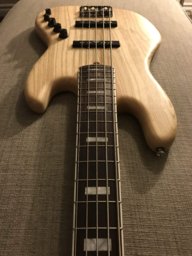
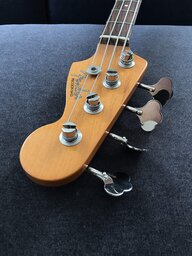
1) If you repeatedly could hear and correctly identify the diff b/t a one piece and a two piece bodied bass in a blindfolded, back to back test, and,
2) could accurately describe to me an audible difference that several other listeners could also identify and agree upon when pointed out, then;
3) I'd buy you a case of whatever is your preferred adult beverage
If I could hear the difference I would work at NASA but I still feel very confident there is one...I'll still take that beer if your offering...

And then there's the whole "wood versus glue" thing. My guess is that anytime you add more glue to the equation, there is a potential for some tonal change. But in the case of a two-piece body, this effect should be pretty minimal, and I would think that from a practical perspective, there would not be much perceptible tonal difference between a one-piece and a two-piece body as a result of that one glue line.
I would also add that some luthiers intentionally choose different woods, or different density of the same wood, for the "bass" and the "treble" side of the instrument.
I agree about the glue comment and the fact that glue has no positive tonal properties whatsoever...
IMO different woods, or different density of the same wood, for the "bass" and the "treble" side of the instrument is way over the edge...