• TalkBass has been independent since 1998. Add your voice.
    Create a free account to reply to discussions, view embedded media, and browse with fewer display ads.
    Join freeLog in
    Want zero display ads or expanded classifieds tools? Compare plans.

Club Alleva-Coppolo (Part 18)

Status
Not open for further replies.
In a word. YES.

I played my second nitro finished AC bass late last night and now can safely conclude there IS a difference over the poly finish. The advantage I personally feel is for the nitro.
I played a nitro NYC 1600 that was KILLER in Jimmy's own words--and believe me it was--IS !!! AND a newer white LG 5 Classic in white

I played 2 LG 5 Classics (CAOJ LG 5 and White LG 5--- and there is a difference---- with the nitro having more richness and fundamental to each note. Initially too, I felt there was a better ( more percussive and sweeter ) slap tone. NOTE: The nitro LG 5 also has the new capped at the headstock fingerboard which Jimmy claims on Meet Your Maker vid to give a better slap tone ????
For me it did anyways--KILLIN'. :hyper:

So my humble conclusion is that on the same wood choice bass, or model, the nitro finish will likely yield a more satisfying tone for the masses over its counterpart-the poly finish.

If budget were not an issue I would ALWAYS choose the nitro over the poly for tone, hands down.

Durability ?? Well maybe a poly would be better for wear and tear and stuff. :hmm:

For a humble old school kind of guy I personally find the Alleva Coppolo basses to be the most pleasing in the high end Fender styled boutique bass world..
I'm good with them....:D

You are attributing the difference in tone to different instruments to the paint job:eek:

+1 to the previous posts....every bass sounds quite different, even with the same electronics and wood spec.

With today's thin poly finishes, it would be extremely strange to think that a difference in paint would impact tone in any meaningful way.

The best support for this is the guys who had the problematic nitro fishing on their FBasses stripped and refinished in nitro. As far as I know, not a one has felt that tone was impacted at all.

That being said, many like the 'feel' of nitro on the neck, and many appreciate the 'glow and warmth' of the visual look of Nitro. Those are perfectly valid reasons to go with a nitro body finish.

I will +1 you on your comment that the A-C's are something special, nitro, poly, LM, LG.... they are special!
 
I'm not naive enough to believe you can ever attribute any of this sonic stuff down to an isolated factor. I've played a few poly LG's and I own three nitro LG's. FWIW they've all been great but the nitro ones have been the exceptional ones. For me though it's a combination of aesthetics, physical feel and tone that makes it desirable.

Certainly not a hill to die on but, for my money, I want an LG that's as period correct as possible. That authentic 60's vibe is why I bought those basses in the first place.

Just my .02.
 
I'm not naive enough to believe you can ever attribute any of this sonic stuff down to an isolated factor. I've played a few poly LG's and I own three nitro LG's. FWIW they've all been great but the nitro ones have been the exceptional ones. For me though it's a combination of aesthetics, physical feel and tone that makes it desirable.

Certainly not a hill to die on but, for my money, I want an LG that's as period correct as possible. That authentic 60's vibe is why I bought those basses in the first place.

Just my .02.

+1 all the way. 'Period correctness' is a valid goal, and nitro makes much sense on a 60's style instrument. Not sure if that massive upcharge would be worth the cost for most, since again, I don't think there is much of a tonal impact. However, if you can afford the scratch, as you know, Jimmy's nitro finishes are just beautiful. It is as if they are alive or something.
 
IMHO(!!), the only reason to upgrade to nitro is you want the finish to wear through sooner for a naturally earned relic'd look, and you just happen to like the way nitro looks over a comparable poly finish (I do think they look different, even if they're the "same color"). Count me firmly in the camp (just like last time we debated this) that doesn't buy into any tonal impact. FWIW. :)

Musicfreak1988, fantastic spec. You are going to LOVE that bass. I can't wait to hear your first gig reports. :)
 
Nitro has a different feel All together.. Waaaaaay different than Poly... Does poly chip less easily? Yes. But Poly can chip too.
Does it sound different. Not at first , but after years, I believe it does.

Nitro can breathe, and will thin out and shrink over years, where Poly is basically a controlled application of a colored plastic layer applied over the wood.

Different look too... Nitro looks deeper and more organic than Poly..
Much like Like velvet compared to Satin...

My last two basses that i got form Jimmy are Poly.. my LG5 and new KBP5 Ave Maria NAMM show sparkle bass...
I spec Nitro necks , except for my new KBP5
I prefer the feel of nitro on a neck, and it wears in much nicer over time.. Im not one of those guys that puts my bass in a case to worship it, or show off to people about how shinny i can keep it and buff it each day. Thats poseur stuff. I play the damn things.
My sadowsky NYC has been one of my main basses for 20 years... they have Nitro necks and i have worn though each one from constant gigging.. And now they feel like satin to play!

Anyway, Poly will look more glossy over time with minimal care..
Either way you will be happy because Jimmy POLY is very thin compared to others.. Some poly basses are like a glove encasing a bass not so with the Alleva..

And to say there is no difference is really disinformation IMO. .Like a non wine taster not knowing the difference between a Box of Gallo wine and a bottle of 2005 Cuvaison Merlot.. Just IMO...
Is one better than the other... IMO no.. they both will satisfy their consumer either way...
 
Before I had my LM4 built, I asked Jimmy if he thought there was a tonal different between nitro and poly. His answer then was "Yes, but it is a very slight difference".

I have a nitro LG4 and a poly LM4, and while I like the LG4 better slightly, I can't honestly say that it is the finish that makes the difference. The woods much more influence the tone, is my educated guess.

With some EQing I can make the LM4 sound close enough to the LG4 that probably 99.9% couldn't tell which was which in a blind test.
 
My KBP4 is 3tone sunburst, all nitro finished, vintage bridge, but it is an "A" neck, 1.5" width at the nut. My new KBP5 will be all poly finished with satin textured neck and have the standard Hipshot bridge. I will celebrate the tonal differences but I don't think it's going to come from the paint, in any measurable way. As long as the paint is thin I'm good. I take the OOOO steel wool to the back of the necks anyway. Then you play them a while and they get shiny again and I take the wool to them again. A very enjoyable cycle. And I love getting the character markings the old fashioned way -- earning them.
 
That is what my kbp4 is 1.5 at the nut... Actually that neck profile is an exact replica of my old L series J bass that jimmy did years ago.

Talking about steel wooling a neck .. My friend gets brand new sadowskys and his tech takes ALL the finish off the back of the neck with sandpaper.. Its smoother and warmer feeling..
I think Nitro feels warmer and silkier than a poly neck IMO...

Yup, I too think character makings as you call them should be earned and not done on purpose..
That is what my "poudah" kbp4 is like.. each dent and wear mark are from a gigs or a tech or myself dinging it over the few thousand gigs its been on...

The only bass that i like that is pre worn in are the Fender RW... So far i haev not played a bad one.. They have all been lightweight and resonant.. and its already dinged up so you dont ever have to worry about it... I want to think about playing or not think about it, and let auto pilot take over on a gig, than worry about and smudge or ding or dent.. Its counter productive in my opinion. Just play the thing and the dings fall where they may... haha


My KBP4 is 3tone sunburst, all nitro finished, vintage bridge, but it is an "A" neck, 1.5" width at the nut. My new KBP5 will be all poly finished with satin textured neck and have the standard Hipshot bridge. I will celebrate the tonal differences but I don't think it's going to come from the paint, in any measurable way. As long as the paint is thin I'm good. I take the OOOO steel wool to the back of the necks anyway. Then you play them a while and they get shiny again and I take the wool to them again. A very enjoyable cycle. And I love getting the character markings the old fashioned way -- earning them.
 
That is a great neck shape, makes the whole thing feel more agile. I think of my KBP4 as almost a classical instrument. Also mine has a full bar string retainer behind the nut like the 5 strings get which I think is a big plus to the feel and sound.
 
Hello everybody,
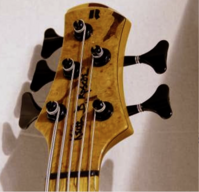
glad to be new AC's owner.:hyper:
 

Attachments

  • ACCM Full front small-2.jpg
    ACCM Full front small-2.jpg
    23.3 KB · Views: 109
  • ACCM Close front small.jpg
    ACCM Close front small.jpg
    42.6 KB · Views: 112
Nitro has a different feel All together.. Waaaaaay different than Poly.

Does it sound different. Not at first , but after years, I believe it does.

Nitro can breathe, and will thin out and shrink over years, where Poly is basically a controlled application of a colored plastic layer applied over the wood.

I'm always one who thinks it's often too difficult to isolate single factors in what makes up or changes the tone of a bass, but Chris Stambaugh has an interesting take on poly vs nitro vs oil (his usual preference) finishes.

Stambaugh Designs website said:
For gloss finishes, I typically use urethane, though nitrocellulose is available. Many players feel that vintage instruments sound better over time. Some attribute this to the nitrocellulose used at the time, but this is not due to any inherent superiority of the finish.

The nitro breaks down over time, turning yellow, brittle, and cracking. This separates it from the wood, allowing the wood to breathe and vibrate freely, creating a better sounding instrument. It is the inherent flaws of the finish that are it's best attributes. Rather than waiting thirty years for this effect to take place, other finishes can instantly start this vibration tuning process.

Rubbed oil has become a popular finish for basses in the past few years. It readily allows the wood to breathe while providing moderate protection against the elements. Oil finish also creates the feel of bare wood under the hands, which many players find extremely comfortable. Clients regularly report that after only about six months, there is a noticable improvement in the tone, as the wood has "opened up."

It's an interesting concept and one where Chris seems to feel similarly to you Kirk.

Even if there's the possibility of a slight tonal gain I'd likely opt for a gloss finish on an AC for the convenience especially since Jimmy does such thin poly finishes. Either way, you know you'll get a beautifully finished instrument from Alleva Coppolo.
 
Status
Not open for further replies.

Latest posts