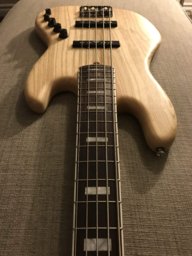
That is pretty light, most LG5's are somewhere around 9lbs.
Speaking in a generalized sense as weight is discussed so much on this site, but it's mostly due to players that want a bass to be built for comfort or to not exasperate a neck or shoulder injury sort of like you mentioned. Adding mass to the bridge obviously changes how the bass sounds? Some would say no, others say yes. There's many on this site that will say the pick-ups are the main driving force behind the sound of the instrument. I believe the right woods chosen by a good luthier are definitely part of the tone equation having experienced a lot of Jimmy's basses and many other brands. Ash is an interesting wood where weight matters from my experience, but you always have to play the finished instrument to find out. Heavier pieces of ash tend to have a huge sound...but not always. Light ash can sound great too, but generally for some serious cutting tone.
Remember your former 2011 Limited Edition LM5 from what back? I owned that bass a while back. That one was pretty killer. I also remember that one wasn't overly heavy and it had a Badass bridge on it too.
SOLD - FS ONLY: Alleva-Coppolo LM5 Deluxe Limited Edition
9.5lbs from your thread...not that heavy. I had Jonno's former Blonde LM5 which near 11 lbs
 TRADED - Alleva Coppolo LM5 Deluxe - Butterscotch Blonde
This one had the had a hipshot bridge on it. I was lucky enough to have tried your former LM5 with a hipshot bridge too.
I'm doing an experiment testing out the Fender Fat Finger. Just had two shipped to me today so I have nothing to report yet. I'm sure some have tried these already, so I'm late to the party, but it's interesting how attaching more weight to the headstock can add sustain and move deadspots. The cost of admission to try one of these was pretty cheap for the experience, but I thought why not? Is it possible that it could make any of my basses sound better? I guess I'll find out!
Also interesting to consider that Tom Stenback adds a weight inside the control cavity of his basses to do something similar that the Fat Finger achieves. Was this design principle added to replace the void due to the cavity therefore replacing the missing mass? I don't know the answer to this question, maybe someone does.
I did notice in some of the videos on YouTube of Tom's basses that he added clamps to the headstock.
There's definitely ideal weight for an instrument. Couldn't imagine what one of those double neck basses weigh...those are probably real boat anchors! Doesn't mean they'll sound awesome either just because they weight a ton.
The one conclusion I can confirm is weight doesn't necessarily make a bass "better"...some basses are just built with all the right conditions for amazing tone.
Having said all this, I'd still like to check out that fancy LM5 that Sammy has in stock! LOL!