OK, here's another one on practice. The author knows whereof he speaks. Long post:
If you are like most people, you are either self-taught or you learned how to play a musical instrument in the public schools. If so, then be aware that you may have been programmed to learn in an inefficient and largely unrewarding way. As a result, many hours of practice have been lost because you cannot remember what you learned. And, obviously, if you cant remember it, you cant use it. Unfortunately you may have invested a great deal of time and money only to feel as if learning music is all work and no reward. If this has been your experience, then its time to learn a new way.
The problem of the old way is that it depends for its success upon rote learning and ineffective methods of memorization. By contrast, the new way is compatible with the way the nervous system processes information and enables you to make progress in a natural and satisfying way.
It is essential to bear in mind that the valuable years of learning, which passed when you were very young and the nervous system was still being formed, have already been given up to the old way. Habits have been formed which are, for the most part, bad habits. These are destructive to the learning process, and will not contribute to your growth or pleasure in the study of music. However, simply recognizing these habits for what they are is not enough to get rid of them. You may consciously understand the new way, but the unconscious is in the grip of the old way and will prevail unless you constantly remind yourself. Presence of mind throughout the entire learning experience is necessary if you want to break the spell of the old habits. The new way may seem a little artificial to you because it is so unlike your previous training, but have faith you will see results soon!
Now, lets look at the features of the new way. We will take up in turn: Quality, Quantity, Motivation, Diagnosis, Two Kinds of Memory, Recall, Time Frames, Accuracy and Speed, and Overload.
Quality
With the old way of learning, you are fed a piece of information of dubious relevance or importance and expected to master it for some future good, which you do not presently comprehend. Because the information is not perceived to be of use to you, it is not well enough imprinted for easy recall. Then, six months later, when you need it for a particular application, you have to go back and learn it all over again. This has taken twice the time for half the musical payoff. This does not mean that you wont encounter material from time to time whose immediate relevance is not clear to you. You will. Should you ignore it and go on to the next assignment? The answer is no. Once your eyes, ears and hands have touched a thing, there is a kind of déjà vu effect, which makes it much easier to remember later when the need arises. For this reason you should go through the regimen and discipline of learning that piece of information, knowing full well that you may not fully retain it this time around. There is how ever, a more efficient way to learn. It is based on the often heard but little appreciated rule that states: a person learns what he wants to learn when he wants to learn it. This is of the utmost importance in the selection of material. You must know exactly what you are working on and exactly why you want it. You must see how it fits into your present body of musical knowledge and how and where you will use it once you master it. Therefore, whenever possible, work only with information which has a useful purpose now.
Quantity
Lets talk for a moment about dealing with large quantities of information.
When approaching a new piece of music with hundreds of notes that you are supposed to learn, are you going to learn all of those notes simultaneously? The answer is not likely. Nevertheless, it is possible to make the simultaneous learning of many notes appear to happen, as it does with good studio sight-reading, but this is an illusion. They are still learning one note at a time; only the process is so accelerated, as to seem like magic.
The old Chinese proverb A journey of a thousand miles begins with a single step changes the nature of the problem of learning altogether. You have only to play the first note successfully and properly to inform your nervous system that you are capable of playing that first note well and that you have now played your instrument correctly. You have now proven to yourself that you are a successful learner. Now you need only to build on the base step by step, and the performance of the rest of the piece is merely a question of quantity rather than quality. In other words, if a student skier can ski the first three feet correctly, he certainly can ski the next three feet correctly and the next and the next. With this recognition comes strengthened motivation. The next note is easier to learn and the process accelerates. Just remember; after learning that first note, ask yourself simply what is the next step? The obvious answer is - the next note. In this way, dealing with hundreds of notes at once never overwhelms you.
The next step is just to put the first two notes together and perform them in sequence. Youve now doubled the amount of material youve mastered without increasing the difficulty. Next? The third note and the fourth note
and now all four together
!
Motivation
We are all accustomed to think that motivation results from the input we receive from others, whether this is a gold star, a word of encouragement, or even a failing grade. This is part and parcel of the old way of learning, but the motivation received in this way is short-lived. The only lasting and reliable source of motivation is successful performance, and only you can insure this. The self is the real source of motivation.
When you turn to a lesson and sit down to devote fifty minutes of your time and concentration, you must be assured that at the end of the period you will put your instrument down and walk away with what you sat down to get. You must give up the habit of failing and replace it with the habit of success. Youve got to walk away with the reward every time, or know exactly what went wrong. With the new way, failure to learn and grow is eliminated by design. You will never walk away with a blank because you are confused about what you are doing or because of poor study techniques. But how do you determine what to do if something does go wrong? This brings us to diagnosis.
Diagnosis
In your studies it is very important to be aware of the effects of environmental factors such as weather, light and background noise.
If it is a hot, stifling day and the oxygen count is low, your learning is going to be affected. Improper lighting can cause fatigue and eye strain. Be sure that your practice area is well lit; if you are particularly sensitive to this problem you might solve it with full-spectrum lighting, etc. Next, be aware of distracting noises in the environment. We live in a world of 60-cycle hum. The electricity in all of our walls is humming away, producing a pitch somewhere between b-flat and b-natural. If there is an air conditioner of refrigerator nearby, the sound can influence everything you play. You can be severely out of tune with the refrigerator and easily misdiagnose the problem as a fault of a tin ear or lack of talent.
All of this points to a larger concern- the problem of properly diagnosing and identifying the obstacle to successful and rewarding learning. You might think, for instance, No matter how hard I try, I cannot play fast enough there must be something wrong with my hands. The problem may actually be only the poor synchronization of two excellent hands.
Finally, relaxation is an important factor. Being relaxed affects your blood-flow and your muscle tone. Proper posture is equally important. Get up from your chair, get the instrument out of your hands, and stretch frequently. If the task starts to seem overwhelming lie down flat on the floor and breathe deeply for a few moments. Imagine yourself playing the passage perfectly; be kind and considerate to yourself- after all you are learning to play music for the joy of it. Keep yourself relaxed and comfortable at all times, and your learning will be many times more effective.
Two Kinds Of Memory
There are two kinds of memory involved in the learning process, motor memory and data memory. Your motor memory is the training of the physical or motor skills and your data memory is the memorizing of conceptual data. If you are training motor skills, you can practice for many long hours without doing any harm. The more of this kind of repetition the better. In fact, much of this kind of learning can be accomplished unconsciously. A person can achieve wonders while mindlessly staring at the television, playing or doodling for hours, even with the sound on.
With data memory (memorizing scales, fingering patterns, licks, songs, harmony etc.), you must work within very short time frames, making sure you do not exceed your attention span. Bear in mind that your attention span will vary from day to day, and may be as short as five, ten or fifteen minutes at any one sitting. The signal that you have come to the end of your natural attention span, may be anything from staring at the wall, to thinking about your vacation, to playing that little old blues lick you have known since you were seven. In this case, your unconscious mind is telling you, youre done, youre full, and youve had enough for now. This is perfectly natural. So take a short break. Its no big deal. Youll recover quickly and you can continue on effectively.
Remember, then, that there are two completely different aspects to gaining musical control of the instrument. First, learn by mental rehearsal, visualization and recalling it from memory. Second (though no less important), develop and train your motor skills through repetition. Dont fall into the trap of confusing these two different types of learning by spending hours working without concentration trying to acquire conceptual data (data memory). Also, dont be fooled into thinking that there is a short cut to acquiring motor skills.
Recall
Studies have shown that the mind is like a camera. Once it gets a clear impression of the material, the picture is snapped into focus. You have it. It can now be recalled and replicated in order to train the motor system. Memory should not depend on repetition. Rather, the rote learning we are taught in school is actually destructive to the learning process. What you should be doing is looking at the material once to get a very clear, focused picture: then, mentally rehearsing it without actually using the instrument. On the old rote-memory system, you are taught to repeat the learning process over and over. This is where you start to forget. The picture blurs, and you do not learn how to remember.
Reinforce this new way of learning by staying away from the printed page as much as possible. Make the snapping of the image only once a matter of habit. Practice recalling the sounds and visualizing the fingerings that match those sounds. Do this when youre stuck in traffic, waiting for the bus, standing in line at the bank or having lunch. In time this will become a second nature, and you will become a perpetual learner, able to learn as much away from the instrument as you can with it in your hands.
Time Frames
You may ask How long should I work on new material at any one time? The answer is, you should work on new material in very short time frames. A few minutes of concentrated, thoughtful study can make a solid impression and can prove far more beneficial than hours of unfocused drudgery.
You will need to assign yourself breaks by the clock until you become sensitive to your own physical and mental signals. So get yourself a kitchen timer and time each section of your practice.
I recommend practicing:
15 minutes on
5 minutes off
15 minutes on
5 minutes off
When your timer goes off, obey the discipline of the signal. Do not break it and go beyond your assigned time limit! Then as time goes by and you become better at managing your time, you will become more and more sensitive to your own limits, and youll be able to sense when you have gone on too long and need to rest. Remember that, while on the old method it is all right to practice until you drop, the new method requires you to re-train yourself for a whole new kind of learning experience.
Accuracy and Speed
It is natural for any student of instrumental music to want to play fast right away. This is a perfectly legitimate desire. It is crucial to remember, however, that speed is a by-product of accuracy. If youre not accurate, your speed will simply not develop. If you try to play too fast too quickly you will simply reinforce the bad habit of sloppy playing.
Your first mistake should serve as a signal, informing you not to do it again. That little mistake might not seem like much to the casual listener, but to you, engaged in the training of your motor system, that one mistake is far too costly to let slip by uncorrected. If you do let it go by, your nervous system will begin to view that level of performance as acceptable, and the mistake will become more and more difficult to overcome. So an important rule to remember is: Do not make the same mistake more than once. Multiple mistakes of the same type are very dangerous. Once you make a mistake stop, go back and slow it down to a tempo that you can play accurately without making a mistake. Then slowly increase the tempo and speed with accuracy will come naturally.
The Overload Problem
Now you might ask All right, now Ive broken the material down into very small sections, and Im going to work on them slowly. But how many of these small sections can I keep in the air at the same time? This is where you have to answer your own question. The process of assembling small bits of material is like a juggling act. If youre trying to handle four small sections and at that moment you are only capable of handling three, adding the fourth can make you fumble the other three. So, if you feel a sense of overload, back off and concentrate on parts 1, 2, and 3. Its far better to leave your practice session with three bars of successfully accomplished study than to walk away with fifty bars of material you dont quite remember and cant quite execute. If you do subject yourself to overload, you will exhibit some discouraging symptoms. The most obvious symptom is not getting around to practicing you just dont feel like doing it, even though you cant explain why. Does this sound familiar?
Remember, that the ability to manage your time must always be kept in consideration. Realize that it may never become completely natural to you, because our previous training is likely to be deeply ingrained. Youll have to remind yourself constantly that you are in the business of adopting new methods for more efficient learning.
Food For Thought
To become a well-rounded musician takes time and patience. Rarely does anyone accomplish such a goal in less than four years, and I would guess that the norm is five to ten years-or longer. It takes time to be a good musician. There are no shortcuts or quick fixes.
Realize that very few people use their time to maximum efficiency. Minutes and hours of time pass unnoticed by most of us every day. Learn to use those minutes and hours, rather than wait for a longer, more reasonable time later. If there isnt time to do everything, the do something. It is better to concentrate on a smaller number of items, anyway, than to attempt everything in one session.
Heres an example: If you laid five bricks a day, at the end of the year youd have a 10 x 10 practice room. If you copied one part from a score each day, by the end of a year youd have copied 24 arrangements for a 15-piece band. If you drive to school or work, put some kind of stereo in your car. If the trip is 20 minutes each way, and you stay home on evenings and weekends, you can still listen to about 165 hours of music in a year. A typical jazz standard can be learned in about half an hour. If you learned a new jazz standard each day, in a years time youll have learned 365 songs.
By following these simple suggestions, at the end of the year youd have a brick practice room, 24 arrangements copied (which could earn you up to $500), listened to 165 hours of music and learned 365 jazz standards.
This list probably doesnt coincide with your goals or the timetable youve set for accomplishing your goals. But it should be obvious to you that without forsaking many, if any of your present activities, you can accomplish your goals and become what you wish to be.
Benny Goodman
Jazz Musician
May 19, 1985 University of Hartford
I remember one occasion, some years ago, when my late wife, a passionate and enthusiastic gardener, had been listening to me through an open window repeating endlessly certain passages of a piece I was practicing for a concert. She finally came in and said: Dont you ever get tired of going over and over and over the same phrase? I had been glancing out of the window from time to time while playing so I replied: Its funny you should ask me that. I have been watching you working in the boiling sun for hours on end, weeding, digging, planting, pruning, covered with dirt and Ive been thinking the same about you.
So perhaps one thing is common to both gardening and music. Good results depend inevitably on the work one is willing to put into it and in the work itself whether practicing or planting you find your true enjoyment.
__________________


 ) when i finaly took lessons .. that is 2+ yrs ago ...
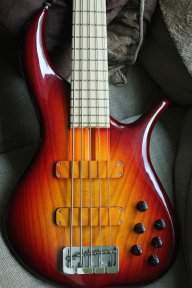



 Hey everyone. I am posting this in a bummed state. I was going to get the "Naked" VF5 at Fretspot, but I just cannot get it right now. So, GOOD NEWS for all of you folks that this bass is still avail. Hit up Donovan at the Fretspot.com and grab this thing.