• TalkBass has been independent since 1998. Add your voice.
    Create a free account to reply to discussions, view embedded media, and browse with fewer display ads.
    Join freeLog in
    Want zero display ads or expanded classifieds tools? Compare plans.

Club Sadowsky!!!

With all the PJ talk, played two gigs with my new-to-me MV5-PJ yesterday and it killed through the Aguilar TH500/SL112 (x2) rig. Really meaty and full but with very tasteful top end. I don't have to tell y'all how much it is different from the JJ config it is but, I'm diggin' it and the PJ is definitely my preference of the two. I do find myself boosting the pre more on the PJ than what I'd run on the JJ. Just a really sweet, rich sound out of this thing.
 
I want a bass that sounds like the bottom 2 strings (coil closer to the neck) of a Sadowsky PJ across all 4 or 5 strings. Has anyone ever seen a bass like that? I'm thinking sadowsky narrow soap plus an HC J could be right on the money. But I'd want it to really have that P sound on the neck pickup. The D and G would get that stu zender reverse P pop sound, but I'd still have my big meaty E and A. A split coil soap with the right aperture should be close?

I have a J bass I'm considering modding as an experiment/prototype. NYC order would be a pretty heavy commitment if it was the first ever with that config. It would be ash/braz if I did it though. And maybe universal route for JJ and a second pickguard, hmmmm.

Just don't like the near-coils sound at all on a pj, either on the low or high strings. LOVE the E and A on a PJ.
 
"cut passive, boost active"

I do this almost always.

While I never feel the need to do this, it makes much sense if you want to boost the upper midrange/lower treble, and remove the upper treble from your tone.

Since the active boost pretty much boosts everything above 4K (I believe it is a shelving circuit, or at least a VERY wide Q treble boost), and since the passive circuit cuts the same amount of lower and additionally lower frequencies as you engage it (works kind of like a variable lo pass control... not technically, but in 'end result'), you can basically, for example, boost everything abov 4K active, and then take everything over 6K off with the passive tone control (as an example), resulting in a 'presence/grind' sort of boost without a lot of sizzle.

Subtle, but works pretty well if you like 'bright, but no sizzle'.
 
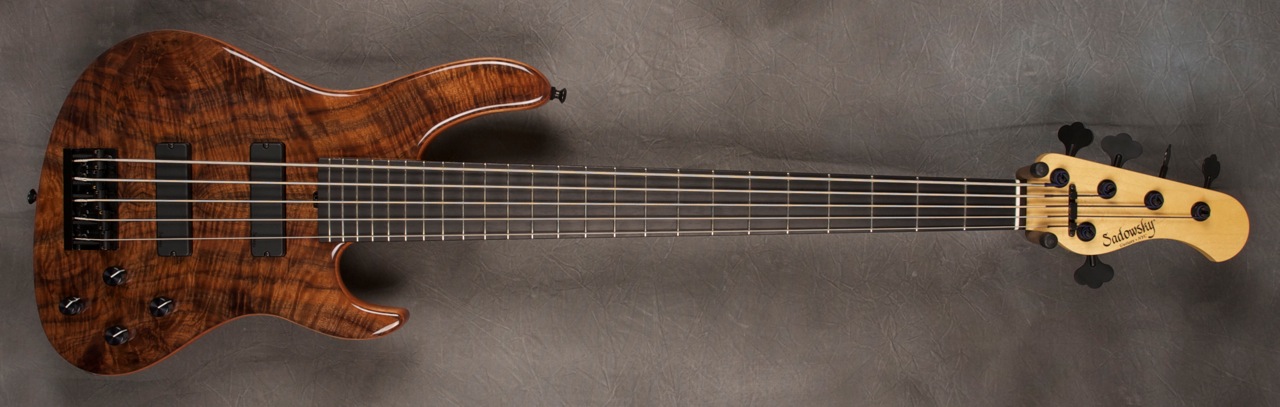
Recently took delivery on what I guess are the P2 pickups. (correct? Not familiar with the term. Assume from context above it's just the soapbars in the smaller shells)
DSC_2057.jpg


These are amazing pickups.

My ears are used to Alembic Series I pickups and Stock Fender Jazz pickups.

Active, these Sadowsky's provide a clarity similar to my Series I, and passive (or active & flat) they hover sonically around a J or PJ, depending on which pickup you favor. Not identical, but brethren to be sure.

My pickup location is different than a standard modern, and I believe this has a definite effect on the sound.

My [Invalid or Expired Link Removed] had the larger shells in the standard locations. (I think !?!) Also a great sound.

It would be marvelous if you could provide more detail in comparing the soaps in '60's position, as compared with the "modern" placement. Can the 60's placement still do that burpy, Jaco-like thing? (and let's not dwell on why that tone seems to come more easily on 70's placement, while Jaco played '60's instruments!) It would be really great to have some sense of the difference with each pickup soloed, and with both full on...Thanks!
 
While I never feel the need to do this, it makes much sense if you want to boost the upper midrange/lower treble, and remove the upper treble from your tone.

Since the active boost pretty much boosts everything above 4K (I believe it is a shelving circuit, or at least a VERY wide Q treble boost), and since the passive circuit cuts the same amount of lower and additionally lower frequencies as you engage it (works kind of like a variable lo pass control... not technically, but in 'end result'), you can basically, for example, boost everything abov 4K active, and then take everything over 6K off with the passive tone control (as an example), resulting in a 'presence/grind' sort of boost without a lot of sizzle.

Subtle, but works pretty well if you like 'bright, but no sizzle'.

Ken, that was my conclusion as well, and that treble boost must be a very wide Q because it sure is a game changer when it's boosted and passive tone is engaged. Makes me wonder what the value is on the tone cap, it sounds like it's pretty high.
 
It would be marvelous if you could provide more detail in comparing the soaps in '60's position, as compared with the "modern" placement. Can the 60's placement still do that burpy, Jaco-like thing? (and let's not dwell on why that tone seems to come more easily on 70's placement, while Jaco played '60's instruments!) It would be really great to have some sense of the difference with each pickup soloed, and with both full on...Thanks!

I definitely plan to share something along these lines. End of year is my busy time for my day job, so it might not be for a while. (i.e. 2013 :rollno:)

One thing I am slowly coming to appreciate is just how much variation is possible with this set-up. I feel like I haven't even come close to mapping out all the different ways to vary the tone.

Even leaving the tone along for the most part and just moving where I am plucking closer to the bridge or neck has a significant sonic effect. This might be the most "transparent" (for lack of any other, more accurate term) bass I've ever played.
 
Ken, that was my conclusion as well, and that treble boost must be a very wide Q because it sure is a game changer when it's boosted and passive tone is engaged. Makes me wonder what the value is on the tone cap, it sounds like it's pretty high.

The bell curves for the bass and treble boost on my preamp are very wide.....on the treble, 4K is the center point of the bell curve....it is boosting equally on both sides of center.

I love the way you can boost treble and use the VTC to roll off highs. They compliment each other very well.

Roger
 
The bell curves for the bass and treble boost on my preamp are very wide.....on the treble, 4K is the center point of the bell curve....it is boosting equally on both sides of center.

I love the way you can boost treble and use the VTC to roll off highs. They compliment each other very well.

Roger

Makes sense. So, you get a nice dose of lower treble AND upper mids (the wide Q non-shelving circuit) by boosting that active treble and then 'shaving off the upper treble' with the passive tone control. Nice, again, for those that want it 'bright, but not sizzly'.