Regarding wear and tear on strings, here are a few non-fake facts:
1) The string cores are a hardened steel.
2) Initial installation of the string causes permanent deformation of the core at the bridge saddle.
3) Permanent deformation of hardened steel fundamentally changes the mechanical properties of the core, and that occurs at the bridge witness point.
Regarding the point 3, it is likely that further cyclic strain induced during playing further changes the basic structure of the steel core at the bridge witness point.
All of these aspects add up to changes in the string, which are not recoverable by boiling etc. I don't want to get too deeply into the metallurgy; but if you actually need strings to last longer, you would want to avoid the witness point damage by using a collet type of bridge point, or something like that. The other way to lessen the impact is to increase the distance between the tailpiece and the bridge point, while reducing the break angle. Of course, that also would require a substantially different body profile.
When the damage gets to the point that the string loses 12th fret intonation, the string can not be played in tune any more, and there is no way to correct that for the damaged string.
Other than that, carry on.









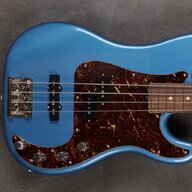


 The Blue Labels work great on my current Sadowsky.