• TalkBass has been independent since 1998. Add your voice.
    Create a free account to reply to discussions, view embedded media, and browse with fewer display ads.
    Join freeLog in
    Want zero display ads or expanded classifieds tools? Compare plans.

Club Sadowsky!!!

Screw to wood connections require attention. Especially on newish wood. Roger recommends hand tightening neck pocket bolts and strap lock screws at every intonation and string change.

This isn’t screw to wood - the pickup height adjustment screws have metal threaded inserts and there’s enough tolerance there to allow them to loosen pretty easily.

While I do make sure strap button screws are tight before every gig and occasionally make sure my neck screws are snug, I’ve never had an issue with pickup height adjustment screws loosen on their own when screwed directly into wood.

Blue Loctite is your friend

Yes - I mentioned this in my original post. Clear nail polish works great too if you’re in a pinch.

Still not ideal, IMO. Threaded inserts seem a bit unnecessary when it comes to locations that don’t require a lot of tightening, retightening, removing, etc.
 
  • Like
Reactions: Vic and marchone
Threaded inserts seem a bit unnecessary when it comes to locations that don’t require a lot of tightening, retightening, removing, etc.

I've had to deal with pickup mounting screws becoming too loose when embedded in wood. But I don't believe I've owned any basses with threaded inserts for pickup mounting, so I can't say which is more reliable.
 
  • Like
Reactions: Alessandro Cruz
Unless you're the kind of person like "set it and forget it" or have zero interest/knowledge/skills to deal with adjustments or pickup swapping or whatever, I guess the inserts are in there to avoid any issues with holes being worn out, making it difficult to hold the screw tight in place. Just my POV, though...
 
I’ve never had an issue with pickup height adjustment screws loosen on their own when screwed directly into wood.
After having my guitar painted and installing a Sadowsky preamp, the pickup screw came out on a gig a few months after the service.

The front pickup on my Schecter, where I anchor my thumb, the top screw came out while playing during a performance.

I noticed the E string was dead and lousy sounding.

I looked down and the screw literally fell out.

Waited for the song to end and swapped basses with my Jazz.

The next day I pulled all the pickup screws and put good old fashioned Tite-Bond in all the screw holes.

Fixed.

Screw back out is a reality, so check your screws.
 
After having my guitar painted and installing a Sadowsky preamp, the pickup screw came out on a gig a few months after the service.

The front pickup on my Schecter, where I anchor my thumb, the top screw came out while playing during a performance.

I noticed the E string was dead and lousy sounding.

I looked down and the screw literally fell out.

Waited for the song to end and swapped basses with my Jazz.

The next day I pulled all the pickup screws and put good old fashioned Tite-Bond in all the screw holes.

Fixed.

Screw back out is a reality, so check your screws.
35 years in and hasn’t happened to me once with regular wood pickup screws. I guess I’m lucky. Strap buttons on the other hand … :rollno:

I had to readjust and/or tighten the Metroline threaded insert pickup screws twice in 4 gigs before I had to do something about it. First time I thought it was a fluke - second time I realized it’s just fancy for fancy’s sake and causes more trouble than it’s worth. At least on my bass.

*shrug*
 
Last edited:
  • Like
Reactions: Tim1
35 years in and hasn’t happened to me once with regular wood pickup screws. I guess I’m lucky. Strap buttons on the other hand … :rollno:

Either you've been lucky or I've been unlucky because it's happened to me somewhat regularly over four-plus decades... translation: once or maybe twice per decade. Not nearly as often as loose strap buttons (but Dunlop Dual Designs reduced that problem significantly).
 
I own a 78 pre EB stingray with threaded pickup screws for 40 years, never once did I have an issue. I think it depends on how much counter pressure in form of foam or in case of the Stingray springs is pushing the pickups upwards. Enough pressure should prevent the screws from moving. Regarding strap locks, I had issues with old Schaller pins coming lose, but ever since I use Dunlops with the screws that come with the set, it's a non issue.
 
I own a 78 pre EB stingray with threaded pickup screws for 40 years, never once did I have an issue. I think it depends on how much counter pressure in form of foam or in case of the Stingray springs is pushing the pickups upwards. Enough pressure should prevent the screws from moving.
This is actually a great point - after just checking, there’s definitely a more forgiving “squish” to the pickup if I press on it than there is with any other bass I own, so I bet a more substantial chunk of foam underneath would also help.

Great insight - thanks!
 
This is actually a great point - after just checking, there’s definitely a more forgiving “squish” to the pickup if I press on it than there is with any other bass I own, so I bet a more substantial chunk of foam underneath would also help.

Great insight - thanks!

True.

That's why some basses will come with springs over the screws or larger springs under the pickups, like the MEC pickups from Warwick basses.

upload_2022-9-30_19-15-34.jpeg
 
  • Like
Reactions: Fred312b
I would suspect it can be influenced by right hand playing style. Someone who slaps over the pickup or rests their thumb on it may well put the screws under greater pressure and create a problem. I have never had any issues of this kind in over fifty years of playing but I do not slap and my hand usually floats free.
That’s exactly why it came out.

I forgot, that screw fell out 4 or 5 years earlier.

The glue fixed it for sure.
 
Anyone know when those finishing and inspecting the NYC basses began signing and dating the inside of the cavity covers?

I've seen photos posted online of such... merely curious when this practice began.

Thanks!

Not aware of the exact date the signings started, but my 1990 has Ken Fallon’s signature on the cavity cover and his initials on the preamp module. All you could get was NYC at that time, and even back then the workmanship on the bass as well as the electronics was superb. If my is story right, Fallon went on to become more of an acoustic guitar specialist as well as the touring guitar tech for The Rolling Stones.

I would not be surprised if Roger signed the instruments or had someone sign them from day one. It’s a centuries-old practice in the stringed/bowed orchestral instrument world, which of course carried over to premium guitar builders.
 
Last edited:
I have had my new Sadowsky Ultra Vintage J5 since Tuesday. It arrived during a week and weekend with no gigs which is highly unusual. My first chance to play the NYC UV J5 with my band will be on two shows this week. I can't wait!

Today I asked my wife to listen to my Sadowsky NYC Ultra Vintage (Roasted Ash body/Flame Maple) compared to my Sadowsky Japanese MetroExpress J5 (Ash/maple) in my home studio. I laid down a loop on electric guitar so I it could be heard in a musical context.

She doesn't have a musicians vocabulary to describe tone so it's always interesting when she describes how she hears things. Her comments mirror my own although I would describe things differently and in words my bass brethren would understand. When I played both a couple of times she pointed to the NYC Sadowsky Ultra Vintage J5 and said "I like that one!" When I asked why, she said; "That bass sounds like Professional bass like what I hear when I listen to songs. When I asked about the Japanese MetroExpress J5, she said it sounds like "Seinfeld." Ha!!

I totally get it. The Japanese ME5 is brighter and has more mid scoop and no matter how I EQ it with all things b being equal, it is brighter and bit more lean. I don't know if that is because it is an 8 lb Ash/Maple bass versus the 9lb Ultra Vintage J5 with roasted ash and flame maple. It doesn't really matter.

What I would say is the NYC UV J5 has more growl, and perhaps some more inherent midrange and a depth of tone that I cannot quite replicate on my Japanese MetroExpress J5. I still love them both. The ME5 plays faster in my hands and has a ton of charm. But this NYC Ultra Vintage J5? It has some secret sauce. Definitely has more girth and a growl and punch to that feels weightier than my Japanese ME5.

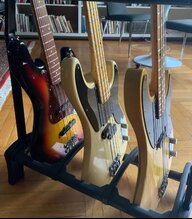
7EE2C41C-4139-4BF9-8380-43D92A592EDF_1_201_a(1).jpeg

BAD711DA-E345-4338-9F93-27A10A1A0B21_1_201_a(1).jpeg
 

Latest posts