• TalkBass has been independent since 1998. Add your voice.
    Create a free account to reply to discussions, view embedded media, and browse with fewer display ads.
    Join freeLog in
    Want zero display ads or expanded classifieds tools? Compare plans.

Club Sadowsky!!!

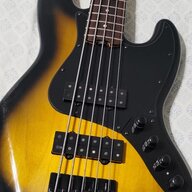
I'm not 100% sure, but I doubt these are the new MetroExpress basses w/ Sadowsky logo, because of the string retainer...

Would be great if Roger himself could confirm that...

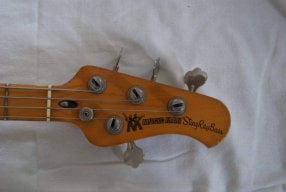
As the #1 issue I have with my RSD ME is the string retainer, I've noticed on all of the new Sadowsky logo MEs I've seen pictures of have the nicer string retainer. Which somehow has me really GASsing for one, even though I absolutely don't need it!
 
  • Like
Reactions: Alessandro Cruz
As the #1 issue I have with my RSD ME is the string retainer, I've noticed on all of the new Sadowsky logo MEs I've seen pictures of have the nicer string retainer. Which somehow has me really GASsing for one, even though I absolutely don't need it!

I bought one about 9 months ago, despite having to work a bit on it to get it "spot on" ( I mean, all the proper setup ), I ended up selling it to a friend who was almost begging for it, and now I'm going to wait for the latest batch with new logo and maybe other upgrades. For the money, despite the trouble with setup thing, it is a really nice instrument.

upload_2023-6-27_12-36-17.png
 
In an impulse buy I snatched this from the Sadowsky stock page this morning.

[Invalid or Expired Link Removed]

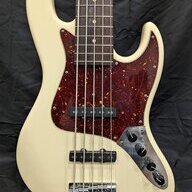
So if anyone is interested in a oly white German Metroline (with updated tuners), please click here :)
For Sale - Sadowsky Metroline 5/21 Vintage JJ

I’m usually not a white finish guy but this really speaks to me with the black hardware and guard and inlays. Is the control plate black also? Really nice beautiful.

 
  • Like
Reactions: kevinpmajka
Roasted maple necks now standard on MEs?
Why would the powers that be make this “upgrade” standard on a low-tier model? It’s a $200 option for a NYC. I’d rather they upgrade the hardware.

I heard the following:

- Roasted Maple necks
- Pickup route and control cavity shielding
- Hum canceling pickups like in the metroline
- New string retainer

I wouldn't bother about the hardware at all. All these improvements are pretty good, IMO.
 
I'm not a fan of roasted necks. I think they sound different than non-roasted and I haven't found them to be any more stable. They are showing up regularly on inexpensive basses so it makes the typical upcharge for it on higher end instruments even more suspect. I have to assume the roasted maple that an NYC uses is of a better quality than what the ME, Sire, Harley Benton and many other uses. I wonder what the differences are from the "high end" roasted to the "low end" roasted. The upcharge some companies charge for roasted maple is sometimes more expensive than an entire import bass.

Roasted maple necks now standard on MEs?
Why would the powers that be make this “upgrade” standard on a low-tier model? It’s a $200 option for a NYC. I’d rather they upgrade the hardware.
 
I'm not a fan of roasted necks. I think they sound different than non-roasted and I haven't found them to be any more stable. They are showing up regularly on inexpensive basses so it makes the typical upcharge for it on higher end instruments even more suspect. I have to assume the roasted maple that an NYC uses is of a better quality than what the ME, Sire, Harley Benton and many other uses. I wonder what the differences are from the "high end" roasted to the "low end" roasted. The upcharge some companies charge for roasted maple is sometimes more expensive than an entire import bass.
I'm curious too.
I think it's largely price gouging to be honest, with a little of the extra cost accounted for simply because it isn't a production line instrument.
 
Wood properties and heat treatments in particular are one of those topics TB’ers seem to discuss from time to time. But, the topic is complex, to say the least. Categorical statements are not particularly useful, nor are they generally accurate.

Here is a link to a 2009 survey article; which actually is not mainly applicable to treatment and properties of wood for MI purposes, but does show some of the complexity.

Invalid Link Removed

First, ALL wood used in the construction of musical instruments undergoes some level of heat treatment, the minimum being what we refer to as “kiln drying.” Instruments are NEVER made with green wood stock.

The referenced article shows that a a number of complex processes happen to the structure of wood during heat treatment. The initial “kiln drying” is mainly used to establish dimensional stability needed to make stuff. But, that particular process does not necessarily optimize particular properties needed for specific uses.

A couple of properties useful for bass guitars are moisture uptake and release, and stiffness. The article shows that moisture uptake is reduced by condensation of certain chemical groups in the wood structure by additional heat treatment. The article also shows that stiffness is increased by a mild level of heat treatment, then is degraded by more extensive heat treatment; which is complicated.

It is worth noting that both of these structure / property transformations tend to happen over longer times at room temperature. So “vintage” instruments tend to acquire some of these positive improvements.

Thinking about necks specifically, the article shows that “roasting” needs to be carefully controlled and monitored to get an optimal property improvement. Do all luthiers necessarily have optimized sources for thermally treated bass guitar necks? Quite possibly not. I do know that Roger’s NYC “roasted” necks compare very favorably with the tendency for reduced moisture uptake / release to my ‘62 Jazz Bass. I don’t have information about the stiffness relative to “kiln dried.” I have to trust Roger on that one.

Is thermal treatment of wood a “marketing scam,” as some might suggest? I suppose the answer depends on the technical knowledge and control of the materials sources. Ultimately, we measure the end result. My definite impression is that Roger’s “roasted” neck stocks are pretty carefully treated, and improve the playing properties. Of course, that is a survey experience of one.

This might be a topic best left to the engineers / materials science types.
 
I had an NYC with a roasted maple neck. It was definitely not more stable than any of my other non-roasted necks. It didn't necessarily move more than my NYC with a non-roasted but it seemed I had to adjust the necks similarly with humidity/temp level changes. I know this is a anecdotal but in comparing the two NYC's with the exact same specs, the bass with the roasted maple neck was thinner sounding with a very different character that was also much more compressed. It wasn't a bad instrument but didn't missing something that my main NYC has in abundance. The white NYC in my profile pic is the closest to sounding like a 60's jazz in a 5 string that I've ever played. It's an extraordinary instrument.
 
the bass with the roasted maple neck was thinner sounding with a very different character that was also much more compressed

This is a sample size of just one. Not saying it isn't valid, but there's no way to know how significant, given that there can be natural variation in tone between "identical" instruments strung with identical string sets.

FWIW, a friend who owns three roasted neck basses said that their tone is warmer with less 'snap' than unroasted maple. Even that is a small sample size.