
Enjoy the benefits of a premium membership!
Upgrade Account
-
TalkBass has been independent since 1998. Add your voice.
Create a free account to reply to discussions, view embedded media, and browse with fewer display ads.
Join free Log in
Want zero display ads or expanded classifieds tools? Compare plans.
You are using an out of date browser. It may not display this or other websites correctly.
You should upgrade or use an alternative browser.
You should upgrade or use an alternative browser.
More options
Who Replied?


I bet if you set up the same bass with 3 different neck woods and did a blind tone comparison through the same electronics with the same strings, nobody could tell a bit of difference.

Sounds like a youtube video waiting to happen…I bet if you set up the same bass with 3 different neck woods and did a blind tone comparison through the same electronics with the same strings, nobody could tell a bit of difference.

That neck is insane!I really like the look of roasted maple. My German Masterbuilt has a flamed maple roasted neck and I love it. Seems plenty stable to me and nothing thin sounding about this bass.
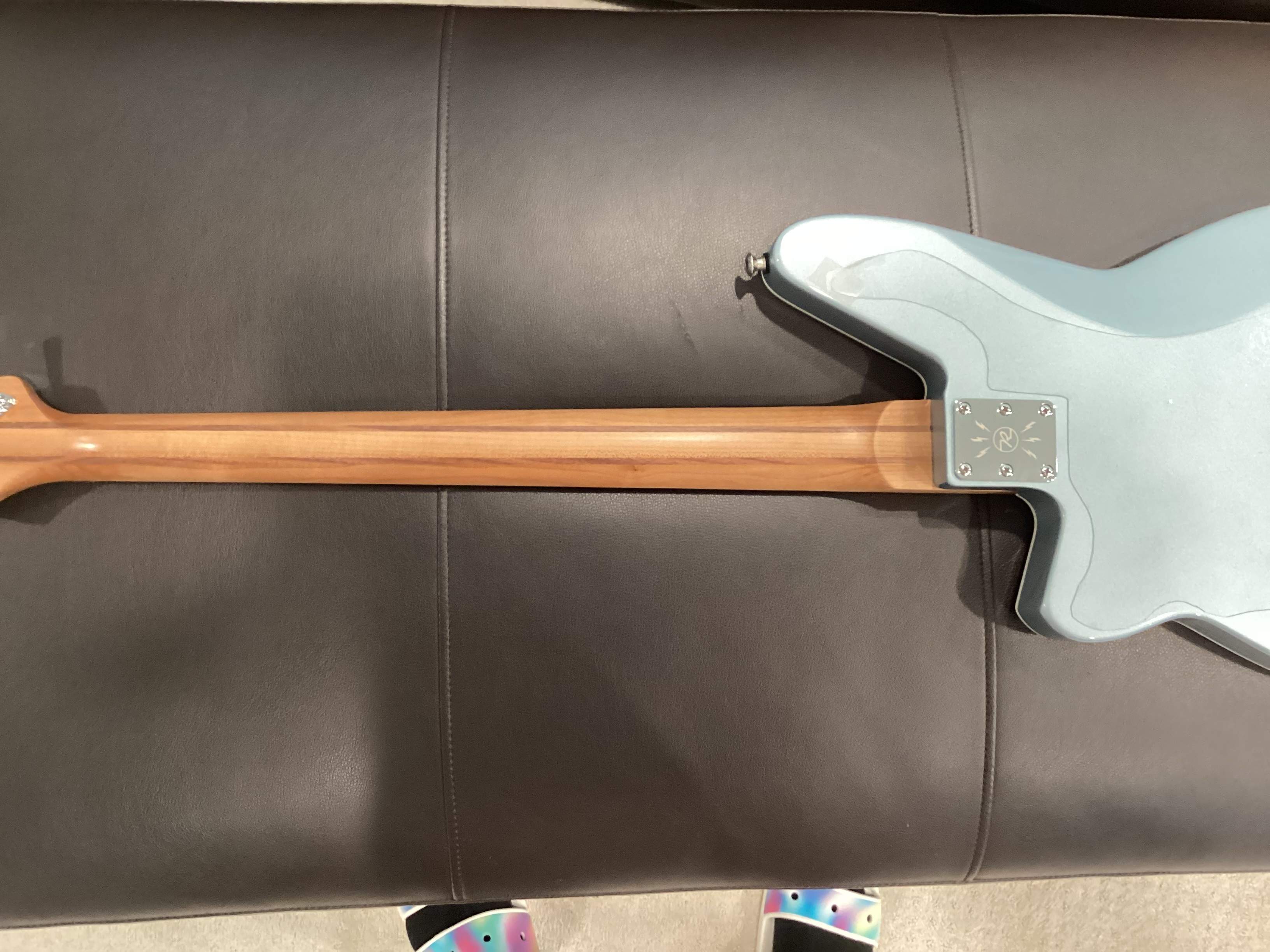
View attachment 5109005
Oh, and a pic of the front of the bass for good measure.
View attachment 5109008
Love it!
For what it’s worth, my Revered has a roasted neck that I have not touched the neck since I owned it.
Played it on a few gigs humid summer and cold winter venues and never adjusted it.
Very stable.
Played it on a few gigs humid summer and cold winter venues and never adjusted it.
Very stable.

I know what you mean, but I sure hope you "touched" that beautiful neck since you've owned it.

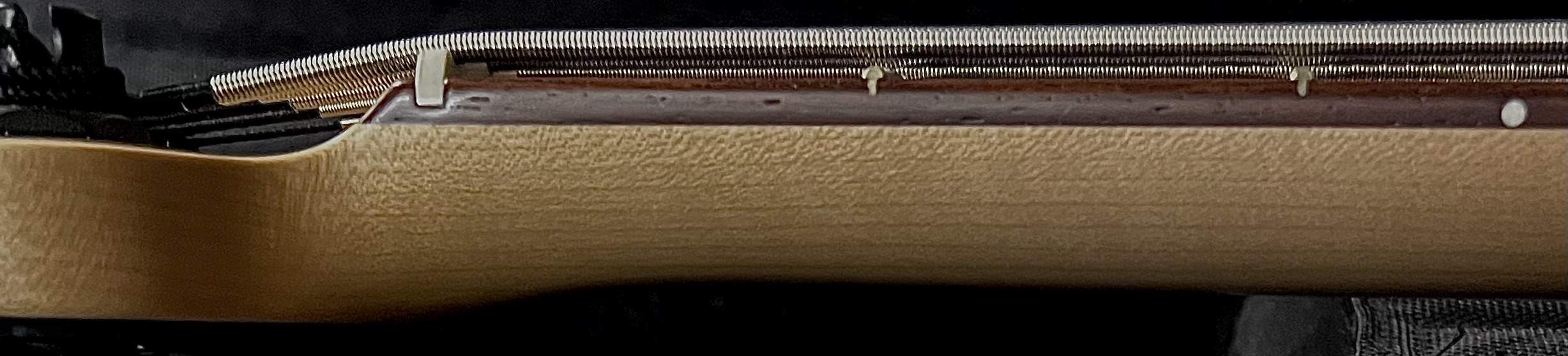
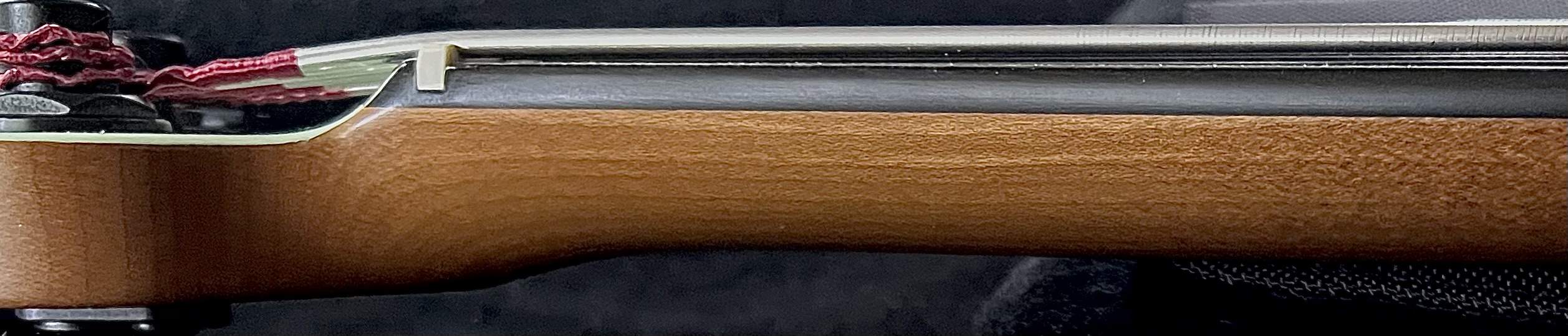
Of the many NYC’s that I’ve owned, all the (roasted and non-roasted) necks were very stable. With the three roasted versions, I hear(d) more sweetness/less aggressiveness. Might be a placebo effect, and my ears just wanted to hear it???
But there’s been one tangible difference in my small sample…all of the roasted necks have been sleeker/thinner front to back, and calipers proved it each time.
These cell pics may not be perfectly sized the same, but hopefully you can get my point…
Non-roasted NYC WL5:
Roasted NYC SC5 FL:
But there’s been one tangible difference in my small sample…all of the roasted necks have been sleeker/thinner front to back, and calipers proved it each time.
These cell pics may not be perfectly sized the same, but hopefully you can get my point…
Non-roasted NYC WL5:
Roasted NYC SC5 FL:
Last edited:
It could also be the fact it’s a 5 piece neck, and roasted.For what it’s worth, my Revered has a roasted neck that I have not touched the neck since I owned it.
Played it on a few gigs humid summer and cold winter venues and never adjusted it.
Very stable.
View attachment 5109242
Which one is providing the additional stability, is anyone’s guess.
Warmoth put out a good video comparing a roasted and non roasted neck on the same guitar. There was a definite difference that also echoes my own experiences.

As I recall, Roger's use of roasted maple was initially for highly figured neck woods. He felt that highly figured necks (as opposed to just boards) were more likely to warp or twist over time (other top luths have said the same), but roasting added enough stability to mitigate that risk.
Obviously there are differences of opinion regarding both stability and tone of roasted. I'm not aware of any science to back up any particular opinion, so the bottom line is, it's all subjective which means that everyone's opinion is correct.
Obviously there are differences of opinion regarding both stability and tone of roasted. I'm not aware of any science to back up any particular opinion, so the bottom line is, it's all subjective which means that everyone's opinion is correct.
If we needed science/facts to back up what we post on TB, this place would be a ghost townI'm not aware of any science to back up any particular opinion

And I am NOT taking a shot at anyone in particular- I am guilty of it too
For the record, I ordered a roasted “mastergrade” flame maple neck on my NYC after talking to Roger, he said his feedback had been it sounds warmer and “vintage-y-er” (paraphrasing, Roger is better spoken that that
 ), so we’ll see. I am trusting him to build an expensive instrument for me that I will keep until I can’t play it anymore, and I have faith he will deliver.
Last edited:

Tone/stability discussions aside, why is this “upgrade” showing up on budget instruments? Is there a surplus somewhere? Lol
It’s probably just regular maple and the roasting treatment has gotten more affordable/available. Remember when active electronics were for higher end basses only? Neck through construction? Figured tops? The less expensive brands are always nipping at the heels of the “boutique” guys and gals, which ain’t a bad thing.Tone/stability discussions aside, why is this “upgrade” showing up on budget instruments? Is there a surplus somewhere? Lol
Last edited:

I'm not 100% sure, but I doubt these are the new MetroExpress basses w/ Sadowsky logo, because of the string retainer...
Would be great if Roger himself could confirm that...
Tone/stability discussions aside, why is this “upgrade” showing up on budget instruments? Is there a surplus somewhere? Lol
They flame it to hide all the imperfections
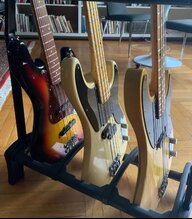
Anyone here have both a NYC Sadowsky Will Lee 4-string and a Warwick Sadowsky MetroLine Will Lee 4-string? A comment above has me curious about other experiences. It makes me want to go to the shop with my MetroLine for a direct comparison.
I wanted to share my experience with two months playing a German Metroline Sadowsky JJ5 ash/maple.
I was about to buy a Sadowsky Metroline in 2015, and tried them out that time but ended up with a Lull M5V alder/rosewood. It was a really well made bass but I just never got used to the 35 ” scale and 18mm spacing. So this spring the Sad arrived.
I noticed that the tuners weren’t as good as Lull’s USA hipshots and replaced Sadowsky tuners with those. I posted here about a change in sound and initially put originals back. Eventually I went with the Ultralites anyway, and they did not change the sound, instead just work better and balance the neck even more. Balance was okay originally too.
The sound is obviously very different than Lull even though my Lull had Sadowsky preamp. Really focused and clear with lots of growl but easily tamed to more mellower tones too. It is true what they say here, the first band practice and gig really showed the ”thing” that is the Sadowsky sound magic, it really works!
On TB there has been concerns about German Metros being inferior to earlier Japanese ones. I have very limited experience with Japanese Metros but I can say that (tuners aside) the quality of this bass is really really good. Subjectively I find it to be a better bass than the Lull and workmanship and finishing is spot on, really as good as the Lull (which was ”boutique” compared to ”factory” Sadowsky). The woodwork leaves nothing to be desired. Weight is 3,7 kg!
It came with the Express Porta Bag, which is no premium product, interior feels cheap, BUT actually is quite sturdy and rigid, providing good protection. Better than a normal gig bag by far. I might go for the Professional Road Bag some day for premium feel but there is no need for that really.
So in conclusion, my German Metroline is a very good bass, and I am very happy with it!
I was about to buy a Sadowsky Metroline in 2015, and tried them out that time but ended up with a Lull M5V alder/rosewood. It was a really well made bass but I just never got used to the 35 ” scale and 18mm spacing. So this spring the Sad arrived.
I noticed that the tuners weren’t as good as Lull’s USA hipshots and replaced Sadowsky tuners with those. I posted here about a change in sound and initially put originals back. Eventually I went with the Ultralites anyway, and they did not change the sound, instead just work better and balance the neck even more. Balance was okay originally too.
The sound is obviously very different than Lull even though my Lull had Sadowsky preamp. Really focused and clear with lots of growl but easily tamed to more mellower tones too. It is true what they say here, the first band practice and gig really showed the ”thing” that is the Sadowsky sound magic, it really works!
On TB there has been concerns about German Metros being inferior to earlier Japanese ones. I have very limited experience with Japanese Metros but I can say that (tuners aside) the quality of this bass is really really good. Subjectively I find it to be a better bass than the Lull and workmanship and finishing is spot on, really as good as the Lull (which was ”boutique” compared to ”factory” Sadowsky). The woodwork leaves nothing to be desired. Weight is 3,7 kg!
It came with the Express Porta Bag, which is no premium product, interior feels cheap, BUT actually is quite sturdy and rigid, providing good protection. Better than a normal gig bag by far. I might go for the Professional Road Bag some day for premium feel but there is no need for that really.
So in conclusion, my German Metroline is a very good bass, and I am very happy with it!
I wanted to share my experience with two months playing a German Metroline Sadowsky JJ5 ash/maple.
I was about to buy a Sadowsky Metroline in 2015, and tried them out that time but ended up with a Lull M5V alder/rosewood. It was a really well made bass but I just never got used to the 35 ” scale and 18mm spacing. So this spring the Sad arrived.
I noticed that the tuners weren’t as good as Lull’s USA hipshots and replaced Sadowsky tuners with those. I posted here about a change in sound and initially put originals back. Eventually I went with the Ultralites anyway, and they did not change the sound, instead just work better and balance the neck even more. Balance was okay originally too.
The sound is obviously very different than Lull even though my Lull had Sadowsky preamp. Really focused and clear with lots of growl but easily tamed to more mellower tones too. It is true what they say here, the first band practice and gig really showed the ”thing” that is the Sadowsky sound magic, it really works!
On TB there has been concerns about German Metros being inferior to earlier Japanese ones. I have very limited experience with Japanese Metros but I can say that (tuners aside) the quality of this bass is really really good. Subjectively I find it to be a better bass than the Lull and workmanship and finishing is spot on, really as good as the Lull (which was ”boutique” compared to ”factory” Sadowsky). The woodwork leaves nothing to be desired. Weight is 3,7 kg!
It came with the Express Porta Bag, which is no premium product, interior feels cheap, BUT actually is quite sturdy and rigid, providing good protection. Better than a normal gig bag by far. I might go for the Professional Road Bag some day for premium feel but there is no need for that really.
So in conclusion, my German Metroline is a very good bass, and I am very happy with it!
Having owned about 5 Germans and a couple of Japanese I will tell you the neck profile on the Germans is just perfect and the adjustable nut is also a very nice improvement....
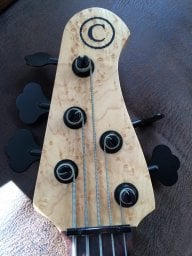
I'm not a fan of roasted necks. I think they sound different than non-roasted and I haven't found them to be any more stable. They are showing up regularly on inexpensive basses so it makes the typical upcharge for it on higher end instruments even more suspect. I have to assume the roasted maple that an NYC uses is of a better quality than what the ME, Sire, Harley Benton and many other uses. I wonder what the differences are from the "high end" roasted to the "low end" roasted. The upcharge some companies charge for roasted maple is sometimes more expensive than an entire import bass.
Joining the discussion, to add one more data point. Several years ago I walked into the Sadowsky showroom, with a bonus check in my pocket and jonesing for a Will Lee 5 with soapbars in 60's position. The shop's tolerance was fabulous as I sampled many basses, and walked out with a single cut with a SuperJ, the Will Lee switch and a roasted neck. Easily the most playable neck carve I've ever experienced, and an incredible, singing tonal character in the upper range that inspired me - it reminded my of my first life as a pro trombonist. However, once back to plodding away in the field, I felt the instrument had markedly less punch than others, to the point of distraction. Then...Covid...no gigs, our drummer passed and he was impossible to replace in the latin/folklorical/rock space we inhabited, and I asked myself what was I doing with a $6500 instrument in my hands...so I sold it. I might not have if I had a steady diet of small group jazz, and it would have been the perfect axe for duos with a jazz guitarist. I've pondered whether the punch thing resulted from the neck, the body shape, the Super J, or all of the above. In discussions with others, including two known luthiers I won't name, I've concluded it was the roasted neck; that sweet, transparent, singing sound came at a cost, when it was time for that bass to stand up to a hard-hitting drummer. Looking forward to other perspectives/experiences on this...

Having owned about 5 Germans and a couple of Japanese I will tell you the neck profile on the Germans is just perfect and the adjustable nut is also a very nice improvement....
The German necks are my favorite.
The whole neck profile thing simply boils down to personal taste imo. One is not "better" than the other, they are just different. Just as our hands are different.The German necks are my favorite.


