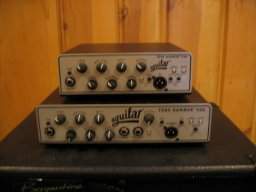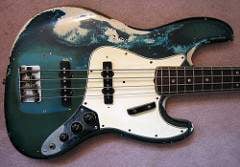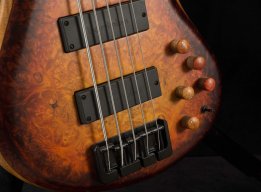
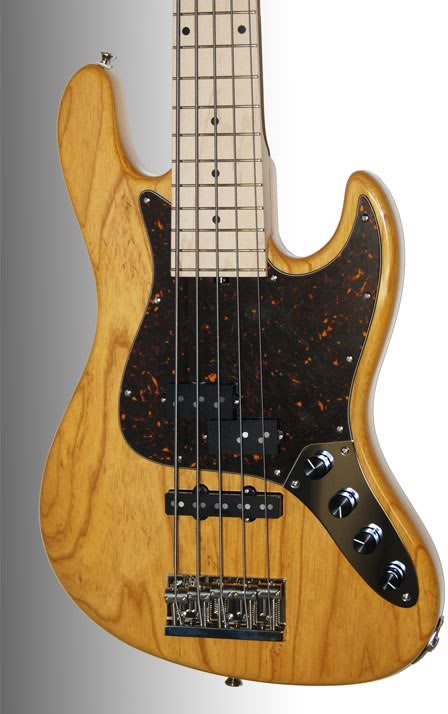
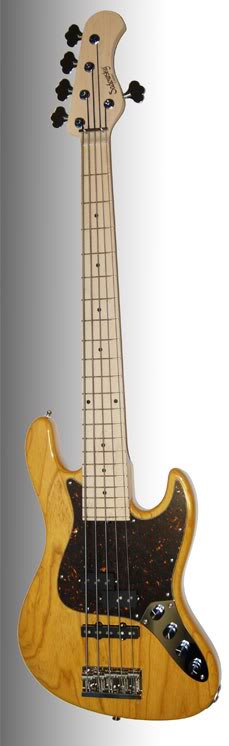
Finally, a lightweight Metro P/J 5 appeared and I snapped it up. 8.9lbs..should be here by Friday. Swap the pickguard for black and we are good to go! 

TalkBass has been independent since 1998. Add your voice.
Create a free account to reply to discussions, view embedded media, and browse with fewer display ads.
Join free Log in
Want zero display ads or expanded classifieds tools? Compare plans.

IMHO, you're too technically oriented here, as opposed to practically oriented.Point taken. I'm just trying to arrive at an understanding as to the feasability of improving the blend function. The Sadowsky preamp is so exemplary that it seems to me that some of it's potential is being lost without being able to dial in ANY ratio that will enhance the "Sadowsky Tone".

Dude, you are going to be SO F'N happy with that bass. That's the total sister to mine. Ash/maple, 8.9 pounds, PJ5. I was just playing mine again last night and boy does it have that magic!Finally, a lightweight Metro P/J 5 appeared and I snapped it up. 8.9lbs..should be here by Friday. Swap the pickguard for black and we are good to go!
IMHO, you're too technically oriented here, as opposed to practically oriented.
Given the sensitivity issue, again, I've literally had no problem whatsoever getting pickup blend I was happy with... from less to more burpy or less to more bassy (of course fully blended or soloed is a no brainer). I would suggest that the additional minute variances offered by a more linear system that you can't either get, or get very close to, with a passive blend, would be too minute to worry about... especially in a live mix, and maybe even in a studio mix (tho I'd personally grant more latitude to the argument in that kind of pristine environment.)
Ironically, I'd say it's the greatness of the Sadowsky preamp (and I suppose custom picukps, as applicable) that makes the lack of a more finely grained adjustment a non-issue!
I'm still not convinced that a blend pot gets you 100% of the relative volume combinations available with vol/vol (100%/90%, 100%/75%, 50%/100%, etc.). Or, if those ratios do exist somewhere on that blend pot, then as you say, they must happen over an extremely small range of the pot.
Either way, I'm just so much more comfortable dialing in tone using a vol/vol setup (and I like the idea of having one less potentiometer in my passive signal chain). But I know that other folks prefer their vol/blend, and if that works for them, then it's all good, I suppose.
Tom.
Dude, you are going to be SO F'N happy with that bass. That's the total sister to mine. Ash/maple, 8.9 pounds, PJ5. I was just playing mine again last night and boy does it have that magic!
This one is one of those cases where even if I had ordered an NYC..I probably would have ordered it just like this one...So, I went with a Metro this time. 

No, I was just talking about cases where you wanted, for example, 70/90. You'd have to use both the vol and the blend to get that ratio, not just the blend. This is a case where in both cases, you'd have two knobs to twist.
In both cases, you should be able to get anything you want with one or two knobs. Just in the case with the blend control, you can most typically set that once and then adjust overall output "only", without having to upset and then have to reset the blend, which I find very useful.
The issue is not 'blend' versus 'volume/volume', but rather active versus passive.
You can verify this by, for example, comparing the relative pickup 'tone/volume' change per pot travel between a Sadowsky (passive blend) and your Alleva-Coppolo's (passive volume/volume). The function and impact of those two designs is almost identical, although that of course doesn't mean some don't prefer one over the other knob configuration.
As we've all noted, though, it's mostly just personal preference, and what you've become accustomed to. But I, for one, do feel that I can dial in some vol/vol settings that I can't exactly duplicate on vol/blend.However, you need to become the master of that 5% of taper on either side of the blend detent, or the 5% of the taper of each of your volume/volume controls.
Ok, I think I see your confusion. It looks like you believe that each pickup is attenuated to 50% at midpoint, and one comes up while the other goes down as you pan. That's not the case.How would you set a vol/blend to equal the same ratio and overall volume of a vol/vol set to, say, 100%/60%?
Ok, I think I see your confusion. It looks like you believe that each pickup is attenuated to 50% at midpoint, and one comes up while the other goes down as you pan. That's not the case.
The thing to understand about a blend control is, at midpoint, you have both pickups at 100%. As you pan to one side, all you do is fade one down. One stays at 100%. So that's easy, pan to 60% on one side and leave the vol at full.
Think about it, if this weren't true, then a fully blended blend equipped bass would be the same as a vol/vol with both vols at 50%, which we both know from personal experience is not the case.
Nope. Let me try again...Now I'm REALLY confused. With the blend full up on either pup, the output volume is higher than when pups are blended right? So even if it's not 50% attenuation, there is still something similar resulting as I hear it. Just sayin'.
Nope. Let me try again...
Again, when fully blended, both pickups are 100% and both connected to the output.
As you move the pan towards one end, all that happens is one fades away to leave you with the other one still at 100% (solo'd). Going from center to one end does not actually make the one pickup twice as loud and the other fade away.
If it is, it's only because when you connect two pickups together they load against each other. The same thing happens on vol/vol.Not twice as loud - but can we agree that 1 pup soloed is LOUDER than the 2 blended?
No problem.Got it. Thanks Vic.
The circuit of Figure B is the one used in most commercial integrated amplifiers and preamplifiers. It uses a very special control. For half of the control there is no resistance and all of the resistance is in the other half. It is a dual control and one part is the reverse of the other. The schematic symbol shows a rectangle indicating no resistance for half of each part and resistance for the other half. When the control is set to the center of rotation the output for each channel is the same as the input. That means zero dB insertion loss. As the control is moved off center, say to the left, the right hand channel experiences attenuation while there is no change in the volume of the left channel.
Ok, I think I see your confusion. It looks like you believe that each pickup is attenuated to 50% at midpoint, and one comes up while the other goes down as you pan. That's not the case.
The thing to understand about a blend control is, at midpoint, you have both pickups at 100%. As you pan to one side, all you do is fade one down. One stays at 100%. So that's easy, pan to 60% on one side and leave the vol at full.
Think about it, if this weren't true, then a fully blended blend equipped bass would be the same as a vol/vol with both vols at 50%, which we both know from personal experience is not the case.
C'mon, gimme a hard one.
I think I know why this is, but it should be only a slight difference. This is the part where a blend circuit looks like three pots instead of two. The way I understand it is you get an overall slight attenuation compared to the more basic vol/vol, but it shouldn't affect tone much or blending ratio capabilities.I was under the impression that it is not always the case that both are at 100% when set to the middle. At least I was told this by another luthier (not Roger), but I have not empirically tested this, personally. But again, this may not always be the case.
Don't be.Now I'm REALLY confused !
Pretty soon I'm gonna need a diploma to play a 2 pup bass