• TalkBass has been independent since 1998. Add your voice.
    Create a free account to reply to discussions, view embedded media, and browse with fewer display ads.
    Join freeLog in
    Want zero display ads or expanded classifieds tools? Compare plans.

Color or no color?

I'm pretty sure all my favorite bass cabs would be considered fairly "colored". Personally, I'm with the guitarist on this one. :hiding: Guitarist don't want a speaker that is dead flat, reproducing the sound of everything else in the signal chain with perfect accuracy. They look at the speaker cabinet as very important ingredient in their "sonic stew" and the coloration of a particular cab is what adds to their own unique overall tone.

I get the whole perfectly flat bass cabinet concept, just not my thing.

 
In my mind, an uncolored "anything" is a standard that someone with much more knowledgeable than me came up with using their knowledge, a scope, possibly some software and their ears.


I don't really think about it. I've never hooked a scope up to determine if I like a cab. I have played through many different cabs and liked most of them. I love the cabs I have now. All totally different. Venues I play in are different. So I adjust the EQ for the acoustics to get the sound I think sounds good.

Think about it, I have three different heads, four different cabs and three basses. Mix or match, I like them all and ultimately, I sound like me. And I don't mind tweaking to get the sound I am after.

Besides, how do you "really" know what your bass actually sounds like without an amplified cab signal?
 
Isn't flat just a different color?

I agree with what Roger is saying. Flat is one of many possible colors... arguably better suited for some tasks, arguably more adaptable than most, but not necessarily "better" by any means, and clearly inferior in many cases.

Lacking Roger's experienced ear for designing a cab with a really nice inherent tone or "color", I forge ahead with what are hopefully fairly "flat" cabs. There seems to be a market for well-executed examples of both types.
 
i agree with duke. there are cabs of both types that rock. the great thing about it is we can choose. we may get forced into picking favorites on talkbass, but in the real world we can use a colored cab one day and an uncolored cab the next day.
 
I'm trying to talk people out of this nonsense that an "uncolored" cab is "sterile" or lacking tone, or that it's only useful in a studio or for a PA. Just trying to clear up misconceptions.

I'll have to say that I do find studio monitors sterile and lacking tone for bass specifically. You go record a track with a DI and go through all those preamps, compressors, EQ and stuff, adding different colors to your tone. The next day you bring the same bass to the same studio, mic your 30W combo and, just like magic, you've got great tone in no time.

Why is that?

It seems that all of sudden anything that adds color to your tone is cheap, poorly designed gear.
 
good monitors,
Sterile in = Sterile out
Warm in = Warm out

If non-flat is what people want, they'd have an easier time finding cabinets with the humps and valleys they like if the manufacturer bothered to publish measurements.

Cabinet manufacturers will never publish their specs because there are afraid they'll be judge by how non-flat they appear on charts. What a rip.
 
Lacking Roger's experienced ear for designing a cab with a really nice inherent tone or "color", I forge ahead with what are hopefully fairly "flat" cabs. There seems to be a market for well-executed examples of both types.

I think "fairly flat" is a good thing. IMO, the ideal cabinet should be fairly accurate, but still manage to have its own distinct personality as well. From the clips I've heard of Duke's cab, I would say the TC fits that description as well. The smaller cabinet size and plug-able ports give the cabinet some personality without overwhelming your tone.

From my perspective, that's why companies like Ampeg succeeded so well in the market place. Like it or not, everyone knows the "Ampeg Sound". They came out with products that have a distinct personality that were instantly recognizable. SWR, Eden, Hartke, Phil Jones, all came out with products with a unique voice and did very well in the marketplace. It's called personality and it's what gives us bassist such a variety of gear to choose from. Can you imagine if the goal of every bass company had always been to create gear with a ruler flat response and no coloration? How boring!
 
Cabinet manufacturers will never publish their specs because there are afraid they'll be judge by how non-flat they appear on charts. What a rip.
Seamonkey I can understand your frustration with the lack of frequency response charts, but to a certain extent it would be giving away proprietary information.

Suppose there's a well-respected cab whose tone just about everybody loves, and that unique tone was arrived at after a painstaking process of prototyping and listening and prototyping again. So there was a considerable investment of time and money and expertise on the designer's part, the results of which set his cab apart from the competiton. Cough cough Jim Bergantino cough.

Now suppose this company publishes an accurate frequency response chart of their cab. Making a few educated guesses about driver choice and what's happening off-axis, I could conceivably mimic its performance without investing nearly the time & money they did, and without the hard-earned expertise they brought to the table.

Just my opinion and there are arguments on both sides, but I wanted to put that out there because it's not obvious.
 
I mean, does anyone really loves how their bass sounds through a pair of NS10's?
Not used with an amp at war volume, but otherwise, sure. Don't assume that NS10s are uncolored; they aren't. They were very popular in studios as near fields but not for their accuracy. Rather, they were used to hear what the mix would sound like when played back on typical consumer systems. Said mix was usually done using Westlakes, Genelecs and the like.
As for coloration with bass cabs, most are and always have been highly colored. There's a simple basic problem with getting truly flat response: it requires a large cab to driver size ratio. But the average consumer wants the smallest possible cab stuffed with as many drivers and the highest wattage rating possible, and that means colored response. More manufacturers might offer more flat response cabs if there was a larger market for them, but there really isn't. Looks and watts sell, uncolored response doesn't.

Now suppose this company publishes an accurate frequency response chart of their cab. Making a few educated guesses about driver choice and what's happening off-axis, I could conceivably mimic its performance without investing nearly the time & money they did, and without the hard-earned expertise they brought to the table.
True once, not today. You can go to G-C or whatever and get a cab, take it home, measure the response with your laptop, $100 worth of hardware and a freeware FR program, then open up the cab and measure the driver specs with another $100 piece of gear. And then reassemble the cab and return it to where you got it and swap it for another to reverse-engineer in less than an hour. The hi-fi crowd has been doing so for over a decade already, so there are no secrets in the hi-fi world. But there never really were, as many sources had always published their charts anyway, and those that didn't had them measured by everyone from Stereophile to Consumer Reports. Yet low and behold, the sky didn't fall.
 
Cabinet manufacturers will never publish their specs because there are afraid they'll be judge by how non-flat they appear on charts. What a rip.

And what's inherently wrong about being "non-flat"? Are bass cabs supposed to be flat at all? If yes, why?

I love how my cabs sound. If I find out that they are full of valleys and humps am I supposed to instantly start hating them?

What I don't get is the whole "that's a great cab because it's flat" instead of "that's a great cab because it sounds good and is built to last".

Not used with an amp at war volume, but otherwise, sure.

Sorry about asking this, but I honestly don't know: you actually play bass guitar, right?
 
Sorry about asking this, but I honestly don't know: you actually play bass guitar, right?
What's that got to do with listening to the electric bass track on a song when played through NS10s?
And yes, probably since long before you were born, and undoubtably better than you ever will. :D
 
What's that got to do with listening to the electric bass track on a song when played through NS10s?

Perhaps bass players generally want to hear a good tone, while some cab designers want to hear a flat tone.

And yes, probably since long before you were born, and undoubtably better than you ever will. :D

Wow... I just haven't seen you posting in basses, or technique, or recordings... BTW, got a sound clip so that I can hear your "better than I'll ever be" playing?
 
...Cabinet manufacturers will never publish their specs because there are afraid they'll be judge by how non-flat they appear on charts. What a rip.

Sea, I respect your point of view, but I really don't think there is a conspiracy by the manufacturers to cover up the fact that their cabs are not flat. Your'e statement is based on the assumption that manufacturers have any interest at all in creating a flat response cabinet. I doubt that is the goal of almost any manufacturer out there. Now, if there is a manufacturer out there claiming that their bass cabinets provide ruler flat response, with no coloration, then I would certainly expect that company to put their money where their mouth is and publish specs to prove their claim.
 
Seamonkey I can understand your frustration with the lack of frequency response charts, but to a certain extent it would be giving away proprietary information.

There's nothing to hide. Cabinet's from private collections with signature sound are getting their impulse response taken (IR may be a frequency sweep).

If they don't like it they better publish their charts so they can claim it was theirs first.
 
And what's inherently wrong about being "non-flat"? Are bass cabs supposed to be flat at all? If yes, why?

I love how my cabs sound. If I find out that they are full of valleys and humps am I supposed to instantly start hating them?

What I don't get is the whole "that's a great cab because it's flat" instead of "that's a great cab because it sounds good and is built to last".

There's nothing wrong with non-flat if that's what you want But how do you reproduce it if you don't take measurements? Why aren't the manufacturers saying this is our signature sound - see here are the measurements?

When it comes time to change your cab, upgrade or downgrade how do you know what you got that you like? You can't listen to every cab on the internet.

You can always get flat and EQ it to match peaks and valleys. You can't always take a peaky valley cab and make it sound like some other peaky valley cab you once had.

In the end of it, if there's some signature/familiar sound, then the manufacturer is working with a impulse response company to get an "official" response captured. Which when played back on hi-fi sounds like the original. If they don't get on board with the impulse responses, they're going to be ripped off.
 
Sea, I respect your point of view, but I really don't think there is a conspiracy by the manufacturers to cover up the fact that their cabs are not flat. Your'e statement is based on the assumption that manufacturers have any interest at all in creating a flat response cabinet. I doubt that is the goal of almost any manufacturer out there. Now, if there is a manufacturer out there claiming that their bass cabinets provide ruler flat response, with no coloration, then I would certainly expect that company to put their money where their mouth is and publish specs to prove their claim.

Hmmm - we might agree. It's about looks right? :D

Coming out with bass cabinet line?
2x10, Check
1x15, Check
4x10, Check
8x10, Check

Do a 1x12, and 1x18 later, they're not as popular.

I would never assume most bass cab manufacturers actually were out to do sit down and crunch on designs like the fEarful.

Long live the fEarful!
 
You can go to G-C or whatever and get a cab, take it home, measure the response with your laptop, $100 worth of hardware and a freeware FR program, then open up the cab and measure the driver specs with another $100 piece of gear. And then reassemble the cab and return it to where you got it and swap it for another to reverse-engineer in less than an hour.

No I can't keep someone from dishonestly acquiring proprietary information, but that's still not the same as me giving it to them. And I think most people are inclined to be honest.
 
I think that prefered sound qualities of cab depend on witch bass do you play and witch tone you're after. I found best solution for my needs and my bass in Phil Jones Superflightcase 300. They are caracterized as HI-FI.. Thing that I like is that there are lot of detail in midrange when i plug in my jazz with flats... it's kind of tasty:bassist:...really tasty.. ! There was always something missing on other cabs / amps and I didn't know what it is. Don't get me wrong, have nothing against coloration especialy fender bassman + precision :bassist::bassist::bassist:!
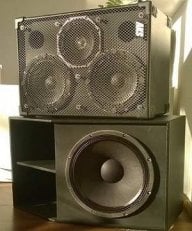
 
Well, here's my 2 cents on this matter.

I like both concepts, colored and uncolored. I can see why people (just like guitarists) want the cab be an integral part of their sound.

For me though, the only reason to build a cab without "color", is because I want to have the most control over my sound in a live situation with a PA. I want my bass and my (pre-) amp to determine the "sound" and route THAT signal to my colorless cab and to the mixing board of the PA.
Allthough any PA will sound different (and every venue is different), the differences in a good "tuned" PA set will be less then the differences in bascabs. So, the sound coming out of my colourless cab will sound more or less the same as the sound coming through the PA.
I know people mic basscabs to capture the "sound", but with multiway cabs it just won't work correctly. The micing will add another "color" to the sound, bending and shaping the frequency response (hopefully in a positive way).
My colorless 210 concept is still "under construction", but it will come in time.
 
There's nothing wrong with non-flat if that's what you want But how do you reproduce it if you don't take measurements?

You mean, how do we, bass players, reproduce it? What for?

Why aren't the manufacturers saying this is our signature sound - see here are the measurements?

I don't understand why a bass cab manufacturer should publish any measurements whatsoever. They aren't selling cabs to engineers or acoustic designers. They are selling cabs to musicians.

Today people are trying to turn music into a visual thing, but it's not. Music is the art of the sound.

Can you imagine a customer coming into a Guitar Center wanting to purchase a bass guitar and the sales guy says "cool, I have a bass that will suit your needs, here's the frequency chart". Would that work at all?

I would never buy a bass cab based on measurements nor flatness. I'm very old style on these things, I buy cabs based on how they sound. Weird, huh?
 

Latest posts