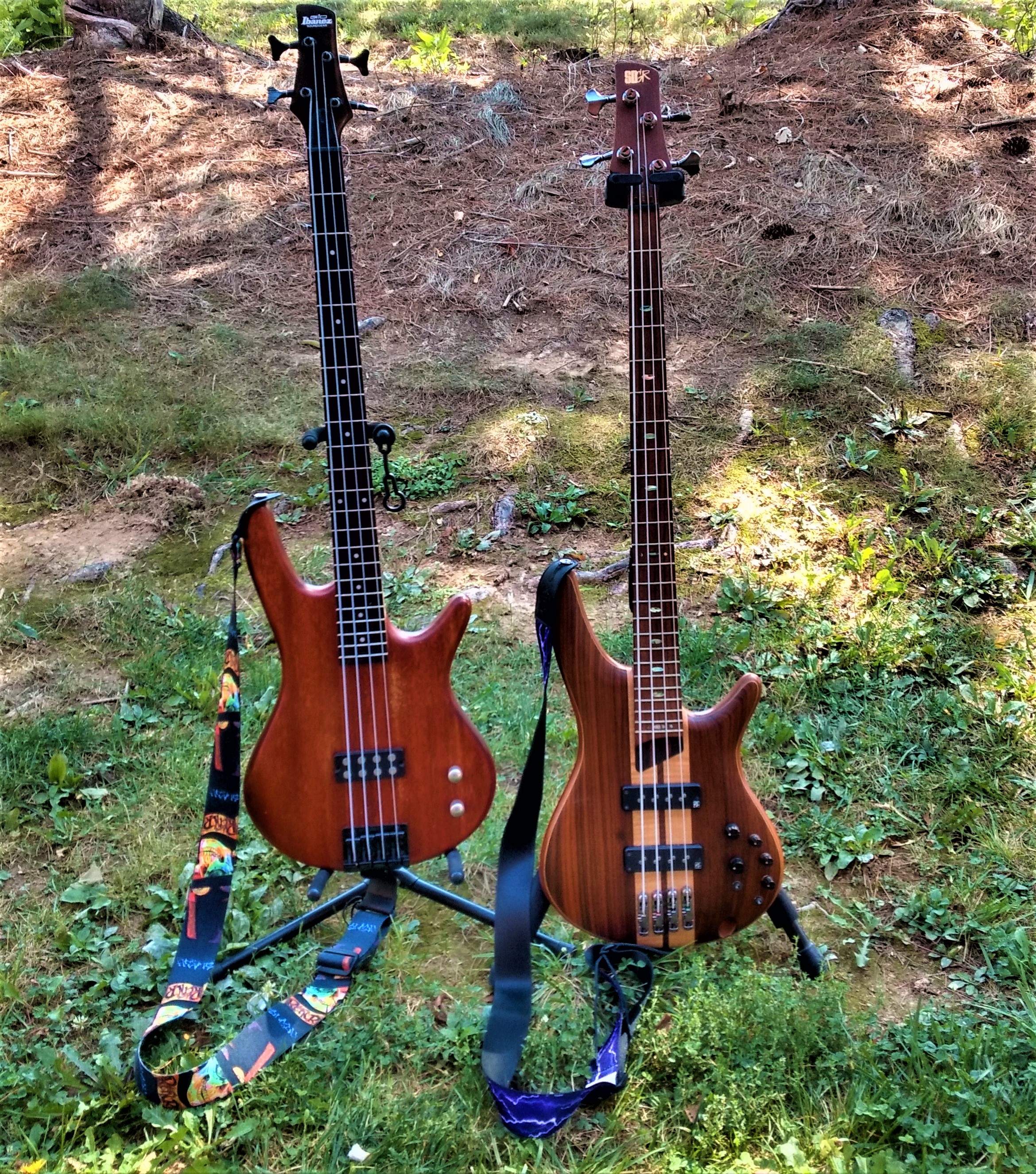
• TalkBass has been independent since 1998. Add your voice.
    Create a free account to reply to discussions, view embedded media, and browse with fewer display ads.
    Join freeLog in
    Want zero display ads or expanded classifieds tools? Compare plans.

comparing neck stiffness (Ibanez content)

Killed_by_Death

Snaggletooth
Inactive
Jan 2, 2015
24,890
61,257
14 Megameters from Groong Tehp
After the local luthier commenting that the neck on my SR1800E has a lot of "give", I was a little concerned.
It's supposed to have titanium rods in it for reinforcement.

Then I grabbed another bass on Saturday, a cheaper SR300EB.
Someone had commented the necks on that model are like spaghetti, so of course I over-thought it & I like experiments!

Tuned all to E Standard & set the neck relief & action the same.

detune each of them to C Standard & checked the difference in neck relief.

The SR eXtreme (SRX) hardly moved & it's just a one-piece maple neck.

The SR1800E moved a little more, but didn't lose all the relief. Wenge/Bubinga neck.

The SR300EB was hopeless & would need a serious truss rod adjustment.
I loosened it 1/4 turn, but that wasn't enough. The strings are still just laying on the fretboard, unable to tune the G string.

It makes me wonder what sort of necks the local luthier is accustomed to, because that SR1800E neck seems perfectly fine to me.
Ironically I got the SR300EB for downtuning & alternate tunings.

Adjusting the T.R. often would be a fact of life if I were to use it like that, but it does have the advantage of a quick access T.R.C.:
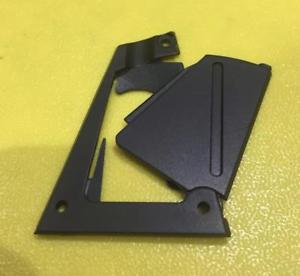
s-l300.jpg


This solidified my resolve that the SR300EB is just a Summer-time toy that won't be around come Fall, LOL!
 
Well, I've been using this method ever since & revealed a stunningly flimsy neck last week & identified my new guitar as having a very strong neck today.
It's kind of ironic, now that I have a bass & a guitar with super-stiff necks, I no longer need my DigiTech Drop, but I will still be holding onto it.

I don't need a Radial Engineering BigShot ABY now that I have two amps with a Effects loop, but I'll be holding onto that as well.
 
  • Like
Reactions: 96tbird
no need for tedious re-tuning, it's easy to just push and pull on a neck to see how "whippy" it is, and ibanez maple bass necks are usually spaghetti noodles. "hey look, i can just grab it behind the first fret, flex my wrist back and all the strings choke out!"

their fancier exotic wood necks are typically stiffer.
 
  • Like
Reactions: Peter Weil
I was expecting good things from the walnut/jatoba neck on a SR600 last week, but it was the flimsiest neck I've experienced thus far.
The signs were clear when I was setting the neck relief & just tuning it up from one string to the next, the previous string would go out.
Yeah it happens, but it was pronounced on this one.

The local luthier invited me to grab & pull on the neck of his Ibanez Jem today, but it's a Prestige with the Titanium rods. It's a very thin neck at the nut.
 
Today I decided to do an experiment with all 3:
The SR1800E has Ti reinforcement bars 5-pc (Wenge/Bubinga), GSR100EX is just a *'one-pc' Maple neck, EHB1500 is graphite-reinforced 9-pc (Panga-Panga/Walnut).

Tuned them all the C-Standard & adjusted the truss-rods so that just a piece of thermal-paper would slip through between 4th string & the 8th fret,
then tuned them all to E-Standard, before measuring the relief again:

GSR100EX - under 0.01"
EHB1500 - under 0.01"
SR1800E - 0.012"

It's some sort of irony that the sort of dodgy spliced neck on the GSR100EX is as stiff as the graphite-reinforced 9-pc neck on the EHB.
(it might actually be a tiny bit stiffer, but my feeler-gauge's smallest 'stick' is 0.01")


* the 1-pc neck on the GSR100EX is actually two pieces spliced together in what a carpenter would call a miter-joint, the joint is between the 5th & 3rd frets
 
Well, hopefully you've learned a few lessons from this:

1.) There's a wide range of stiffness between bass necks. You can find examples from super soft to super stiff.

2.) Having titanium or carbon fiber bars, or being multi-lam construction doesn't guarantee that a neck will be super stiff.

3.) The dimensions of the neck, particularly the overall thickness and shape of the back, are the dominant factor in determining the stiffness. An extra 0.040" in thickness can add as much stiffness as carbon fiber bars. Carbon fiber or titanium bars will add stiffness, but making the wood neck a little thicker will add that stiffness without the extra weight. In engineering terms, it's about beam design.

4.) Likewise, choice of woods or going multi-lam will affect stiffness. But making the neck a little thicker or thinner may have a greater effect.

5.) Stiffness and Stability are not the same thing, and do not necessarily work together. A soft neck built well can be very stable. And a stiff neck built poorly can be very unstable.

6.) The stiffness of the neck plays a major role in the sound of the bass. Yes, the sound on the strings and out through the amp. Not just the overall stiffness, but also the variable stiffness down the length of the neck, and the relative stiffness of the back of the neck vs the front. These are factors that some of us Luthiers play around with to adjust the sound of our basses.
 
2 - I've sampled loads of Standard (non-reinforced) Ibanez SR necks that were flimsy, the Ti reinforcement bars help a lot!
multi-laminate means almost nothing sometimes, in fact the flimsiest neck I've experienced was 5-pc, I commented about it above, Jatoba/Walnut

3 - the dimensions of all the necks in the experiment are different, the GSR100EX is 1.5mm thicker, & the EHB neck is 3mm wider
I have noted in the past that there's some irony in that the economy GSR basses have stiffer necks than the Standard SR, due to their being thicker

5 - I've only experienced a stiff neck that was not stable once, a SR300E. I had a great time with it for a week, but quickly returned it when I noticed the flaw.

6 - I've been preaching this on here ever since my discovery comparing two SR300E, one with a flimsy Standard neck & the other with the really stiff (but unstable) neck.
The stiffness of the woods, including the body, influence what's coming out of the pickups.

Paul Reed Smith did a Ted-Talk on 'tone' & says that it's a matter of reducing the subtraction, because each part of the stringed-instrument 'system' is subtractive.
The less stiff the materials, the more subtractive, IME. Some enjoy that however, & would describe it as 'warm'.

I forgot to mention above that I used the same diameter strings (all hex-core) on all of them: 0.045" / 0.065" / 0.085" / 0.105",
but the set on the SR1800E is Nickel-wound, GSR100EX is Cobalt rounds, EHB is DR Bootzilla (stainless)
 
It's worth noting that adding steel or carbon fibre rods may not actually increase stiffness. To put the bars in the neck you need to remove wood, which weakens the neck making it less stiff. Then you add the rods to make it stiffer. Sometimes the overall effect is a stiffer neck, sometimes it's actually weaker.
 
cut to now, I just measured the relief on all three again:
GSR100EX - didn't move, not even a little!
EHB - 0.014"
SR1800E - higher than 0.015", the action is about 1/4"

So, that 'thing' about the neck moving AFTER the T.R. adjustment is definitely not a myth, but it leaves me feeling more disappointed in the SR1800E than I was a couple of days ago.
Instead of adjusting the rod again I just down-tuned the SR1800E to C-Standard & put it back on the wall. The action is still too high, but the neck will move again soon.

Turns out that GSR100EX is more appropriate for down-tuning than I had expected, & the irony is that it's the cheapest solid-body bass Ibanez sells!