I've been researching ultra-portable bass heads, including just how small they actually are. So I thought I may as well share this diagram with you, my fellow bassists, in case anyone else is similarly contemplating portability.
This image shows the horizontal footprint of the various "micro" bass heads. If you print the image on an A4 sheet of paper (or view it at its native A4 size) you can see the actual footprint of the amps.
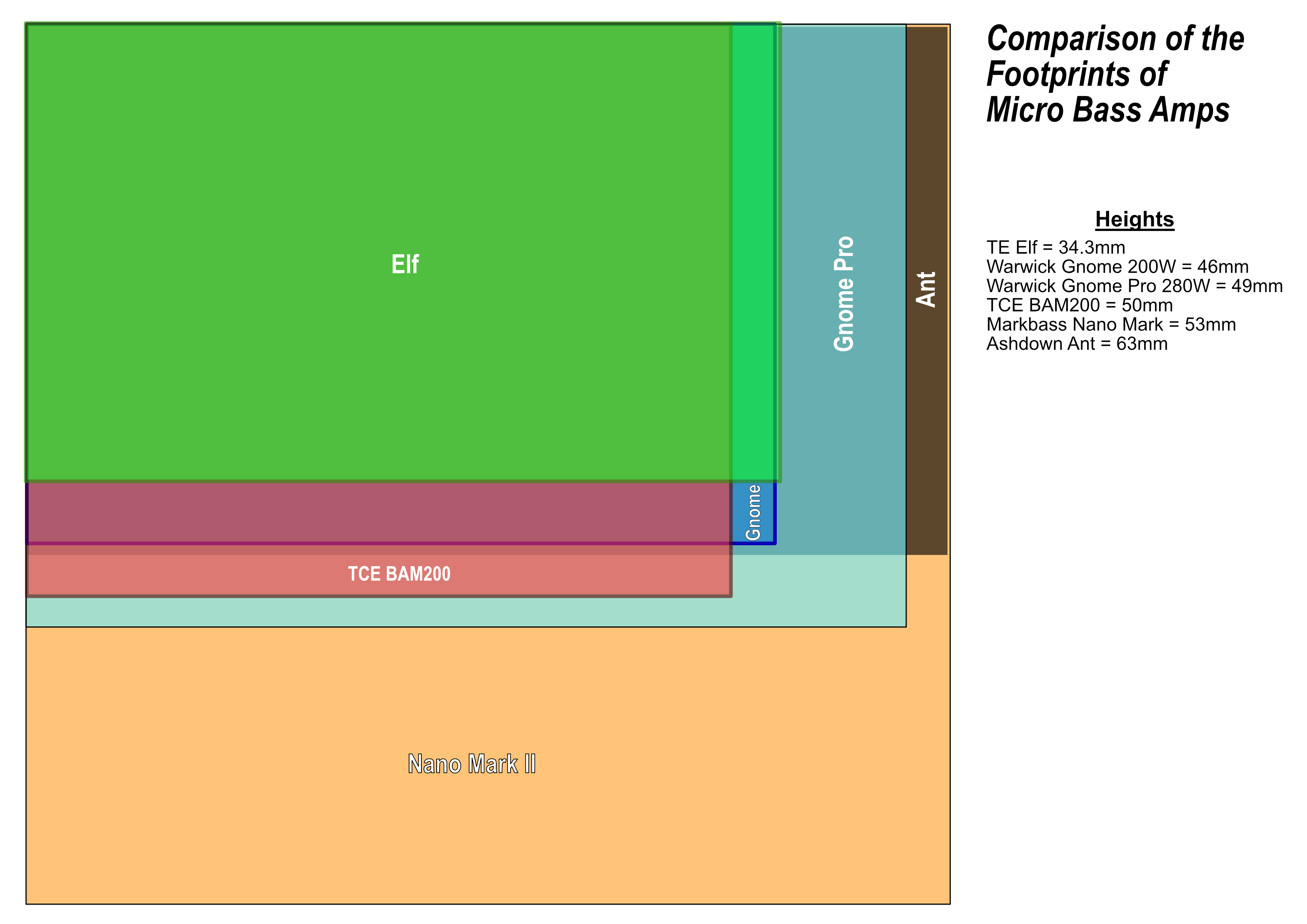
(Just to be clear on how to interpret the image, the amps are stacked on top of each other, with their top left corners in exactly the same position.)
Here are my general observations about micro bass heads:
Obvious Things
This image shows the horizontal footprint of the various "micro" bass heads. If you print the image on an A4 sheet of paper (or view it at its native A4 size) you can see the actual footprint of the amps.
(Just to be clear on how to interpret the image, the amps are stacked on top of each other, with their top left corners in exactly the same position.)
Here are my general observations about micro bass heads:
Obvious Things
- The smaller the form factor, the fewer the features. There's less room on the front and back panels for things like impedance pads, dual Speakon/TRS connectors, pre/post DI outputs etc. The largest of the "micro" heads shown here is the most fully-featured.
- The smaller the form factor, the fewer the watts. Note how the Warwick Pro needs extra space to squeeze out the 80W it has above the base model's 200W.
- The Elf is the smallest micro amp, a little bit smaller and shorter than its nearest competitor, the base model Gnome.
- All the amps offer a DI out, and in most cases, the DI is after the amp EQ and not switchable to pre.
- Only the Ant and Nano Mark provide Speakon outputs. The others are TRS only. This makes me uneasy, though for reasons I cannot specifically technically articulate

- Some folks report the Elf as having "distinct Trace Elliot tone". The other amps, with the potential exception of the Nano Mark, are described as "clean and transparent".
- The Elf's gain control is multi-functional. As the Gain knob is increased, first compression kicks in, and then distortion. Some users dislike the compression.
- The Elf has an always-on fan, and the amount of noise it generates bothers some people in a studio context. Having looked inside, I see a standard micro PC case fan (40mm?) and it looks like it might be possible to plug in a specialsed lower noise PC case fan. (However, small fans are inherently noisy, so the best you could achieve would be to lessen the noise, not prevent it.)
- The Elf, which is the most expensive of the "low wattage" amps here, comes with a natty little carry bag for bassists whose back pocket is used for something other than spare bass amps.
- The Ashdown Ant has no Gain control. The design assumption is that you'll use a DI/FX pedal to shape your tone, and the amp is mostly there to make things louder (though there are a couple of presets and the usual 3-way EQ controls).
- The Markbass Nano is relatively large in comparison. However, it provides more than double the watts, and a lot more "big amp" features. It's also far more expensive.
- The Ant is not only bigger than the smaller amps of a similar wattage, it's also almost double the height of the Elf.
- The TC Electronics BH250 (not pictured) offers a Toneprint to give the amp a programmable character, but it's appreciably bigger than the other amps shown here.
Last edited: