• TalkBass has been independent since 1998. Add your voice.
    Create a free account to reply to discussions, view embedded media, and browse with fewer display ads.
    Join freeLog in
    Want zero display ads or expanded classifieds tools? Compare plans.

Compatible Cab for GK 1001 Rb?

Thanks guys! I might run a 700RB with a 410 NEO.

My bass is a sterling stingray, so I should be able to achieve that growl with this setup correct?
I have used my Sterling Ray 34's with both the NEO 410 and 2 NEO 112'S through a GK 700rb II.

You can get an impressive kick and growl through the 410, but the D and G strings will sound a bit thin and weak in a band mix.

You will get even more growl through 2 12's and the D and G strings will sound fuller and thicker, but the kick will be a bit more subdued. IMHO and IME.
 
  • Like
Reactions: BassMick
One thing I forgot to ask is, will the pre-amp in my Sterling Stingray cause a GK1001RB to clip or fart a lot?

IME with Stingrays, no. Not unless you significantly boost the EQ. Despite the popularly held belief, and the fact that they're active, Stingrays aren't particularly hot.

You should be able to use it without engaging the pad, then you'll just need to figure out where to set your amp's initial "volume" so that it doesn't overdrive the first gain stage (unless that's what you're aiming to do, which is fine).

With my Stingray 5, I'd just start to get preamp distortion when digging in hard with the pad off and volume at noon. With it turned down one full notch from noon, audible distortion essentially disappeared no matter how hard I played.

From some brief testing, I've found that for my personal needs, I'm able to maximize headroom when running my 1001RB volume at -2.5 notches from noon. I like my input stage to be kept as clean as possible: for my preferences, if there are any stages that I want distortion from in terms of the amp itself, it's the boost and power amp stages, though the 1001RB is such a powerful amp that getting power amp distortion will likely take some work... and hearing damage. :p
 
Amplifiers have any number of stages before their final power section that is mostly responsible for making things louder. Those stages make up the amp's pre-amp, and within each of those those gain stages, filters, and EQ, there is the potential for distortion (or clipping) to occur if you hit the section with too hot of a signal. Sometimes this is desirable, sometimes not. Sometimes stages are engineered to distort gracefully sounding good in the process, and sometimes less so.

I'd say that more often than not, the first stage of an amp is an input gain type stage that is controlled by a knob, and if there is a clip light on the amp, it most often is associated with the stage controlled by that knob. This is why in many cases amp how-tos will tell you to bring up the initial gain until it starts clipping, or the clip light starts flashing, and then to back it off a bit as a method of finding a somewhat optimal signal - powerful enough to drive the other stages, but not so powerful that it distorts.

Some GK amps, like the RBs, operate differently, hence @wave rider 's post. The instruction above doesn't work on the GK RB amps, as the only thing on the amp that affects the input that the clip light is associated with is the pad. Check out one of the last pages of most RB manuals for a block diagram that shows the order of sections for a visual representation.

Usually the pad isn't needed, and again, shouldn't be needed for your Stingray unless you're really boosting EQ, or if you're sending it through pedals prior to the amp that are greatly boosting your signal. From there, you can begin to set up your other stages on the amp, mainly volume (as I mentioned in my post above), boost, and then finally master.

Hope that helps - if you have other questions, ask away!
 
Last edited:
Amplifiers have any number of stages before their final power section that is mostly responsible for making things louder. Those stages make up the amp's pre-amp, and within each of those those gain stages, filters, and EQ, there is the potential for distortion (or clipping) to occur if you hit the section with too hot of a signal. Sometimes this is desirable, sometimes not. Sometimes stages are engineered to distort gracefully sounding good in the process, and sometimes less so.

I'd say that more often than not, the first stage of an amp is an input gain type stage that is controlled by a knob, and if there is a clip light on the amp, it most often is associated with the stage controlled by that knob. This is why in many cases amp how-tos will tell you to bring up the initial gain until it starts clipping, or the clip light starts flashing, and then to back it off a bit as a method of finding a somewhat optimal signal - powerful enough to drive the other stages, but not so powerful that it distorts.

Some GK amps, like the RBs, operate differently, hence @wave rider 's post. The instruction above doesn't work on the GK RB amps, as the only thing on the amp that affects the input that the clip light is associated with is the pad. Check out one of the last pages of most RB manuals for a block diagram that shows the order of sections for a visual representation.

Usually the pad isn't needed, and again, shouldn't be needed for your Stingray unless you're really boosting EQ, or if you're sending it through pedals prior to the amp that are greatly boosting your signal. From there, you can begin to set up your other stages on the amp, mainly volume (as I mentioned in my post above), boost, and then finally master.

Hope that helps - if you have other questions, ask away!

Thanks for giving such an informative answer Kro!

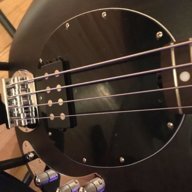
So regarding my Sterling Stingray, is the pick-up passive, with active pre-amp? or the pickup is entirely active with the active pre-amp? I always thought, (battery = must be an active pick-up)

I own this one https://www.guitarcenter.com/Sterli.... StingRay Rosewood Fingerboard Electric Bass
 
So regarding my Sterling Stingray, is the pick-up passive, with active pre-amp?

Yup.

I always thought, (battery = must be an active pick-up)

Nope, fully active pickups, at least in my experience, are relatively rare. I'd dare say that most basses with a battery just have a preamp, like the type that you'd have in a pedal or on the front end of your amp, onboard in the bass. Some basses use that preamp just for tone shaping from a neutral position, and others (like Stingrays IMO) really rely on it for their signature tone.

The Stingray pickup, despite how aggressive looking it is, is actually relatively weak given that its default presentation is with it wired in parallel. Something like a typical passive Precision with the pickup wired in series will put out a much hotter signal - I know this from personal experience, as I have both, and had a thread at one point where I expressed my surprise at the finding. Those smarter than me were quick to point out the reason, but see here for just one other reference that I found from some quick googling.


Very cool. IMO it has the three most important elements that make a Stingray sound like a Stingray:
1. the dual-coil pickup with a wide sensing field wired in parallel
2. the pickup position in the Stingray sweet spot
3. the preamp - which, if I'm not mistaken, I believe is the same, if not similar specs-wise to its more expensive brethren

Did you pull the trigger on an amp yet?
 
Last edited:
  • Like
Reactions: BassMick
Yup.


Nope, fully active pickups, at least in my experience, are relatively rare. I'd dare say that most basses with a battery just have a preamp, like the type that you'd have in a pedal or on the front end of your amp, onboard in the bass. Some basses use that preamp just for tone shaping from a neutral position, and others (like Stingrays IMO) really rely on it for their signature tone.

The Stingray pickup, despite how aggressive looking it is, is actually relatively weak given that its default presentation is with it wired in parallel. Something like a typical passive Precision with the pickup wired in series will put out a much hotter signal - I know this from personal experience, as I have both, and had a thread at one point where I expressed my surprise at the finding. Those smarter than me were quick to point out the reason, but see here for just one other reference that I found from some quick googling.


Very cool. IMO it has the three most important elements that make a Stingray sound like a Stingray:
1. the dual-coil pickup with a wide sensing field wired in parallel
2. the pickup position in the Stingray sweet spot
3. the preamp - which, if I'm not mistaken, I believe is the same, if not similar specs-wise to its more expensive brethren

Did you pull the trigger on an amp yet?

Thanks a bunch man! so if my Stingray is passive yet with an active pre, when I plug into an amp and it has an active and passive input, which would I plug in to?


I'm leaning towards the GK, but still checking. Any experience with Hartke with a Stingray?
 
Thanks a bunch man! so if my Stingray is passive yet with an active pre, when I plug into an amp and it has an active and passive input, which would I plug in to?


I'm leaning towards the GK, but still checking. Any experience with Hartke with a Stingray?
GK heads will take a StingRay preamp without need of the “active” input pad.
 
  • Like
Reactions: Kro
Thanks a bunch man! so if my Stingray is passive yet with an active pre, when I plug into an amp and it has an active and passive input, which would I plug in to?

What @Stevorebob said.

In general, when it comes to passive/active switches or inputs, it's best to disregard the label, and just test it out. If the preamp is distorting more than you'd want and you can't otherwise tame it, or if the clip light isn't just flashing briefly, but is on more often than not, it makes sense to utilize the pad. Otherwise it's unnecessary.

All that a passive/active input or switch does is bring down the input signal strength. It's roughly equivalent to turning down the volume knob on your bass to decrease the signal before it hits the amp. Nothing else fancy about it. If it isn't needed, then it isn't needed.

I'm leaning towards the GK, but still checking. Any experience with Hartke with a Stingray?

You bet, mostly with their LH500 and LH1000 amps. I like them a lot, but IMO, given that they use the Fender tone-stack which by default is a bit scooped, they're arguably less flexible. They do sound good though, and if you like the tone, then that's all that matters. :)
 
Any experience with running a Stingray through Orange Amps?

Not really. One of the rehearsal spaces I've frequented in the past contained one of the 15" Orange Crush combos that I was permitted to use, but that's about it. It was surprisingly capable given its specs in terms of sheer volume, but it was also very wooly.

Given that people seem to choose Orange amps in large part for their signature brand of distortion, this was probably by design, and it did a good job of keeping the combo usable at loud volume (while distorted) despite the low wattage.

Honestly, there are some rigs that I've liked better than others, but I don't think I've ever come across one that I thought was a bad pairing with my StingRay. :)
 
Last edited:
  • Like
Reactions: BassMick

Latest posts