• TalkBass has been independent since 1998. Add your voice.
    Create a free account to reply to discussions, view embedded media, and browse with fewer display ads.
    Join freeLog in
    Want zero display ads or expanded classifieds tools? Compare plans.

Compensated Nuts

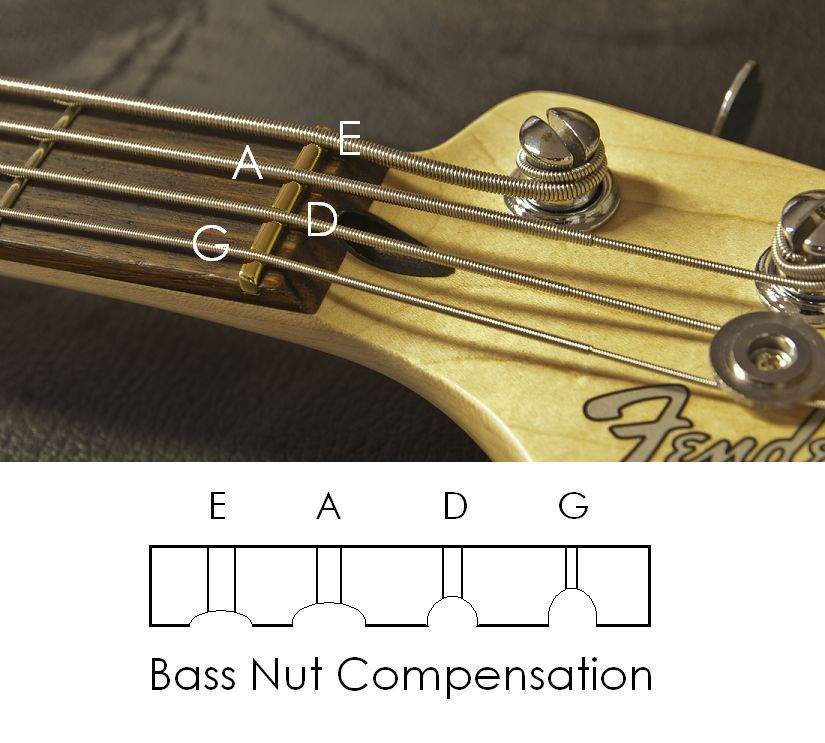
Does anyone have experience with compensated nuts. Does anyone use them in their builds? I bought a "compensated" brass nut, but it seems backwards to me.
$_57 (2).jpg


Shouldn't the compensation bring the zero point closer to the first fret? Like this eNut:
enut.jpg
 
Wouldn't nut compensation not matter once you fretted the string?
Right, but what you're compensating for is the open string... I think.

The nut looks fine for E (to my untrained eye). But I've never noticed the need for compensation on my other strings. Which would make me think it's more minor; hence, yes, I wonder also why the compensation is deeper for the D & G...
 
Yes. It is all relative: move the shim towards the first fret to keep string stretch from pulling strings sharp, or have the insets offset the same way, and widen the nut slot so the entire nut is mounted slightly forward in the nut slot, as the picture shows.

Nut compensation is especially desireable if a player prefers a slightly higher action. However, the drawback to getting the first three frets in tune is to make sure there is enough height in the action so that there is enough string stretch at the 7th through 9th frets or thereabouts so they won't play flat.

Philadelphia Luthiers now sell bakelite compensators to retrofit most guitars and ukuleles. I'm waiting on the bass version for another application.

Here is my custom half-fanned P/J with nut compensation, done with individual shims, Stephen Delft style:
A Different Custom P-style Bass | TalkBass.com
 
This is why I build using zero frets. But recently I was offered a deal from Buzz Fieten to be a licensed builder for their product, which I am considering still, check out the ideology of the system its very interesting.
 
  • Like
Reactions: Robert Canfield
I'm interested in incorporating a compensated nut in my build for more accurate tuning. Does anyone have experience with compensated nuts? Does anyone use them in their builds? I bought a "compensated" brass nut, but it seems that it does not extend in the right direction to me. Shouldn't the compensation bring the zero point closer to the first fret as in the second photo?
$_57 (2).jpg


Like this eNut:
enut.jpg


Or the ZerO Glide nut:
ZerO_Glide_Nuts.jpg


Is there an advantage to installing these as a feature instead of an after thought?
 
  • Like
Reactions: Means2nEnd
Sub'd I have wondered about this for a long time. I think the Buzz Feiten system like the one Mike Tobias uses in his basses where the system compensates I believe by actual fret placement may be a more accurate way to deal with the issue rather than the nut but I am so interested to hear from the experienced builders here. I had a MusicMan Stingray with the compensated nut but I couldn't tell you if it made a difference I really can't remember.
 
I see what you're saying with the brass nut, but I believe it should be installed so that the witness points are in front of where a traditional nut would end. I assume it must come with some sort of instruction from the manufacturer. The compensated nut on my EBMM Stingray is done the same way.

For your second question, I suppose the advantage of installing these as a feature is that you don't have to modify anything later. That said, I have seen compensated nuts done with bone shims mounted to the front of the nut for each string so that it overhangs the fretboard and can be easily swapped with a standard nut that fits the slot, possibly like the second picture you have posted.
 
They are made to help with intonation rather than tuning. If you play a bass or guitar with a standard nut at the first few frets you'll notice the intonation is slightly off. A compensated nut helps with this. They claim that they'll make intonation far better across all frets but I don't see that working. For that you'd need the frets themselves to be compensated such as the True Temperament system.
 
I dont see how a compensated nut could help with anything seeing as how its out of the picture as soon as you fret any note.

Though i'll be the first to admit that the whole physics/vibrating length/mass blablabla stuff gets my mind in knots pretty quick.

Interested to see what people "in the know" have to say on this one as well.
 
In my opinion a compensated nut only affects the first fret as far as tuning goes. Straight fretted instruments are compromised as far as temperament goes, so the compensated nut will do nothing past the first fret. Not worth the trouble in my opinion.
 
They affect the entire tuning, across the board. It changes the scale length very slightly, just like you would when you intonate at the bridge... Basically moving the nut from what would be the ZERO position to a VERY SLIGHT sharp or flat position.. When the string is tuned open with the new compensated scale length the entire string is changed in tension so therefore the entire fretting area of that string is changed as well. In other words no, it does not only affect the first fret, and yes it does do something past it. The desired affect is to lessen the sharpness or even flatness that happens when you fret a note.. If you were to tune the string closed at an octive or just where ever it would change the tuning slightly of the open strings and lower notes... vice versa ect ect.

That said, is it worth it?? I cant say in bass applications.. maybe when doing some chording with a 6 string or similar when you actually put the notes side by side and the sharp or flat would ring out to the ear... In guitar applications it makes a HUGE difference...
 
Here is an experiment to try. Tune your E string then check the intonation at the first 5 frets. Now, place a large paper clip under the E string just in front of (touching) the nut. Retune the open string and recheck the intonation at the first 5 frets. *** Don't try this if you're afraid of marring the fret board*** It didn't mar mine, but you never know. I did this with my Ric and it made a big difference.
 
^^^ Perfect example... If you were to measure that in MM from the zero, to the shallow, to the deepest offset it be very easy to compensate, set a zero fret back and angled to get that effect AND have the benefits of a zero.. best of both worlds... :) I should try it.. throw a patent on it.. make gazillions.. :smug:
 
  • Like
Reactions: iiipopes
This is why I build using zero frets. But recently I was offered a deal from Buzz Fieten to be a licensed builder for their product, which I am considering still, check out the ideology of the system its very interesting.
I had a guitar with a Buzz Feiten nut. It did sound good. My problem with that system is that because of the different core diameters of each string, each has a different stretch, and therefore needs different compensation, just like at the bridge.
With any system of compensation, the player has to be aware and readjust ears on tuning, keeping in mind that major thirds are sharp (so f# on the e string of a regular guitar open D chord will sound "out of tune" until the ear adjusts to the tempered interval), and the goal is to have everything "equally out of tune" so that all keys and all frets are usable, whether the player is playing with keys, other stringed instruments, or horns, or all the above.
 
Last edited:
  • Like
Reactions: scottyd

Latest posts