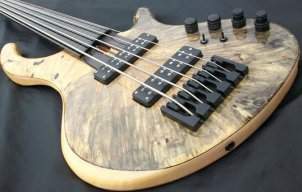
Actually I think I have a pretty good grasp on even temperament and it has nothing to do "the rule of 18" fret positioning . Temperament is how in tune the notes are between the octaves, considering different tensions, and gauges of strings it is impossible to have an even tempered instrument with straight frets. Which is what led to the invention of crazy looking guitars like this
or like this: [pictures redacted for economy of bandwidth]
Compensated nuts help temperament issues on the first fret, and possibly slightly on the next few frets. It has nothing to do with fretting pulling the note sharp, that is remedied by intonation and action adjustments.
Actually, the "Rule of 18" is not a good rule for getting frets in tune. It is an approximation based on historical expediency. The actual mathematical pitch relationship for equally tempered tuning, whether fretted instruments or keyboards, is the logarithmic function of 2^1/12, or approximately the ratio of 1.059631/1 for each successive fret or semitone pitch, and therefore the inverse of that ratio for fret placement.
We do agree that string stretch is an issue, wherever it is. Whether this is compensated on the lower frets by nut shims, overall fret placement, action height, scale adjustments, bridge adjustments, or any other method, the goal is still to try to get the 2^1/12 relationship between semitones across the range of the instrument so it can play in all keys with no more or less "in-tune-ness" or "out-of-tune-ness" in all of the twelve major keys and twelve minor keys.
We also agree on the interactive nature of a guitar scaling and compensating. You may note above I also stated that if the intonation on the first few frets is compensated with nut adjustments, it shortens the overall scale, effectively moving the frets back, and the action may need to be raised to actually induce a little more string stretch in the middle of the scale so the middle frets do not intonate flat as a result of the nut adjustments.
The drawback of an equally tempered system is that nothing is truly in tune save the octaves: perfect fifths are slightly flat, perfect fourths are slightly sharp, major thirds are very sharp, and so on.
Ironically, with gut strings, the "Rule of 18" actually compensates for intonation rather well, due to the nature of gut strings.
To compare "equal temperament" to other forms of temperaments, which favor some keys at the expense of others, and your being in the UK, I encourage you to digest the writings of Thomas Young, and the debates among Samual Sebastian Wesley, Edward Hopkins, and later Henry Willis, who have set forth ad nauseum the finer points of various temperaments and how they are achieved. Even though these authors focused on keyboard instruments, especially the pipe organ, their points are well received when it comes to fretted stringed instrument designs and approaches to the theory of intonation.





 .
.


