• TalkBass has been independent since 1998. Add your voice.
    Create a free account to reply to discussions, view embedded media, and browse with fewer display ads.
    Join freeLog in
    Want zero display ads or expanded classifieds tools? Compare plans.

Concept drawing for a future build.

Hello everyone I am working toward building my first bass and would like some input. This is a rough concept drawing, i.e. nothing is to scale, and it will be some time before I can build it so just looking for suggestions. The concept is a neck through, multi-scale 5 string bass. I am thinking of using 2 EMG 35DC pickups I have on hand and am collecting the other parts as I can. I would appreciate any thoughts about the concept you all may have. Thank you for your time.
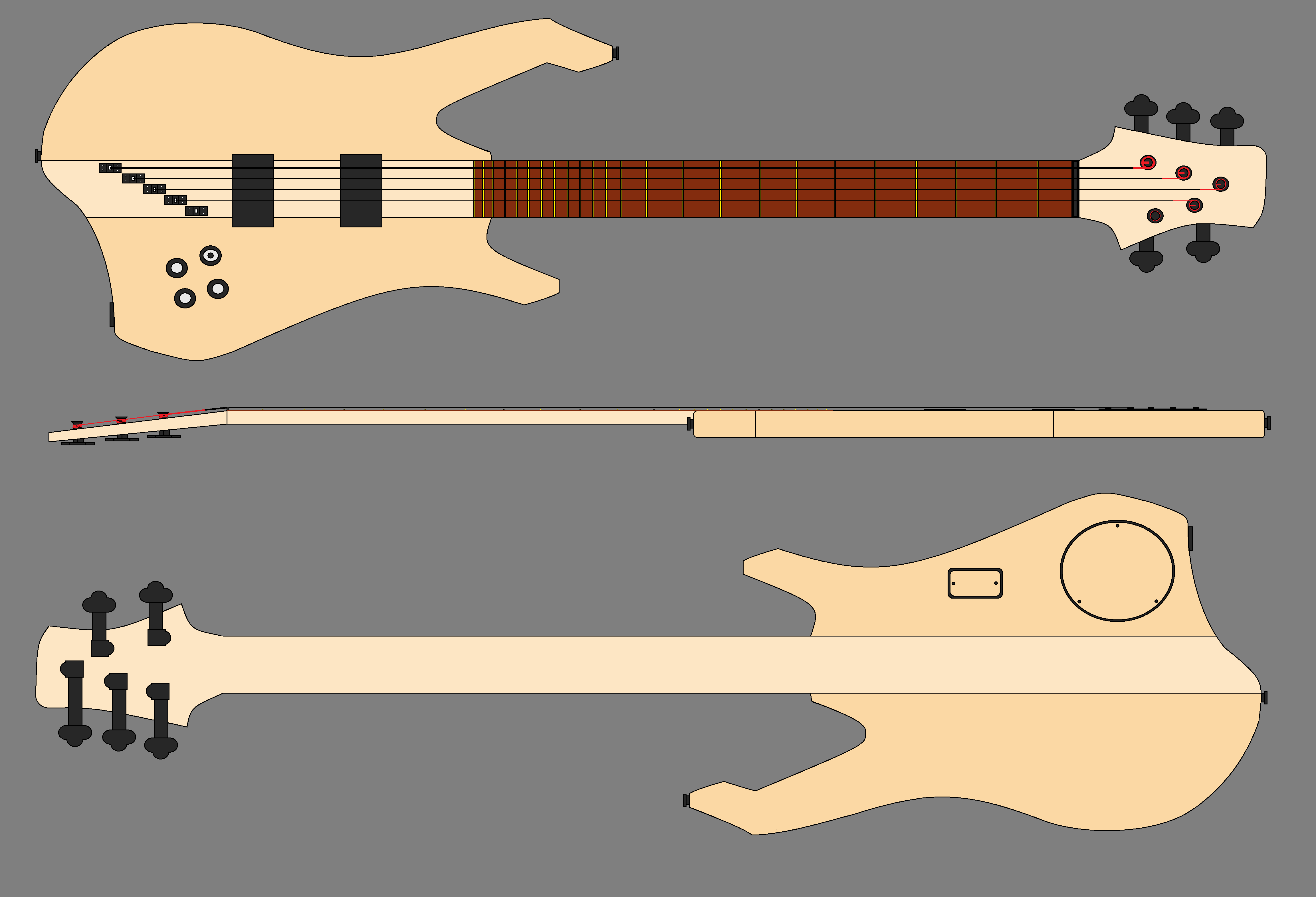
S5 Concept Drawing.png
 
Last edited:
Hi,
I know you say that nothing is to scale yet but I really think that's something that you should start with, otherwise it's hard to really make the design work.
For example, you have the strings completely parallel but, in the end, the spacing will be wider at the bridge than at the nut so that will affect the dimensions and proportions of the body. Ergonomically, I think the control knobs are too close together to be comfortable.
And, I'm not sure, but I think a multi-scale bass needs an angled nut too. Those kind of practical changes will have an aesthetic effect on the bass so I think you should design as faithfully around what will ultimately be the final scale, string spacing etc. etc.
After that, aesthetic choices about the relationships between curves and hard angles is just personal taste. It looks to be that there's much more wood on the bass side of the neck-through-body than on the treble.
 
Hi,
I know you say that nothing is to scale yet but I really think that's something that you should start with, otherwise it's hard to really make the design work.
For example, you have the strings completely parallel but, in the end, the spacing will be wider at the bridge than at the nut so that will affect the dimensions and proportions of the body. Ergonomically, I think the control knobs are too close together to be comfortable.
And, I'm not sure, but I think a multi-scale bass needs an angled nut too. Those kind of practical changes will have an aesthetic effect on the bass so I think you should design as faithfully around what will ultimately be the final scale, string spacing etc. etc.
After that, aesthetic choices about the relationships between curves and hard angles is just personal taste. It looks to be that there's much more wood on the bass side of the neck-through-body than on the treble.

Good points thank you and actually I started a new drawing tonight to address some of that. I believe the frets need to be angled as well so I will work on that more. This is just what's in my head right now so thanks for the input.
 
I agree that scale is important. If you look at the head stock, I don't believe there are any available tuning machines that have an arm peg as long as your A string peg. If you made this bass in real life, you'd have to come up with either a modified head stock, or modified tuner to make that head stock work. The dimensions of each component should be known prior to the design phase.
 
Ignore people's aesthetic opinions and pay close attention to mechanical and design considerations. Try to reverse engineer as much as possible so you don't have to reinvent the wheel.

Get as much of the hardware you can before you make sawdust and verify your designs will meet the specs of the things you don't control. Also, don't rely on third party design specs, if you can get away with it. Try to rely on the real thing. Most mechanical production has degrees of variation and sometimes that can really mess your build.

I think it looks great, as a sketch. The real test is when everything is to scale and all of your hardware has fit into your design.
 
  • Like
Reactions: potomac
View attachment 417096[/QUOTE]

Aside from your initial intents, an interesting visual illusion going on w/your front side illustration - you have the neck the same width at the nut as at the butt (I realize it was a quick rendering and you would later adjust that) and yet it appears that the neck tapers to larger at the nut! I had to check it to make sure. It must have to do w/the strong light-coloured visual wedge shape the horns create pointing inward. Doesn't do that on the back shot because of the uninterrupted neck lines in the same colour.

Just a fun observation… good luck w/the build - subbed!
 
  • Like
Reactions: Vincent Stroup

Aside from your initial intents, an interesting visual illusion going on w/your front side illustration - you have the neck the same width at the nut as at the butt (I realize it was a quick rendering and you would later adjust that) and yet it appears that the neck tapers to larger at the nut! I had to check it to make sure. It must have to do w/the strong light-coloured visual wedge shape the horns create pointing inward. Doesn't do that on the back shot because of the uninterrupted neck lines in the same colour.

Just a fun observation… good luck w/the build - subbed![/QUOTE]

Didn't notice that before but good observation :) I need to get a program to help me, paint just won't cut it for the final drawing.
 
Didn't notice that before but good observation :) I need to get a program to help me, paint just won't cut it for the final drawing.

I use Adobe Illustrator for my computer based design work. It's an older version, maybe 3 or 4 versions old, but it can be pretty accurate. It allows 1:1 rendering, and it can print out in scale (on several pages, since my printer only does 8.5" x 11") I can measure each component with a ruler or caliper, draw or scan it in to scale, and render each component to scale as well. It's helped me immensely. You can probably pick up an older, used version pretty cheap these days, and it they make versions for both Mac and PC.

*edited to fix the quote
 
For my personal taste, I generally want the headstock to echo the feel of the body. Not necessarily similarly shaped (although it is usually good to at least somewhat echo some sort of cue from the body, such as the way the horns curve).

If it's a mostly symmetrical body, I like a mostly symmetrical headstock. If it's a wierd body, I like a wierd headstock.

Ultimately Im saying that as presented, your fairly typical headstock isn't working for me, with the a-typical body shape.

But these are just suggestions ; )
 
For my personal taste, I generally want the headstock to echo the feel of the body. Not necessarily similarly shaped (although it is usually good to at least somewhat echo some sort of cue from the body, such as the way the horns curve).

If it's a mostly symmetrical body, I like a mostly symmetrical headstock. If it's a wierd body, I like a wierd headstock.

Ultimately Im saying that as presented, your fairly typical headstock isn't working for me, with the a-typical body shape.

But these are just suggestions ; )

I welcome all suggestions! That's part of the learning process :) I am reworking the design a bit, I want to keep the general body design but I am redrawing to scale and have made some changes to the headstock, plus now I can draw the frets with the proper angles thanks to Ibridenstien's link (so many numbers! I think my head is going to start hurting) thanks for the input.