Forcing the habit to leave your bass unplugged is a good thing... that's how jacks get broken. I apply the same habit to my passive basses. I believe active basses have a stronger signal and lower impedance even at center detent. My old Samick has a preamp with an on/off switch but no EQ pots, and it does sound better in active mode. I did what you are describing for years until I got a feel for the nuances of the settings, now I wouldn't use my active basses without adjusting to that "sweet spot".I should also ad that I like having the active signal. I have the idea–perhaps mistaken–that an active bass is putting out a more robust signal than a passive one even if you aren't adding stuff with the EQ. The only thing I don't like about having an active bass is that I can't leave a cable in the output jack.

Enjoy the benefits of a premium membership!
Upgrade Account
-
TalkBass has been independent since 1998. Add your voice.
Create a free account to reply to discussions, view embedded media, and browse with fewer display ads.
Join free Log in
Want zero display ads or expanded classifieds tools? Compare plans.
You are using an out of date browser. It may not display this or other websites correctly.
You should upgrade or use an alternative browser.
You should upgrade or use an alternative browser.
Confession: I Never Turn The Knobs On My Active Bass
- Thread starter scottfeldstein
- Start date
More options
Who Replied?
I play both active and passive basses and set the tone on the bass before recording or plugging into an amp and rarely change it. Like @DavidVector I have templates in my DAW for the basses I record with and mostly use the amp EQ for the room I'm in when playing live though some rooms do require drastic measures sometimes! The thing I like about playing outside is that I feel like I get more of the instrument from the amp and its just so much easier to EQ outside though I usually send a pre-EQ signal from my DI to the FOH and have had pretty good luck sitting in the mix doing that with most sound guys and usually only take a little of my signal in my floor monitor so I can hear when at the mic.
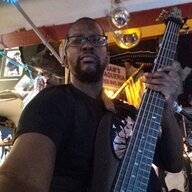
I also play active basses. I generally don't mess with the EQ unless I'm doing something specific, like tracking multiple parts into my Aeros Looper. If I'm stacking chords on the six-string bass, I might cut the bass EQ and enhance the highs, or something like that. It's versatile.
On my SR506, my battery has been dead for a long time - I have an OBP-3 with a passive push-pull on the volume knob to bypass it in this case. During COVID, it's been in passive mode for the most part - I've used the Helix to achieve different effects for bass looping, such as a guitar patch, a pad patch, an ambient patch, etc. (Although these would be even more versatile if I used the bass EQ in front of it.)
On my SR750, it will automatically fall back to passive mode if the pre is dead (the bass knob turns into a tone knob, somehow, it's amazing) and it does have an active/passive switch on it. However, this bass simply sounds better in active mode, even flat. It has a certain shine and presence that is absolutely lovely, and it's simply not there in passive mode. (It doesn't sound bad passive, but in active mode, there's just this sheen, this sparkle that really works well.) Some people may think that active basses sound weak and thin with flat EQ - mine do not.
It's nice to have options even when you don't use them often. It's also nice if you go direct to the amp and need to change an EQ setting while you're playing without having to go to the amp.
On my SR506, my battery has been dead for a long time - I have an OBP-3 with a passive push-pull on the volume knob to bypass it in this case. During COVID, it's been in passive mode for the most part - I've used the Helix to achieve different effects for bass looping, such as a guitar patch, a pad patch, an ambient patch, etc. (Although these would be even more versatile if I used the bass EQ in front of it.)
On my SR750, it will automatically fall back to passive mode if the pre is dead (the bass knob turns into a tone knob, somehow, it's amazing) and it does have an active/passive switch on it. However, this bass simply sounds better in active mode, even flat. It has a certain shine and presence that is absolutely lovely, and it's simply not there in passive mode. (It doesn't sound bad passive, but in active mode, there's just this sheen, this sparkle that really works well.) Some people may think that active basses sound weak and thin with flat EQ - mine do not.
It's nice to have options even when you don't use them often. It's also nice if you go direct to the amp and need to change an EQ setting while you're playing without having to go to the amp.

My conklin has 2 switches... 6 dip switches... 6 knobs... push/pull bass boost
never touch them.
never touch them.


Maybe He needs the Joe Dart bassWhy do you even need active basses? You’d be better off with passive basses with no knob.
Attachments

Last edited:


Yeah okay, I like what phillip Mcknight of know your gear says about Active Pups, "they're like A-1 steak sauce or Siracha! makes every thing sound/taste good! YMMV! I dont really touch the knobs on the bass, but i will dial in or out the amps EQ if something needs to be adjusted, rarely on the bass itself!I have owned a couple of basses with active electronics: an Ibanez SR505 and now my Ibanez BTB745. But here's a confession: I never turn the knobs when I play. I always have the volume maxed out and each of the three EQ knobs at their center detent.
Why? It's because I want the signal going to my board to remain constant. If I start using volumes other than max, or tweaking the bass or mid knobs, the signal going into my compressor is going to swing a lot. Like to the point where it might be compressing too much or even not at all.
I do like to have different EQ settings going into my sound, though. I have often used a mid-forward EQ for finger style and then a more scooped one for the slappy songs. But I always achieved this post comp either on the board with an EQ pedal, or with a switchable graphic EQ on my amp.
Do people who use these knobs just not care about how the signal variance might affect their comps or their filters or even dirt pedals? Or maybe I'm looking at this wrong.
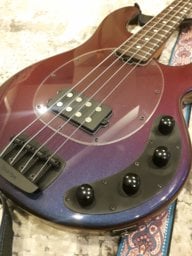
Maybe He needs the Joe Dart bass
Or the Joe Dart Jr. bass which doesn't even have the volume knob.
I'm the same. I use a Helix and tend to record in chunks. If I'm coming back to finish a song weeks later, I don't want to have to guess where my knobs were. I do the same with the blend: almost always in the middle, sometimes 100% neck or bridge, but that's obvious enough.
Bass gets a lot of post production when mixing anyways.
I'd guess live would be entirely different, adjusting to the room as needed.
Bass gets a lot of post production when mixing anyways.
I'd guess live would be entirely different, adjusting to the room as needed.

On my old trusty '77 Jazz with DiMarzio's and J East Retro I don't change much tone-wise. Volume-wise I like it at a 80% just to have a little head room. Eden Amp tone controls were always set very close to noon with a slight bump to bass and treble. That was my sound for years.
Now however I find my self chasing tone after going the Fender Rumble route and building my own instruments. I am getting close though.
Now however I find my self chasing tone after going the Fender Rumble route and building my own instruments. I am getting close though.

I use 3 settings with my MM SR5. 1) EQ flat with pup in series for fast tunes, 2) EQ flat with pup in parallel for slap and, 3) Bass EQ small boost and pup in single coil for slow songs. Volume stays constant with tone changing. Never had a complaint from a sound tech.
I will set the knobs to my licking on my active basses based on the venue acoustic we will be playing but when this done, that's how it will stay unless it really need to be adjusted a little at that point. I will also be playing at different position between the neck (sometimes over it) and the bridge depending on the sound required by the tune.

Yes, if a sound tech wants to screw you, they can. Been in very few situations where that happened, though. Most techs took direction from me and what I got out of my amp and made it sound like that because it worked. Didn't hurt that I started forcing it on them, either. I mean, they still have the last word, but if I high pass at 60 hz and low pass at 5k, not much they can do about thatThose knobs are there just to make some bassist feel like the have the illusion of control.
The sound guy and his mixer board has all the real power.


I use exactly two settings on my two active gigging basses - the knobs don't move very far from center though and are always in the same place when they do get used. I have one small change I make for fingers and another for pick.
My amp doesn't change much either, tiny tweaks for the room and then I leave it alone.
My amp doesn't change much either, tiny tweaks for the room and then I leave it alone.

I have owned a couple of basses with active electronics: an Ibanez SR505 and now my Ibanez BTB745. But here's a confession: I never turn the knobs when I play. I always have the volume maxed out and each of the three EQ knobs at their center detent.
Same. I love active basses and want to have the option to adjust EQ on the fly, but I rarely do. I may not necessarily leave everything at center but once I find the points that sound good to me, I rarely adjust.
I did recently install a Noll preamp with a mid-sweep control in my Lakland 55-01 and having the ability to find a mid frequency that works for the room I'm in is pretty awesome.

The Cirrus has a three band and blend. All with a detent at center.
Just about perfect, right out of the gate.
Just about perfect, right out of the gate.

For many years, I was both FOH and bassist.The sound guy and his mixer board has all the real power.
I play mine at center most of the time. When I need the bump in one of the bands it is nice to have.
I used to be like you. Then I ripped out the preamp in my only active bass and put some Aguilar pickups in. Now I feel like I could change my user name to passive4lyfe

Cave Puppy
"Humph Bo, he's wond!" - John Lennon
If I'm playing my Carvin 5 string bass kit I built umpteen years ago I boost the mids a tad and that's it. That bass also has an internal pot to balance the active and passive outputs. The elecs on that bass suck, though. Very susceptible to noise and crackles. Otherwise I have no use for active basses. I was an EMG guy for MANY years and now the active tone is way too harsh for me.


