• TalkBass has been independent since 1998. Add your voice.
    Create a free account to reply to discussions, view embedded media, and browse with fewer display ads.
    Join freeLog in
    Want zero display ads or expanded classifieds tools? Compare plans.

Confession: I Never Turn The Knobs On My Active Bass

Once I dial in the sound I want I won’t touch them for the duration of the show for reasons similar to your own

THIS..^^ I never change the eq on my preamp after I get it set...but I do vary where I pluck the strings most of the time its in the middle, but I will go up to the neck to puck for a more motown-ish sound, softer attack..and likewise i will pluck near the bridge for a more trebly sound in some cases...
 
THIS..^^ I never change the eq on my preamp after I get it set...but I do vary where I pluck the strings most of the time its in the middle, but I will go up to the neck to puck for a more motown-ish sound, softer attack..and likewise i will pluck near the bridge for a more trebly sound in some cases...

Another interesting insight. It would, after all, be nothing for me to nudge my comp input knob to adjust for the level of whatever I just dialed in on my bass.
 
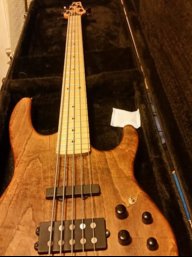
I have owned a couple of basses with active electronics: an Ibanez SR505 and now my Ibanez BTB745. But here's a confession: I never turn the knobs when I play. I always have the volume maxed out and each of the three EQ knobs at their center detent.

Why? It's because I want the signal going to my board to remain constant. If I start using volumes other than max, or tweaking the bass or mid knobs, the signal going into my compressor is going to swing a lot. Like to the point where it might be compressing too much or even not at all.

I do like to have different EQ settings going into my sound, though. I have often used a mid-forward EQ for finger style and then a more scooped one for the slappy songs. But I always achieved this post comp either on the board with an EQ pedal, or with a switchable graphic EQ on my amp.

Do people who use these knobs just not care about how the signal variance might affect their comps or their filters or even dirt pedals? Or maybe I'm looking at this wrong.
Nothing wrong with wanting consistency, but I've been known to twist a knob or two. I just do it in a way that's consistent and I don't make drastic changes unless I'm sure they won't gunk up the works.
 
Active preamps sound weak and thin when at center.
I have experienced this with a number of basses, but I’ll add that for me, it depends. On my main if I’m running both pickups in humbucking I’ll boost the BASS and MIDS slightly. If both in single coil mode I’ll leave the BASS flat and scoop just a bit of MIDS out. Neck in single and humbucking soloed is near perfection so I don’t do a thing. Bridge soloed in single or humbucking gets a healthy dose of BASS and MIDS.

I get what you’re sayin though.
 
  • Like
Reactions: JeezyMcNuggles
Do people who use these knobs just not care about how the signal variance might affect their comps or their filters or even dirt pedals? Or maybe I'm looking at this wrong.
Did you consider that maybe people using those knobs are fine with any resulting effect on their compressors or filters or whatever? And that maybe they are deliberately trying to have their favourite pedal react a different way?

Regarding dirt pedals, I never use them with bass, but it's an extremely common practice for guitarists to use their guitar's volume knob to alter how dirty the signal is: with the right settings on the pedal or amp the guitar's volume knob basically just changes the amount of distortion but not the overall volume.
 
Envelope filter you say. Yep, using the EQ will make your envelope filter react differently and for me that's exactly what I want. And if you are using a compressor specially if you have a limiter too, the purpose of that is to even your sound, so why not use the EQ. Finger to slap - specially then. Boost some bass and treble and dip the mids. I got the active EQ because of that. Also if using dirt pedals, you ride the volume.
 
  • Like
Reactions: nnnnnn
I have owned a couple of basses with active electronics: an Ibanez SR505 and now my Ibanez BTB745. But here's a confession: I never turn the knobs when I play. I always have the volume maxed out and each of the three EQ knobs at their center detent.

Why? It's because I want the signal going to my board to remain constant. If I start using volumes other than max, or tweaking the bass or mid knobs, the signal going into my compressor is going to swing a lot. Like to the point where it might be compressing too much or even not at all.

I do like to have different EQ settings going into my sound, though. I have often used a mid-forward EQ for finger style and then a more scooped one for the slappy songs. But I always achieved this post comp either on the board with an EQ pedal, or with a switchable graphic EQ on my amp.

Do people who use these knobs just not care about how the signal variance might affect their comps or their filters or even dirt pedals? Or maybe I'm looking at this wrong.
I have active basses but I prefer to play them passively. I like how they sound and my amp has eq if I need it but really, I’m a set and forget player. I pluck at different locations for tonal variation and I get what I need from that.
 
  • Like
Reactions: lowdownthump
Do people who use these knobs just not care about how the signal variance might affect their comps or their filters or even dirt pedals? Or maybe I'm looking at this wrong.

Yes and No.
IMO, when you're travelling with a pedalboard, the big advantage you get from using an active bass is that the signal is buffered straight from the start and you can use any cable and cable length you want.
Other than that, the pedalboard prohibits you from turning knobs.
I've played many a gig where I plugged more or less straight into the PA, or played direct with my amp carrying the venue.
In both cases, I often rigged the whole thing so the gains were set to take my signal at 100%, I dialed back to around 75%, though. That led me with the option to boost a little when needed. I also was able to adjust a little EQ on the fly.
 
Active basses help adjusting the tone on the spot when you need it. It really helps me during corpo gigs where I have to play some rock, disco, latin, pop etc in the same hour.

if you don’t need it, just don’t us it.

also, some active preamp are better than others. But again, it’s just a tool. If you don’t need it, just don’t use it.
 
I play active basses predominantly. I kind of prefer passive but having some more frequency centers to control is sometimes helpful as I like to nudge them in one direction or another to impart more of a character change than an overall tonal change. I also quite like the way that active control "messes" with my pedals because I can use the treble and bass knobs to make my drives more saturated, or cut back the highs to reduce how present the drive is in the mix.
 
Active controls are just another option, having them doesn't mean they have to be used all the time, but if there are times and reasons to give those knobs a twirl, then they're there waiting. I've never been heavily into pedals and there are times, maybe just for a certain song, that I need to boost some frequency, maybe a bump in the mids, so I can do that. But yes most of the time I run close to flat, depending on the bass and pickups.
 
  • Like
Reactions: Relayer71
I’m not afraid to turn those knobs. I do it regularly, to get the different tones I need. I never cared, or even considered, the signal level fluctuations. Any level variations due to EQ shaping are negligible compared to the level change between fingers and pick. And I have evolved enough as a player to know how to vary my picking/plucking attack and position to compensate if my ears detect a problem. In other words, I play the instrument, not the knobs.
 
I can tell you where the knobs on my passives 'probably' are, actives, no clue. But in general, my knobs are where I left them until I need them not to be where I left them.
 
Last edited: