• TalkBass has been independent since 1998. Add your voice.
    Create a free account to reply to discussions, view embedded media, and browse with fewer display ads.
    Join freeLog in
    Want zero display ads or expanded classifieds tools? Compare plans.
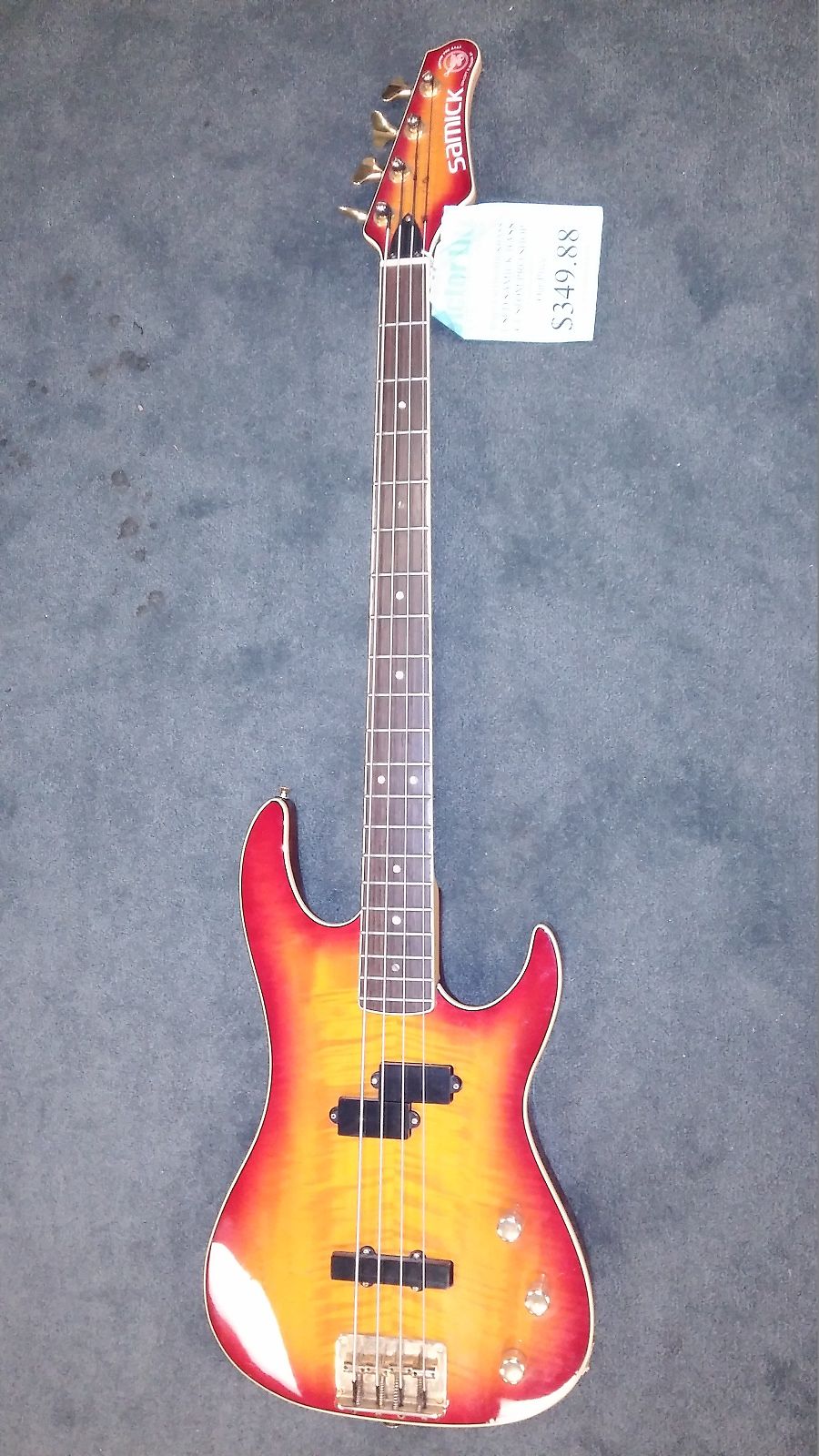
Confession Time: I Am In Lust - With A SAMICK!

My guess is that it isn't really a coil tap and the owner just doesn't know what it does. The bridge pickup is already a single coil, and if you split the neck pickup, you'd only get half the strings, so....
I think you're thinking of a coil splitter, a tap would be a cut somewhere in the windings on each coil, so that , when used, only part of each winding would be live, when switched together the full amount of winding on each coil would be used, making for a thinner sound when using the taps, the P pickup, if tapped, would have 8 leads, the J 4 leads, that's why I can't see it on one switch. But, you are right, a splitter wouldn't work on that setup, and coil taps would be overly complicated, and wind up being expensive, (and have more switches).
 
Last edited:
Definitely make your own offer. It's been listed for over a year and come down $150 from the original asking price. I still think the seller is asking a somewhat high price compared to going rates for what he has, which is to say a Samick branded bass.

Having to remove that huge backplate everytime you want to change the battery isn't going to be very convenient either IMO.

Looks to be in mint condition however.
 
  • Like
Reactions: HubbardsFate
Valley Arts made nice instruments. Samick still do.

No, Korean made instruments generally don't hold the same cache that US or Japanese made basses do, nor do they hold the same kind of resale values, but in the age of CNC machines it gets pretty hard to dismiss the quality of the instruments coming out of Korea and Samick has been at the game a long time.

I agree with the others that the price is too steep - way too steep, actually. On the other hand, that doesn't make it a bad instrument, just an overpriced one.

My personal experience with Samick (and Korean instruments in general) is that their designs are pretty solid and their workmanship is very good. Where they disappoint (me, anyway) is that the hardware & electronics are often second-rate and I don't feel they age their wood enough, which can lead to necks moving around for a long time. That's what one gets for low prices.

The bass you showed in the OP is from 1999 so if that neck was going to move it would have already. 5-strings of that era also tend to have pretty narrow string spacing: a deal-breaker for me, but some folks love that.

Just my thoughts.
 
  • Like
Reactions: HubbardsFate
in the age of CNC machines it gets pretty hard to dismiss the quality of the instruments coming out of Korea and Samick has been at the game a long time

My personal experience with Samick (and Korean instruments in general) is that their designs are pretty solid and their workmanship is very good. Where they disappoint (me, anyway) is that the hardware & electronics are often second-rate and I don't feel they age their wood enough, which can lead to necks moving around for a long time. That's what one gets for low prices.

This. And this.

With modern fabrication methods, the overall build quality is becoming uniformly good no matter the brand since a properly programmed and set up CNC is a CNC. No matter where it is - or who owns it. CAD/CAM has pretty much leveled that playing field.

The big differences are now mainly found in the quality of the wood, finish, hardware, and setup. That's where the cost-cutting occurs these days. It's all in the purchased components and the remaining hand operations where the expense is. Not the machining or mill work.
 
  • Like
Reactions: HubbardsFate
I have a CB630 fretless. It's a decent little bass, very light weight and perfect for a beginner. I've never replaced it because I've never done any real fretless playing. Looks identical to the one in the pic, same colour just no frets or markers - bare neck. This is a pic I found on the net. And yeah, with anything purchased cross border we Canucks buy, import charges are always a consideration.
 

Attachments

  • cb630.jpg
    cb630.jpg
    40.2 KB · Views: 81
  • Like
Reactions: HubbardsFate
I still have a Samick 5 which I brought in about 1992, five string active.
The preamp is a little bit noisy (hiss) and the single coil pickup now adds a bit of hum.

The bass itself is very nice, balanced and lightweight, with a thin neck which stays in tune very well.
It is actually a nice playing and nice sounding bass.
It has an active/passive push/pull on the tone knob, and the passive tone is really anaemic.

I have played that bass so much, the frets have really bad worn grooves, so now it just sits and waits, gathering mould on the fret board..
 
I'm not understanding why there's a coll tap switch.

Yeah *** ???

My guess is that it isn't really a coil tap and the owner just doesn't know what it does. The bridge pickup is already a single coil, and if you split the neck pickup, you'd only get half the strings, so....


Exactly but there's a factory sticker still on the pot that says you can push pull to coil tap... I mean, you could tap a single coil if you wanted weaker output as an option... but... but... but... um... factory stickering error maybe?

Well I guess as Spinal Tap said some mysteries are best left unsolved. Annnnnd, I've forgotten all about this. :wacky:
 
It's a decent bass probably worth closer to 450.00. Now there are higher end Valley Arts basses and guitars that are worth over $1000. Not that this is misleading but the bass still made by Samick, co-designed by Valley Arts.
The real Valley Arts models are USA made, in California.
Also, it won't sound like a true PJ because of the P location. It will be more scooped and probably close to a Jazz bass tone.
 
Exactly. And, in my experience, those remaining hand operations are executed pretty well at Samick. Nice fret and finish work in most cases I've seen.

Agree. And if they're not they can be corrected by the owner. If the neck pocket is pooched, or the truss rod is ruined, it's generally more trouble and money than it's worth to try and fix those. But of it's just wanting for better hardware or electronics, or a setup or some basic fretwork, most owners can do that themselves if they want to. As long as the millwork and neck are ok and the truss rod works, many inexpensive basses can be brought up to a higher standard than you'd expect. Maybe not ever boutique or top shelf OEM level. But many can be reworked into decent players with a little TLC. The trick is to balance out the expense to benefit. There's no point in spending $400 on a guitar and another $600 in parts and service if you can go out and buy a better one to begin with for $900. So you need to balance out the equation and know what you're getting. But it's still possible to find real bargains and diamonds in the rough if you know what to look for.
 
I still have a Samick 5 which I brought in about 1992, five string active.
The preamp is a little bit noisy (hiss) and the single coil pickup now adds a bit of hum.

The bass itself is very nice, balanced and lightweight, with a thin neck which stays in tune very well.
It is actually a nice playing and nice sounding bass.
It has an active/passive push/pull on the tone knob, and the passive tone is really anaemic.

I have played that bass so much, the frets have really bad worn grooves, so now it just sits and waits, gathering mould on the fret board..
My first bass was one of those, bought new in 93. I would still have it, but it got stolen 13 years ago. I'd gladly have another one
 
I still have a Samick 5 which I brought in about 1992, five string active.
The preamp is a little bit noisy (hiss) and the single coil pickup now adds a bit of hum.

The bass itself is very nice, balanced and lightweight, with a thin neck which stays in tune very well.
It is actually a nice playing and nice sounding bass.
It has an active/passive push/pull on the tone knob, and the passive tone is really anaemic.

I have played that bass so much, the frets have really bad worn grooves, so now it just sits and waits, gathering mould on the fret board..

Well, maybe you can put it on Reverb for sale as an "experienced" bass which will make the owner a better player. Start the price at, oh, I don't know...$823 or so , draw a line thru it and offer it at maybe...lemme think...hmmm...lets say $600!
There you go. You make dough , the bass continues to live and someone is automatically a better player.
Tell me you could think of a better deal. I mean, really, just try to. :smug:
 
In 1994, the guitarist in my band dropped his Les Paul guitar to the stage floor, took it in for service, and was loaned a nice looking Samick guitar by the repair technician for a gig while the Les Paul was in the shop.

Neither of us knew anything about the Samick brand or that model of guitar. It looked nice, seemed well-made, and was a free loaner, so we rehearsed with it and played the gig.

After the gig, everybody (all three in the band + some people in the audience who'd come out for our show) had something positive to say about that Samick guitar - including the guitarist himself.

Before he returned the Samick to pick up his own guitar, the guitarist wondered how much he'd have to pay to keep it. It seemed like a $2,000 guitar, easy, so he didn't want to ask. He just gave thanks for getting to use a great-looking, great-sounding, and apparently well-made guitar for free while his own guitar needed TLC.

A week or so later, I spoke to the technician who'd loaned us the Samick. It was a $600 guitar. My guitarist friend turned sheet-white and slack-in-the-jaw when I told him.
 
  • Like
Reactions: HubbardsFate
All kidding aside, when Washburn moved to Samick (Samick taking over from Kasuga plant which had, in turn, replaced Matsumoku), Samick indeed put out some very good Washies for them. So, yes, Samick, whether the Korean plant or the later Indonesian plant, DOES have the wherewithal to put out a quality product. Of course, when they do so for someone else, following those specs (and for which they get paid per contract with no true risk for themselves as long as they fulfill the contractual obligation) they do a real quality bass. When they have done the "Samick" brand for themselves, well, seems they cut a few corners since it can put them in the market at lower cost, while still putting out a "decent" product even tho it does not have the weight of another brand name. That's how I read it. Am I going wrong on this???
 

Latest posts