Inspired by a post that TB member Billfitzmaurice did to the subject mixing of speaker cabs
Mixing Speaker Cabs - Definitive Answer! | TalkBass.com
See post number #6
"...But there are differences in the phase responses of different drivers and cabs, even different cabs loaded with the same driver, ..."
I'm asking myself if issues with same drivers are indeed sometimes experienced by users or at the other hand considered if different cabs loaded with same drivers shall be brought together.
Example:
A 410 ported cab loaded with Deltalite 2510 shall be mixed with a ported 210 cab also loaded with Deltalite 2510.
The Deltalite 2510 shows a nominal impdance of 8 Ohm.
The impedance of the 410 cab is 8 Ohm (Series-Parallel configuration of the drivers), the impedance of the 210 cab is 16 Ohm (Series configuration of the drivers).
The cabs shall be daisy chained (Parallel configuration of the cabs). Will it be fine mixing these two cabs?
The total impedance of the stack is 5.33 Ohm so, unless running in bridge mode, probably any solid state amplifier won't get issues due to a lower deviation of minimal 4 ohm load.
The power spread to the drivers is balanced, every driver gets exactly the same power.
If you say now that everything is fine with this stack because of:
1) no critical total impedance for the amplifier
2) balanced distribution of power for each driver
3) anywhere exactly identical drivers
I say stop it, it's not knwon anything about the way how these two cabs work together on group delay.
I did a simulation for a 410 ported cab and a 210 ported cab, both cabs loaded with Deltalite 2510.
The 410 cab inner volume is 4.8 cu ft and Tuning 55Hz, the 210 cab was simulated as a small cab 1.6 cu ft and Tuning 65Hz.
The predicted group delay looks as follows:
yellow is 410, white is 210
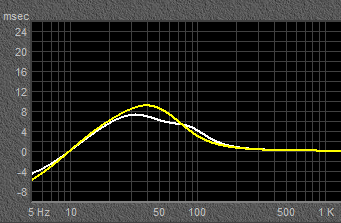
So look what happens around 100Hz. The difference of group delay is appro 1.5msec. Keep in mind that cycle time of 100Hz is 10msec, and a total cancellation would happen at a difference of already 5msec. (at half delay time of one 100Hz cycle). So what happens if mixing these cabs? Very likely some cancellation but, more important the cabs play like they where differently placed in depth by around 1.7 feet.
The next simulation shows the same 410 cab, but 210 now is simulated to be a 1/2 of the 410. That means inner volume 2.4 cu ft and Tuning 55Hz
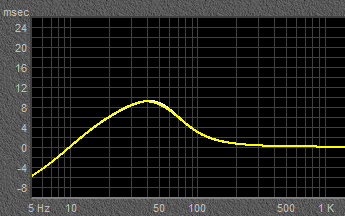
No issues with different group delay nothng at all.
So you may ask the question why this thread. Aren't there countless threads related to this subject? The answer is very simple. Most of the arguments against mixing different cabs / different drivers refere to:
1) unbalanced power distrubution to the drivers
2) The large danger of overpowering/destroying 115 cabs if paired with 410
3) unpretictabel sound issues but, the reasons why in general remain unspoken, tireless stressing that identical cabs or cabs with identical drivers keep far away from non pretictabel sound issues. But identical drivers may indeed cause same sound issues unless the cabs are not designed to work together.
The only way to keep far away from any unpretictabel sound issues is to use absolutely identical cabs. Keep in mind that mixing a 410 cab with 210 cab or the mixing of a 212 cab with a 112 cab does not mean per se you are totally free from sound issues although the cabs you consider to pair with are loaded with exactly identical drivers.
Mixing Speaker Cabs - Definitive Answer! | TalkBass.com
See post number #6
"...But there are differences in the phase responses of different drivers and cabs, even different cabs loaded with the same driver, ..."
I'm asking myself if issues with same drivers are indeed sometimes experienced by users or at the other hand considered if different cabs loaded with same drivers shall be brought together.
Example:
A 410 ported cab loaded with Deltalite 2510 shall be mixed with a ported 210 cab also loaded with Deltalite 2510.
The Deltalite 2510 shows a nominal impdance of 8 Ohm.
The impedance of the 410 cab is 8 Ohm (Series-Parallel configuration of the drivers), the impedance of the 210 cab is 16 Ohm (Series configuration of the drivers).
The cabs shall be daisy chained (Parallel configuration of the cabs). Will it be fine mixing these two cabs?
The total impedance of the stack is 5.33 Ohm so, unless running in bridge mode, probably any solid state amplifier won't get issues due to a lower deviation of minimal 4 ohm load.
The power spread to the drivers is balanced, every driver gets exactly the same power.
If you say now that everything is fine with this stack because of:
1) no critical total impedance for the amplifier
2) balanced distribution of power for each driver
3) anywhere exactly identical drivers
I say stop it, it's not knwon anything about the way how these two cabs work together on group delay.
I did a simulation for a 410 ported cab and a 210 ported cab, both cabs loaded with Deltalite 2510.
The 410 cab inner volume is 4.8 cu ft and Tuning 55Hz, the 210 cab was simulated as a small cab 1.6 cu ft and Tuning 65Hz.
The predicted group delay looks as follows:
yellow is 410, white is 210
So look what happens around 100Hz. The difference of group delay is appro 1.5msec. Keep in mind that cycle time of 100Hz is 10msec, and a total cancellation would happen at a difference of already 5msec. (at half delay time of one 100Hz cycle). So what happens if mixing these cabs? Very likely some cancellation but, more important the cabs play like they where differently placed in depth by around 1.7 feet.
The next simulation shows the same 410 cab, but 210 now is simulated to be a 1/2 of the 410. That means inner volume 2.4 cu ft and Tuning 55Hz
No issues with different group delay nothng at all.
So you may ask the question why this thread. Aren't there countless threads related to this subject? The answer is very simple. Most of the arguments against mixing different cabs / different drivers refere to:
1) unbalanced power distrubution to the drivers
2) The large danger of overpowering/destroying 115 cabs if paired with 410
3) unpretictabel sound issues but, the reasons why in general remain unspoken, tireless stressing that identical cabs or cabs with identical drivers keep far away from non pretictabel sound issues. But identical drivers may indeed cause same sound issues unless the cabs are not designed to work together.
The only way to keep far away from any unpretictabel sound issues is to use absolutely identical cabs. Keep in mind that mixing a 410 cab with 210 cab or the mixing of a 212 cab with a 112 cab does not mean per se you are totally free from sound issues although the cabs you consider to pair with are loaded with exactly identical drivers.
Last edited: